



Global air freight rates edged higher again last week, with rising jet fuel prices and continued tensions in the Persian Gulf adding pressure to an already volatile market.
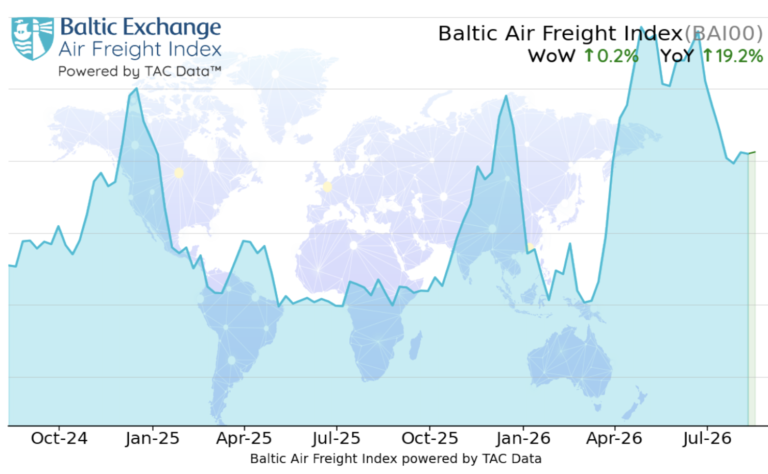
According to the latest data from TAC Index, the global Baltic Air Freight Index (BAI00) increased 0.2% over the seven days to August 17. The index was consequently 19.2% higher than it was a year earlier.
Fuel costs are adding to the pressure. IATA Jet Fuel Monitor data showed average jet fuel prices increased by 8.2% during the week to August 14, leaving prices 76.5% above their level a year earlier.
China-Europe and China-US lanes remain firm
The busiest air freight routes out of China recorded further week-on-week increases to both the United States and Europe.
The market appears to be adjusting after the sharp decline in volumes recorded last month following changes to European customs rules. The EU ended its previous de minimis exemption for smaller parcels on July 1 and introduced a new flat-rate customs regime.
Hong Kong spot rates were broadly stable over the week. However, the broader Hong Kong outbound index, BAI30, which covers both spot and contract rates, increased 3.4% week on week and was 17.6% higher year on year.
Shanghai presented a different picture. The BAI80 index slipped 0.5% week on week but remained 22% above its level a year earlier.
Rates from Southeast Asian hubs such as Bangkok and Hanoi, along with those from India, were generally slightly lower as the traditional summer slowdown weighed on demand.
North East Asia remained stronger, supported by continued demand linked to artificial intelligence and semiconductor-related business.
Rates from Seoul increased on routes to both Europe and the United States, while Taiwan also recorded higher rates to Europe, although rates to the US did not follow the same trend. Japan-to-Europe rates were slightly lower.
European outbound rates weaken
Air freight rates out of Europe were generally softer during the week.
Transatlantic routes to North America weakened, while rates also declined on services to Japan, Brazil and South Africa. Some markets, including India, China, Australia and Mexico, recorded modest increases.
The Frankfurt outbound index, BAI20, fell 3.6% week on week but remained 5.5% higher year on year.
London Heathrow experienced a sharper decline, with the BAI40 index dropping 8.5% week on week. Despite the fall, rates remained 9.6% above their level a year earlier.
US outbound market continues to strengthen
The US market showed greater resilience, with rates generally moving higher across several major destinations.
Outbound rates increased to Europe and the UK, as well as to South America and Malaysia. Korea and China were among the markets where rates moved slightly lower.
Chicago recorded one of the strongest performances. The BAI50 index increased 3% week on week, leaving rates 53.9% above their level a year earlier.
The significant year-on-year increase partly reflects the exceptionally weak market conditions recorded in Chicago a year ago, when tariff disputes and broader trade tensions were putting substantial pressure on air cargo demand.
Rates from Mexico to Europe declined during the week but remained considerably higher than a year earlier.
Overall, the latest figures point to a mixed global air cargo market, with strong demand in technology-related sectors and selected Asian trade lanes offsetting seasonal weakness in other regions. At the same time, sharply higher jet fuel costs and ongoing geopolitical uncertainty remain key factors for carriers and shippers heading into the second half of the year.