



The Drewry World Container Index (WCI) – one of the most closely watched measures of global container freight rates – dropped 1% this week to $4,473 per forty-foot container.
The recent fall is due to weaker spot rates in the trans-Pacific and Asia-Europe trade lanes. Demand, however, remains resilient, with carriers actively managing capacity to support the broader market.
Trans-Pacific spot rates from Shanghai to New York fell 2%, to $9,333 per forty-foot container. The Shanghai-Los Angeles route was steadier with rates holding at $6,818.
Carriers have announced four blank sailings for next week, compared with seven this week, according to Drewry’s Container Capacity Insight. The lower level of canceled voyages suggests more capacity will be likely to reenter the trade.
Drewry also sees trans-Pacific freight rates being less volatile next week, with demand still holding up and carriers still in control of vessel deployment.
In the Asia-Europe market too, rates fell further. Spot rates Shanghai to Genoa fell 2% to $4,866 and Shanghai to Rotterdam dropped 3% to $4,287 per forty-foot box.
Capacity conditions on Asia-Europe trade are tighter than those across the trans-Pacific. Next week will see four blank sailings announced, an increase from two this week.
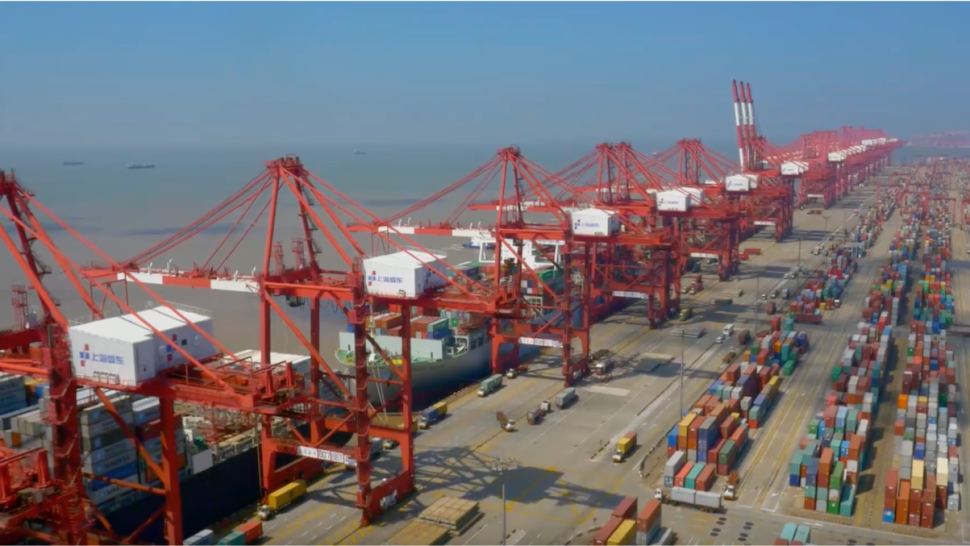
At the same time, congestion at the port of Shanghai has increased. Average vessel waiting times rose sharply to 96 hours, up from 35 hours the previous week. Asian congestion worsens, but Drewry expects Asia-Europe freight rates to remain stable over the next week.
The broader east-west container freight market continues to be hard to predict beyond individual trade lanes. Vessel routing decisions and cargo flows continue to reflect geopolitical tensions and operational constraints.
Uncertainty remains over the Strait of Hormuz, while some carriers have tentatively started to resume transits through the Suez Canal after better security assessments.
Continued congestion at ports in Asia is causing disruption to vessel schedules and cargo movements. In Europe, low water levels on the Rhine are adding further pressure to inland transport, but reports on Thursday pointed to some improvement in conditions.
The Panama Canal is also set to cut transit capacity starting in September to save water.
Overall, these developments add up to a global container market in delicate balance: freight rates are falling but demand is holding up, carriers are cautious on capacity and logistical bottlenecks are still curbing the extent of price falls.