



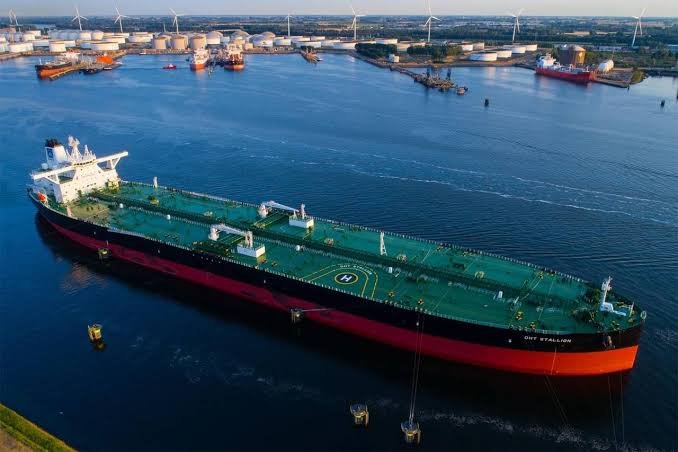
DHT Holdings is benefiting from an extraordinary surge in the very large crude carrier (VLCC) market, with average spot earnings for its fleet reaching $509,100 per day in the fourth quarter to date. The figure represents a 204% increase compared with the company’s spot earnings in the third quarter, reflecting the sharp tightening of tanker capacity amid escalating disruption across the Middle East.
Across its fleet, approximately 78% of revenue days have already been fixed through a combination of spot and time charter contracts, generating average earnings of $225,200 per day. DHT also reported that around 50% of its fourth-quarter spot days had been secured at the time of its update.
The company operates as a dedicated VLCC owner and operator, with full ownership of all 23 vessels currently in its fleet. DHT also has one additional vessel under construction at Hanwha, scheduled for delivery in 2028.
Third quarter earnings benchmark
In its latest business update DHT said average time charter equivalent (TCE) earnings for its fleet in the third quarter were $141,300 per day. On the spot market, VLCCs earned an average of $167,000 a day, and time charter earnings averaged $114,200 a day.
Spot market employment generated 1,054 of the 2,055 revenue days recorded in the quarter.
We expect VLCC earnings to sustain at elevated levels until 1Q2027, with even better financials next year in the current rate environment. DHT has 10 vessels in the spot market and six vessels on time charters that expire in Q1 2027. And they may be subject to further prevailing market rates depending on how they are brought in going forward during their availability.
Individual fixtures show the size of the rally
Daily earnings have grown so high that recent chartering activity shows how far they have come. According to Tanker International data, the DHT Opal was fixed on 7 October with Hyundai Oilbank at $897,000 per day for a voyage from the Red Sea to South Korea via the Suez Canal. The fixture was worth $73.9 million in total.
Another DHT vessel, the DHT Tiger, was booked for a voyage from the Gulf to South Korea at $764,000 per day on 1 October.
These fixtures underscore the strong premiums available to owners of vessels that can serve crude oil transport routes affected by the regional crisis.
Middle East turmoil reshapes tanker economics
The Middle East crisis has hit the market with a mixture of several pressures and VLCC rates have entered uncharted territory. Security for ships and crews in the region has been raised following attacks on tankers that have been attributed to Iran and the Houthis. That means shipowners are asking for higher premiums to assume the risks, while insurance costs have also soared.
Simultaneously, crude oil exports from the Arabian Gulf have increased in the past six weeks. Some of this extra activity has been enabled by tankers taking oil out of the Strait of Hormuz to be transshipped onto VLCCs for further movement.
This allows for the continued flow of crude exports, but creates inefficiencies in operations and consumes more tanker capacity. The demand for vessels is adding to the upward pressure on freight rates.
Route selection is another layer of complexity. Some charterers have chosen to send Red Sea crude exports to Asia via the much longer Suez Canal route, rather than risk Bab el-Mandeb. The strategic passage is still at risk from Houthi threats against ships carrying Saudi cargoes, prompting operators to reconsider their routing choices.
Extended voyages and other transshipment needs further reduce the effective availability of vessels, further reinforcing the mismatch between tanker demand and available capacity.
Baltic Exchange figures confirm the market’s exceptional strength
The latest market indicators underline the scale of the rally. For the week ending 9 October, the Baltic Exchange reported that VLCC rates on the TD3C route from the Middle East Gulf to China climbed by 115 Worldscale points to WS 1,318.75.
At that level, the assessment corresponded to time charter equivalent earnings of approximately $1.4 million per day for a round voyage.
With security risks, insurance expenses, longer routing decisions and inefficient cargo-transfer arrangements continuing to affect vessel availability, the tanker market remains under considerable pressure. For DHT Holdings, the extent to which these exceptional rates persist into the final quarter of 2026 and the opening months of 2027 will be an important factor in determining the potential financial benefits of the current market conditions.
Related articles about tanker

Saudi Arabia resumes Yanbu loadings as DHT VLCC fixed for $55 millionSeptember 30, 2026

DHT Holdings locks in three-year VLCC charter at $100,000 per daySeptember 15, 2026

DHT locks in nearly half of Q2 VLCC spot days at $189,500 averageApril 15, 2026

VLCC rates surge to $1.2 million a day as Gulf of Oman loading gains momentumOctober 7, 2026

Iran expands attacks on commercial shipping, striking three tankers as US disables bulkerOctober 12, 2026