



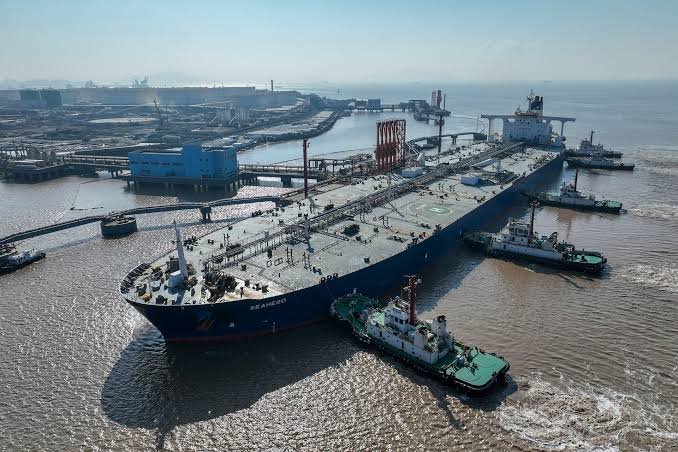
Soaring rates for chartering tankers are changing the economics of international crude oil trade, adding as much as 50% to the cost of delivering U.S. oil to Asian markets. American supplies have become a strategic alternative with crude flows from the Arabian Gulf heavily curtailed in recent months. But the cost of moving oil across the Pacific is now more expensive than ever, and selling it is beginning to look less and less like a good business decision.
Analysts say shipping US crude to China and Japan has become particularly costly at current charter rates. The latest figures from Clarksons Research show average global earnings for very large crude carriers (VLCCs) have climbed to an all-time high of $805,000 per day. China’s crude oil imports from the US Gulf were delivered at a rate of $37.50 per barrel.
Recent fixtures indicate the tanker market is in exceptional shape. Tankers International said the 2022-built VLCC Nissos Nikouria was fixed to Petrobras for a Brazil-China voyage at $867,000 per day. Meanwhile, it was reported that Trafigura fixed the 2021-built Pertamina Prime for the same trade at $795,000 a day.
Asian refiners weigh cost vs supply security
Asian crude buyers are looking at other sources as prices keep rising. But shipments from the Arabian Gulf may still have to run the hazardous maritime conditions but they have the big economic advantage over US supplies of shorter sailing distances.
VLCC rates from the Arabian Gulf continue at abnormally high levels with current rates around $1.4 million per day. However, the shorter voyages to Asian destinations help to offset some of these costs as they mean fewer nautical miles are traveled.
Fresh attacks on ships in recent days notwithstanding, oil is still flowing through the Strait of Hormuz. The strait has been carrying around 10 million barrels a day recently, Clarksons said, compared with an annual average of 15 million barrels a day in 2025.
Much of the oil was being transported in shuttle operations before it was transferred to other tankers in ship-to-ship transfers in the Gulf of Oman, Clarksons said. These steps illustrate how market participants are changing shipping practices to keep the flow of crude going despite higher security risks.
Record earnings not just for VLCC segment
The jump in tanker profitability is not limited to the biggest crude carriers. The latest Baltic numbers show that owners of smaller tankers are also benefiting from a sharp rise in freight rates on several major routes.
Suezmax earnings on the US Gulf – UK/Continent trade were up around 24% last week. The rise lifted the daily round-trip time-charter equivalent (TCE) to around $581,000. The WAF/UKC/Cont route was still a little softer with a TCE of just under $562,000 per day.
Aframax operators have also scored big gains. Cross-UK/Continent rates surged more than 50% week-on-week, with the Hound Point to Wilhelmshaven run fetching a round-trip TCE of nearly $527,000 a day.
The Mediterranean market is also extremely strong in terms of earnings. A 80,000 deadweight tons vessel trading between Ceyhan and Lavera was expected to earn in excess of $308,000 per day on a round-trip basis.
Disruption increases tanker demand
Earnings are also rising simultaneously in the VLCC, Suezmax and Aframax markets, a reflection of the broader impact of the dislocation of global oil flows. Longer alternative routes, complex shipping arrangements and the hazards of key maritime passages add to the tightness in the tanker market.
Clarksons concludes current disruption to international oil movements increases crude tanker demand by more than 13% Asian refiners are struggling to balance the security of their crude supplies against the surging cost of getting them there as charter rates hit record highs, while tanker owners continue to benefit from an extraordinary freight market.
Related articles about VLCC

Abu Dhabi’s Non-Oil Trade Surges as Global Partners Shift FocusAugust 5, 2025

Oil and grain exports push Port of Vancouver to record cargo volumes as trade shifts beyond U.S.September 25, 2026

B.C. Premier David Eby calls early election for Oct. 24 amid trade tensions and Opposition turmoilSeptember 23, 2026

Iran Threatens Broader Tanker Strikes as VLCC Is Hit off the UAEOctober 9, 2026

Scorpio Tankers Expands VLCC Fleet While Selling Three Product TankersSeptember 30, 2026