



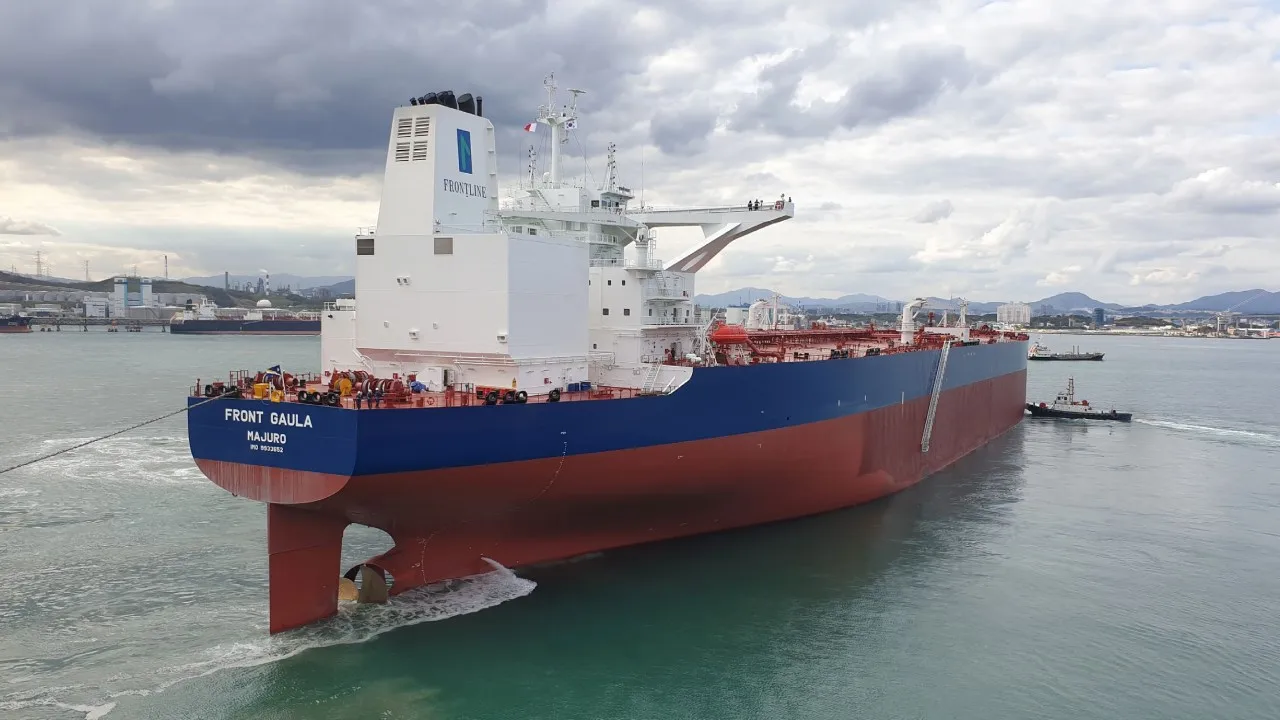
Frontline has reported its strongest quarterly profit ever, posting net earnings of $659.2 million in the second quarter of 2026, compared with $79.1 million during the same period last year. The result also exceeded an already exceptional first quarter, when the tanker operator recorded a net profit of $559.1 million.
Quarterly revenue nearly doubled year on year, reaching $943.3 million, up from $480.1 million in Q2 2025.
Frontline Management CEO Lars Barstad said the second quarter remained highly volatile, with disruption across the wider energy market creating conditions that supported tanker utilisation.
“The entire energy complex is being challenged, creating inefficiencies that support tanker utilisation,” Barstad said.
He added that although the traditional balance between oil demand and vessel supply had temporarily become less influential, Frontline was concentrating on capturing short-term opportunities for shareholders.
The company’s fleet achieved particularly strong earnings during the quarter. Its VLCCs averaged $152,700 per day, while Suezmax tankers earned an average of $111,500 per day. LR2/Aframax tankers recorded average daily rates of $92,400.
Strong charter rates continue into the third quarter
Frontline continued to secure lucrative time-charter deals in July, particularly for its VLCC fleet.
A 2016-built VLCC was fixed for two years at an average rate of $90,000 per day, with the charter beginning in early August. The vessel will earn $110,000 per day during the first year before dropping to $70,000 per day in the second.
Another VLCC was fixed in July for three years at an average rate of $75,000 per day. Under the structure of that agreement, the ship will earn $110,000 per day in its first year, $70,000 in its second and $45,000 in its third. The charter began in late August 2026.
Frontline entered the third quarter with 86% of its VLCC spot TCE exposure covered, at an average rate of $156,900 per day. That compares with an estimated breakeven level of just $23,800 per day over the next 12 months.
Middle East conflict reshapes tanker trade flows
Barstad said the longer-term consequences of the ongoing conflict in the Middle East could have a significant impact on global energy transportation.
While the ultimate outcome of the conflict remains difficult to predict, he said Frontline expects energy supply security to become an increasingly important factor in strategic decision-making, potentially reshaping established trade routes.
The company also expects the need to rebuild depleted oil inventories to provide additional support for tanker demand.
Renewed Houthi attacks on Saudi-related shipping in the Red Sea are another factor influencing Frontline’s outlook. The company expects more cargoes to be routed around the Cape of Good Hope, increasing tonne-miles and supporting tanker utilisation.
Frontline also expects average VLCC voyage distances to remain elevated. Asian buyers, it said, are likely to reassess their reliance on Middle Eastern crude and diversify their sourcing, potentially creating additional demand for longer-haul tanker voyages.