



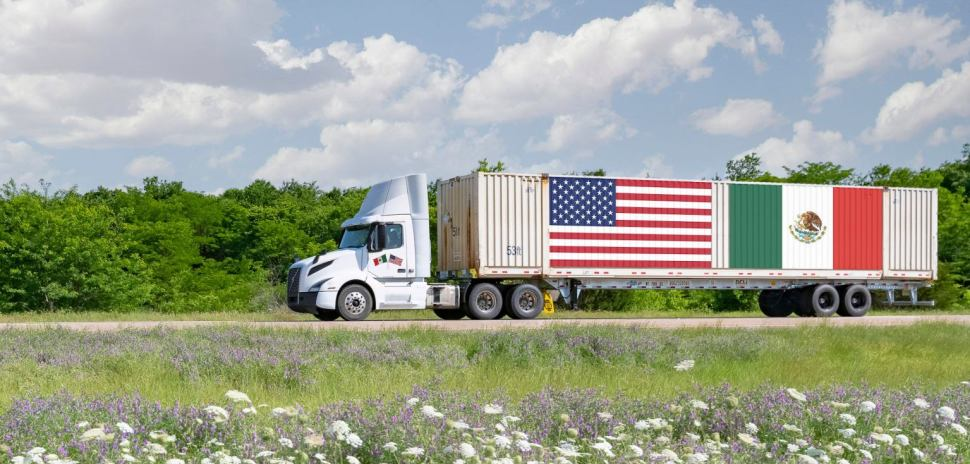
North America will need deeper economic integration and closer coordination between the United States and Mexico if the region is to remain competitive with China and other major global economic powers, economic and municipal leaders said during the 2026 NADBank Summit.
Agustín Carstens, former governor of the Bank of Mexico and one of Mexico’s leading economists, called on the United States, Mexico and Canada to embrace what he described as “smart integration” as the global economy faces geopolitical fragmentation, persistent inflationary pressures, the rapid expansion of artificial intelligence and increasingly vulnerable supply chains.
The same message emerged from El Paso Mayor Renard Johnson and Ciudad Juárez Mayor Hector Ortiz. The two mayors argued that closer cooperation between their cities will be essential to maintaining the flow of cross-border trade as investment accelerates in advanced manufacturing, aerospace, technology and data centers across the Borderplex.
Their remarks came Thursday at the North American Development Bank Summit in San Antonio, an annual forum bringing together government officials, business leaders, financial institutions, academics and infrastructure specialists from the United States and Mexico.
This year’s event placed particular emphasis on strengthening binational cooperation and financing infrastructure projects along the U.S.-Mexico border.
Carstens calls for ‘smart integration’
Carstens used his keynote address, titled “North American Integration and Global Trends,” to look back at the transformation of the economic relationship between the United States, Mexico and Canada.
He described the North American Free Trade Agreement as a watershed moment for the region, while pointing to the creation of NADBank as one of its lasting institutional outcomes.
For Carstens, the bank is a concrete example of the two countries working together to address challenges that cross the international boundary.
“It’s our border, but it’s also our problem,” Carstens said, emphasizing the ability of binational institutions to develop joint responses to problems affecting both sides.
Carstens served as governor of the Bank of Mexico from 2010 to 2017 and later led the Bank for International Settlements. During his keynote, he placed North American integration within a much broader transformation of the global economy.
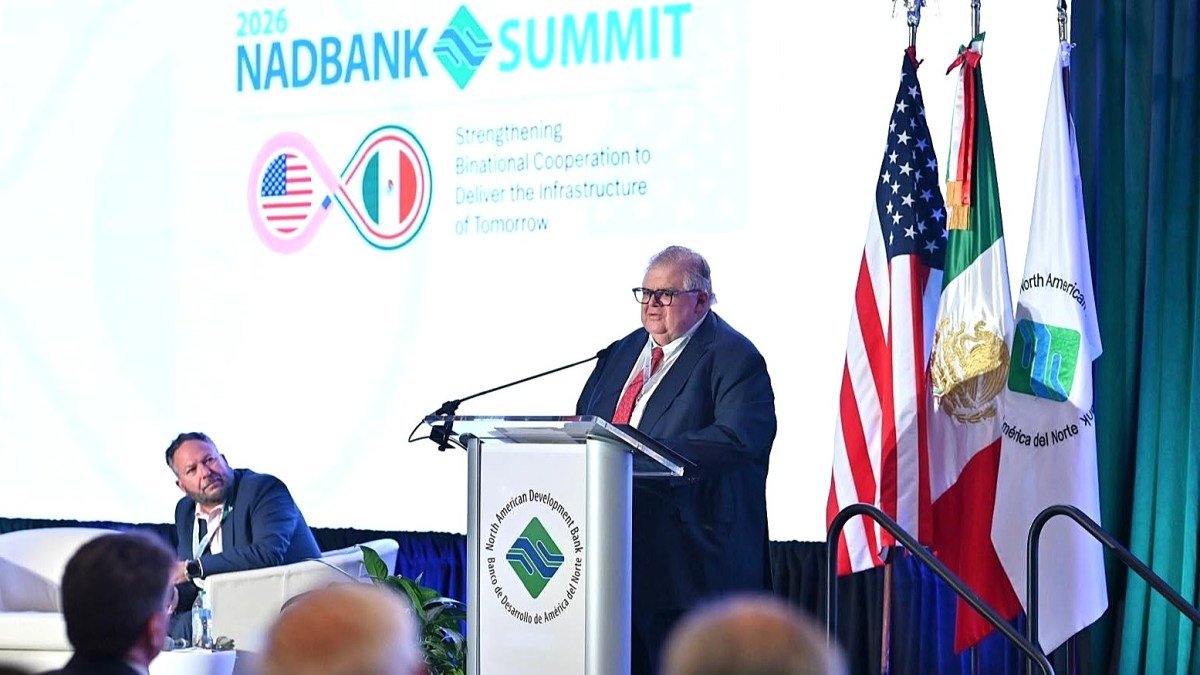
For decades, globalization, increasingly integrated supply chains, technological progress and expanding labor markets allowed producers to respond efficiently to rising demand, Carstens said.
Mexico was among the major beneficiaries of that model. The country evolved from an economy heavily reliant on oil exports in the early 1980s into the United States’ largest trading partner.
But, Carstens argued, the conditions that supported that transformation have changed significantly.
Pandemic-related disruptions, geopolitical conflicts, higher energy costs, protectionist policies, trade tensions with China, labor shortages and inadequate investment have all reduced the flexibility of global production.
The consequences include greater vulnerability to inflation and weaker economic growth.
Governments, meanwhile, have less room to depend on fiscal and monetary stimulus when new economic shocks emerge.
“We see more inflation and less economic growth, a little bit similar to stagflation,” Carstens said.
His response centers on structural reforms designed to increase productive capacity, greater infrastructure investment and stronger workforce skills, combined with renewed regional cooperation.
“I think that we need to reintroduce smart integration, smart regional developments, join forces and move forward,” Carstens said.
He added that North America needs to consider “our competitiveness as a region with respect to the rest of the world.”
Carstens also highlighted artificial intelligence as both an opportunity and a potential source of disruption.
While AI could generate significant productivity gains, he warned that its economic effects could resemble the disruptions produced by previous waves of globalization and technological transformation.
Governments, he said, should prepare workers for that transition by promoting more flexible skills and education while also investing in infrastructure capable of removing barriers to economic expansion.
“For many, many decades we have abandoned infrastructure,” Carstens said. “We see it here on the border. It goes at a piecemeal approach, especially in terms of transportation.”
Those transportation constraints directly limit productive capacity and, consequently, economic growth, according to Carstens.
He argued that NADBank could play a larger role in addressing those weaknesses.
“Let’s think big about NADBank,” Carstens said. “Let’s modernize this institution because there is a lot that can contribute.”
El Paso and Juárez increasingly present themselves as one economic region
The call for greater regional integration was echoed later in the summit by Johnson and Ortiz.
Rather than portraying El Paso and Juárez as separate municipalities competing across an international boundary, the two mayors described them as interconnected parts of a single economic region.
Johnson said El Paso, Juárez and the surrounding communities are increasingly promoting themselves as a market of approximately 2.7 million people instead of presenting El Paso on its own as a city of roughly 800,000 residents.
“We are in alignment for the first time in many, many years,” Johnson said.
He pointed to aerospace, advanced manufacturing and technology as sectors in which the two cities can develop together.
Ortiz expressed a similar view, describing the El Paso-Juárez-Las Cruces region as a large, interconnected economic engine.
Juárez “can never be done alone,” Ortiz said, arguing that stronger coordination with El Paso and Las Cruces could create a larger commercial and economic development hub serving both Mexico and the United States.
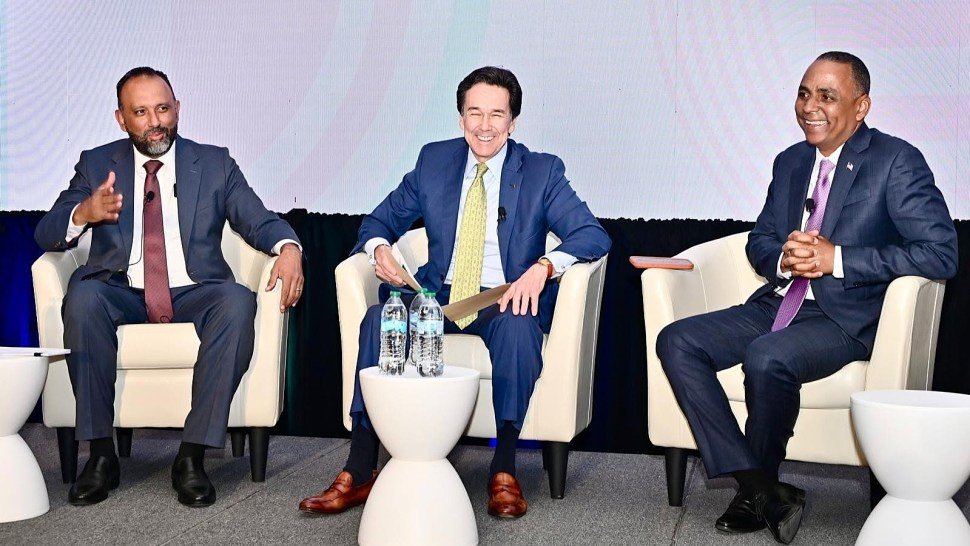
The Borderplex already ranks as the fifth-largest manufacturing hub in North America by employment, according to figures cited during the panel.
Johnson said one out of every four jobs in El Paso is connected to manufacturing. He also noted that every 100 manufacturing jobs created in Juárez generates approximately three jobs in El Paso.
More than $140 billion in trade moves through the El Paso border region, Johnson said, arguing that increasing throughput at the city’s international bridges could unlock billions of dollars in additional economic activity.
El Paso operates the Paso del Norte, Ysleta and Stanton bridges.
“If we were to just increase cross-border traffic, you would see billions of dollars come into not only Texas, but throughout the United States,” Johnson said.
Border infrastructure becomes central to North American competitiveness
Taken together, Carstens’ keynote and the discussion between the El Paso and Juárez mayors pointed toward the same conclusion from two different perspectives.
As global supply chains become more fragmented, expensive and vulnerable to disruption, North America’s competitive advantage may increasingly depend on making its existing economic integration more efficient.
For communities along the U.S.-Mexico border, that means more than increasing trade volumes.
It could require improvements to international bridges and transportation networks, stronger workforce development, more reliable water supplies and a broader understanding of communities on either side of the border as interconnected components of the same supply chain.
The broader challenge is therefore not simply whether North America can continue trading as an integrated region, but whether the infrastructure, workforce and institutions supporting that trade can keep pace with the changing global economy.
Why it matters: The push to strengthen North American supply chains could place border infrastructure, freight capacity and workforce development at the heart of the region’s competition with China and other major global manufacturing powers.