



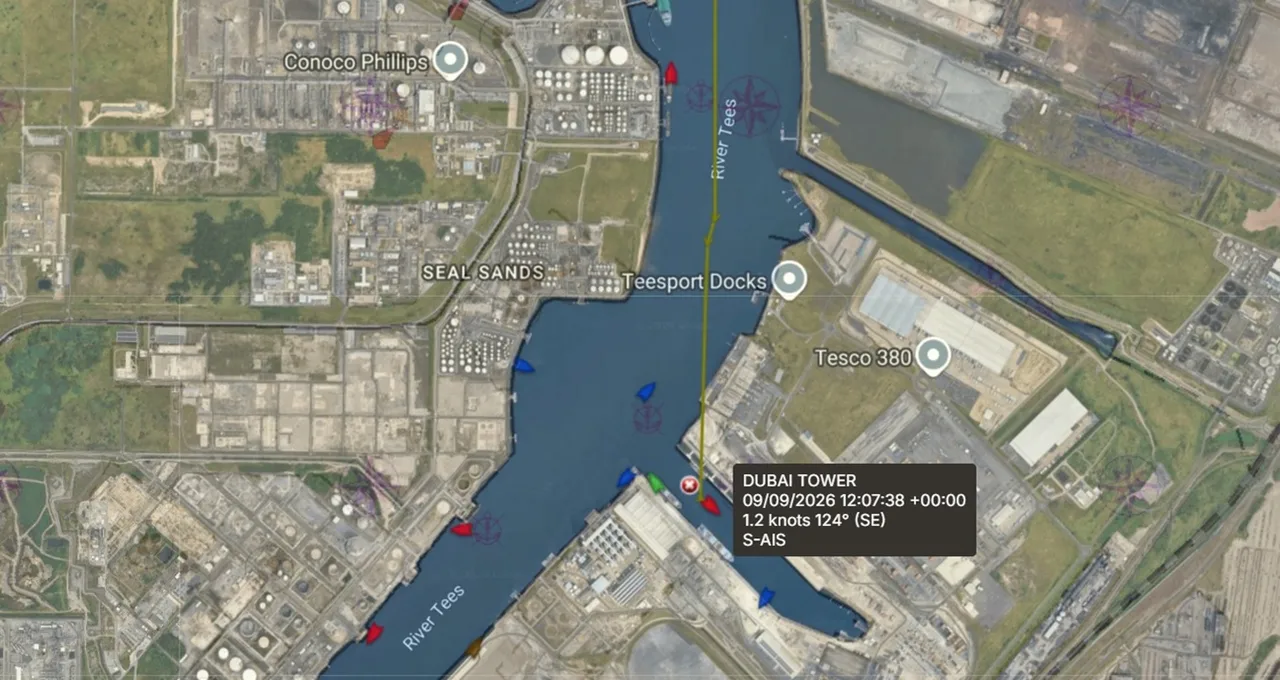
The container vessel Dubai Tower has arrived in the United Kingdom after completing a voyage from Ningbo, China, via the Northern Sea Route (NSR) through the Russian Arctic.
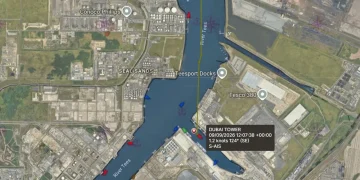
According to AIS tracking data provided by Pole Star Global, the 1,740 teu vessel has called at the QEII berth in Teesport, in northeast England.
Registered in Liberia, the Dubai Tower is the first vessel involved in a series of eight weekly voyages that Sea Legend is offering during the Arctic’s summer ice season as part of its China Arctic Express Service.
The vessel departed Ningbo on 15 August and had initially been expected to arrive in Felixstowe, UK, on 5 September. Teesport was not originally included by Sea Legend among the planned ports of call. In addition, the QEII berth is primarily designed to handle bulk and project cargo rather than containerised cargo.
The Northern Sea Route offers a significantly shorter connection between Asia and Europe during the limited period in which Arctic ice recedes during the summer months. A voyage to the UK and Europe via the NSR can take roughly half the time required to sail around the Cape of Good Hope, a route that typically takes between 40 and 50 days.
Sea Legend is not the only carrier exploring the Arctic route. Two other Chinese shipping companies, New New Shipping and OVP Shipping, are also operating Asia-Europe services via the Arctic. They are joined by South Korean container shipping newcomer PanStar.
PanStar’s trial Arctic voyage, operated by the PanStar Arco, is currently continuing south along the coast of Norway, according to its AIS signal. Data from analyst Alphaliner indicates that the 2,758 teu vessel is carrying 737 teu of laden containers.
The use of the Northern Sea Route has continued to attract shipping activity during the Arctic navigation season. According to the Centre for High North Logistics, 2025 recorded 103 transit voyages on the NSR, carried out by 88 vessels, between 30 June and 30 November.
Among those passages were 15 container ship voyages, including eight eastbound and seven westbound transits. Tankers accounted for the largest share of Arctic route passages, completing 34 voyages during the year.