



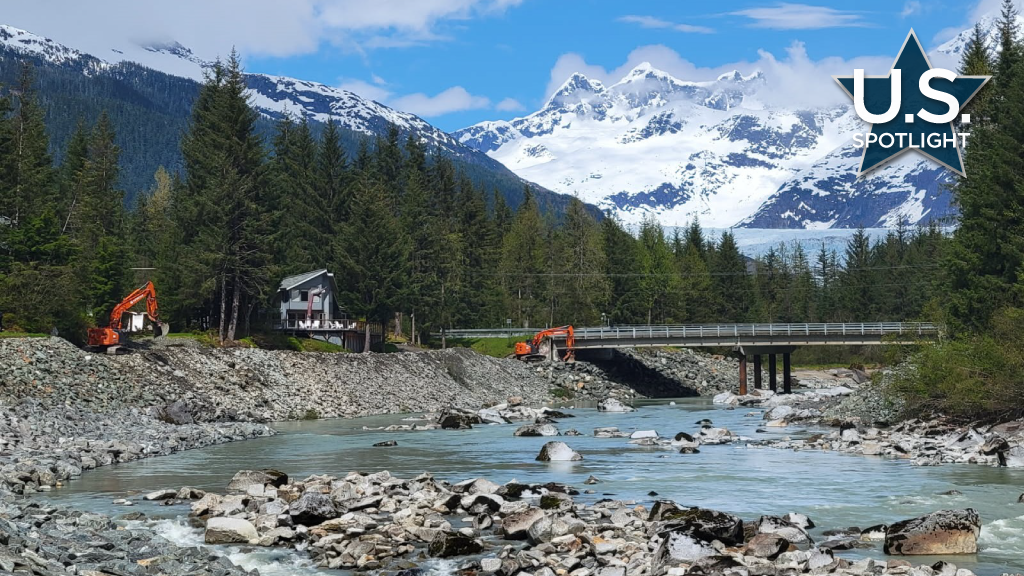
Recurring glacial flooding in Juneau, Alaska, has pushed the U.S. Army Corps of Engineers (USACE) to take an unusually aggressive approach to infrastructure development. With floodwaters from the Mendenhall Glacier system repeatedly putting homes, businesses and critical infrastructure at risk, the agency is moving away from the traditional federal project-development process in favor of a fast-track strategy designed to deliver a permanent solution.
The USACE, working with the U.S. Department of Agriculture and the U.S. Department of the Interior, recently announced a new initiative known as Building Infrastructure, Not Paperwork (BINP). The program is intended to significantly shorten both the timeline and the cost associated with addressing recurring glacial lake outburst floods originating from the Mendenhall Glacier system.
Flooding has become an annual threat for Alaska’s state capital. Water accumulates behind the glacier’s ice wall, and when it is released, billions of gallons can inundate local roads and cause extensive property damage.
For federal and local officials, the situation has reached a point where the community cannot afford to spend years navigating environmental reviews, permitting requirements and other bureaucratic procedures normally associated with major infrastructure projects.
Under the conventional federal process, officials estimate that designing and constructing a permanent flood-mitigation project could take more than a decade and cost upwards of $1 billion. The BINP approach is intended to substantially reduce both figures by bringing agencies together, eliminating duplicated reviews and using existing authorities to accelerate decisions.
Adam Telle, assistant secretary of the army for civil works, said the challenge facing Juneau is unlike anything the USACE has previously confronted, requiring an equally unconventional response.
“Finding unique, common-sense ways to solve the most difficult water infrastructure problems is what BINP is all about, and we intend to deliver the real, lasting safety Juneau deserves,” Telle said.
At the heart of BINP is a simple principle: build the infrastructure rather than allow projects to become trapped in endless studies, reviews and paperwork.
Instead of relying on the traditional sequential system, in which different agencies conduct separate reviews and approvals, federal departments have been instructed to coordinate their work. The goal is to make greater use of existing authorities, remove duplication and speed up decision-making.
By reducing bureaucratic delays and operating at a much faster pace, the collaborative approach puts construction and immediate community safety ahead of prolonged administrative processes. It is also intended to ensure that federal resources can be deployed more rapidly.
The Juneau project is emerging as a potential test case for a different model of complex public infrastructure development, particularly when communities face an immediate and recurring threat.
For residents of Juneau, that threat is far from hypothetical.
Recent flooding has increased concern over the vulnerability of homes and businesses throughout the Mendenhall Valley. At the same time, climate-driven changes affecting glacial systems have made the timing and scale of future flood events increasingly uncertain.
Temporary protection has already been used. HESCO barriers, for example, have been installed over the years to help shield vulnerable areas. But officials continue to emphasize that such measures are only temporary and that a permanent solution is essential.
Federal officials argue that waiting another decade would leave the community exposed to an unacceptable level of risk.
“Flooding from Mendenhall Glacier’s Suicide Basin poses a serious risk to residents of Juneau, Alaska,” said Stephen Alexander Vaden, deputy secretary of the U.S. Department of Agriculture.
The danger is made more difficult to manage because major flood events can develop with relatively little warning.
The accelerated federal approach also reflects years of calls from Alaska Sen. Dan Sullivan, his team and Juneau residents for a faster long-term solution.
“Thankfully, no lives have been lost to date, and a short-term solution is in place with the HESCO barriers. But,” Sullivan said, “the urgency of delivering a long-term fix could not be clearer.”
The USACE is also preparing to depart from its traditional acquisition and project-development timelines.
Brig. Gen. Joseph Goetz, commanding general of the USACE Pacific Ocean Division, said the agency intends to make greater use of private-sector innovation and technical expertise.
“We are breaking away from traditional acquisition timelines to rapidly harness industry-led innovation and technical expertise. This prototype is a critical step forward in our co-ordinated effort to protect downstream communities and minimize flood risk,” Goetz said.
Speed is not the only objective. The accelerated strategy is also designed to limit the financial burden on taxpayers.
Federal officials point out that prolonged delays can drive construction costs substantially higher while leaving communities exposed to the same hazards year after year.
The Corps has already carried out temporary flood-mitigation work for the past couple of years. Those measures, however, were never intended to replace a permanent project and are designed only to provide short-term protection while a lasting solution is developed.
The forthcoming BINP initiative will instead seek to deliver an innovative, permanent infrastructure solution capable of providing long-term protection for Juneau.
As part of that effort, the Corps plans to solicit proposals addressing the flooding phenomenon through an approach designed to accelerate the development of real-world, cutting-edge infrastructure prototypes. The objective is to move faster while achieving the solution at a significantly lower cost to taxpayers.
Juneau Mayor Beth Weldon said the city’s recurring flood threat is unlike the challenge faced by communities elsewhere in the United States.
“It’s hard to express how grateful we are for the USACE’s fast-tracked approach to solving to Juneau’s glacial lake outburst flooding and the threat and anxiety facing our residents every year. Juneau stands ready to support the Corps’ work to get this completed as quickly as possible,” Weldon said.