



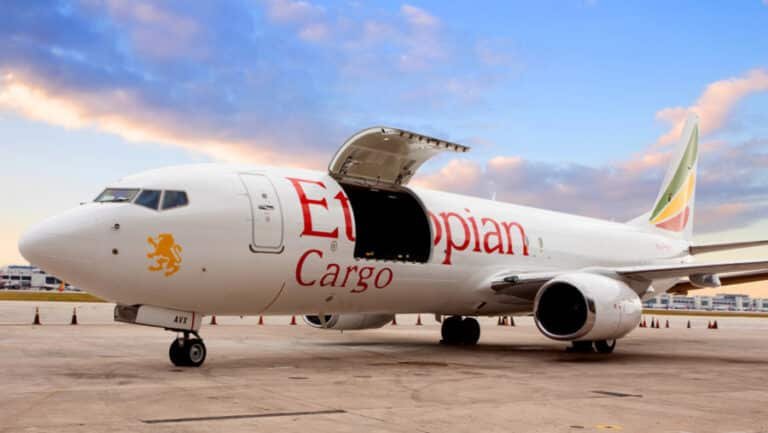
The potential order for Boeing freighters by Ethiopian Airlines is about much more than adding to its fleet. The carrier is increasingly shaping three elements of its cargo strategy – fleet expansion, stronger connections with Asia and additional airport capacity – around a broader ambition to cement Addis Ababa as one of Africa’s leading cargo gateways.
A Boeing Order Built Around Fleet Timing
Reports suggest Ethiopian Airlines could get eight to 10 Boeing freighters, a mix of current-generation 777Fs and the newer 777-8F.
Such a mix would serve two different priorities. More 777Fs could provide Ethiopian with capacity that can be deployed in the near term, while the 777-8F would give the airline a longer-term route toward fleet modernization.
The strategy would be based on operational experience to date . Ethiopian Airlines already operates 12 Boeing 777 freighters, so the carrier is familiar with the aircraft family and its operating requirements.
The timing is especially important as Boeing is changing over between generations of freighter. Emission restrictions mean that the production of the standard 777F is capped after 2027, while the larger 777X program has faced delays. A combined order could thus help mitigate some of the risks of the transition for Ethiopia.
Instead of waiting for the delayed 777-8F program, the airline would add more aircraft to its fleet to support near-term growth, while also preparing for the next generation of freighters.
Addis Ababa: the Heart of the Cargo Strategy
Ethiopian Cargo’s hub-and-spoke network is the strongest case for more of the big freighters.
Today, the airline flies to 70 dedicated cargo destinations and over 140 passenger destinations. That extensive network means that freight from a number of African markets can be consolidated via Addis Ababa rather than requiring long-haul services from all origins.
This hub model is particularly relevant as Ethiopian expands its relations with China.
The carrier’s new Chengdu service is an example of how the network can work. Cargo originating in China can be diverted to markets such as Lagos, Accra, Dakar, Entebbe and Lubumbashi.
This structure makes operating large freighters more economic because the aircraft are not tied to the cargo volumes of a single city pair. Instead, several markets can be consolidated onto the same long-haul service.
The move also puts Ethiopian Airlines in a stronger position in the growing Africa-Asia trade corridor.
China is a leading supplier of manufactured goods, machinery and electronics to African markets. African exporters also trade in agricultural and other time-sensitive products that can benefit from faster air transport, in the other direction.
Ethiopian can use its hub in Addis Ababa, located between the flows, to connect cargo moving in both directions and take a bigger share of Africa-Asia trade.
Bishoftu Can Increase Cargo Capacity
But all of the potential for fleet growth will only be realized if airport infrastructure is able to efficiently handle the extra cargo.
That makes Bishoftu International Airport a vital asset in Ethiopian Airlines’ longer-term expansion strategy. The first phase will add a significant amount of cargo capacity to the airport.
Operations at Bishoftu have the potential to become more efficient, decreasing congestion and accelerating transfers between arriving and departing flights. That, in turn, would support the economics and operational benefits of Ethiopian’s hub-and-spoke cargo model.
But there are risks to the expansion as well.
Cargo demand is cyclical and operating large freighters can become more expensive with falling aircraft utilization. Ethiopian will need to make sure fleet growth stays broadly in line with actual cargo demand.
Another fleet-planning challenge could be on the horizon, with more potential delays for the 777-8F. The timing of aircraft deliveries and the development of cargo volumes will mean that the airline will have to balance its desire for bigger scale with that.
Strengthen Ethiopian Cargo’s Competitive Position With Additional Capacity
If the demand is there for more aircraft, a bigger fleet could bring Ethiopian Cargo some commercial benefits.
The airline could operate more freighters to increase schedule frequency, provide customers more flexibility and better utilize its aircraft overall. These could bolster Ethiopian’s competitive advantage over other hubs that are handling African freight flows through the Middle East and Europe.
So, the combination of additional 777Fs, future 777-8Fs, expanded Asian connectivity and new airport capacity would create a network effect beyond just fleet size.
The prospective Boeing order should ultimately be viewed as part of a much bigger cargo strategy for Ethiopian Airlines.
The routes in Asia and investment in airports are interrelated with aircraft. If the carrier can convert those investments into sustained high volumes of cargo, Addis Ababa could reinforce its position as a gateway connecting Africa with Asia and other key global markets.