



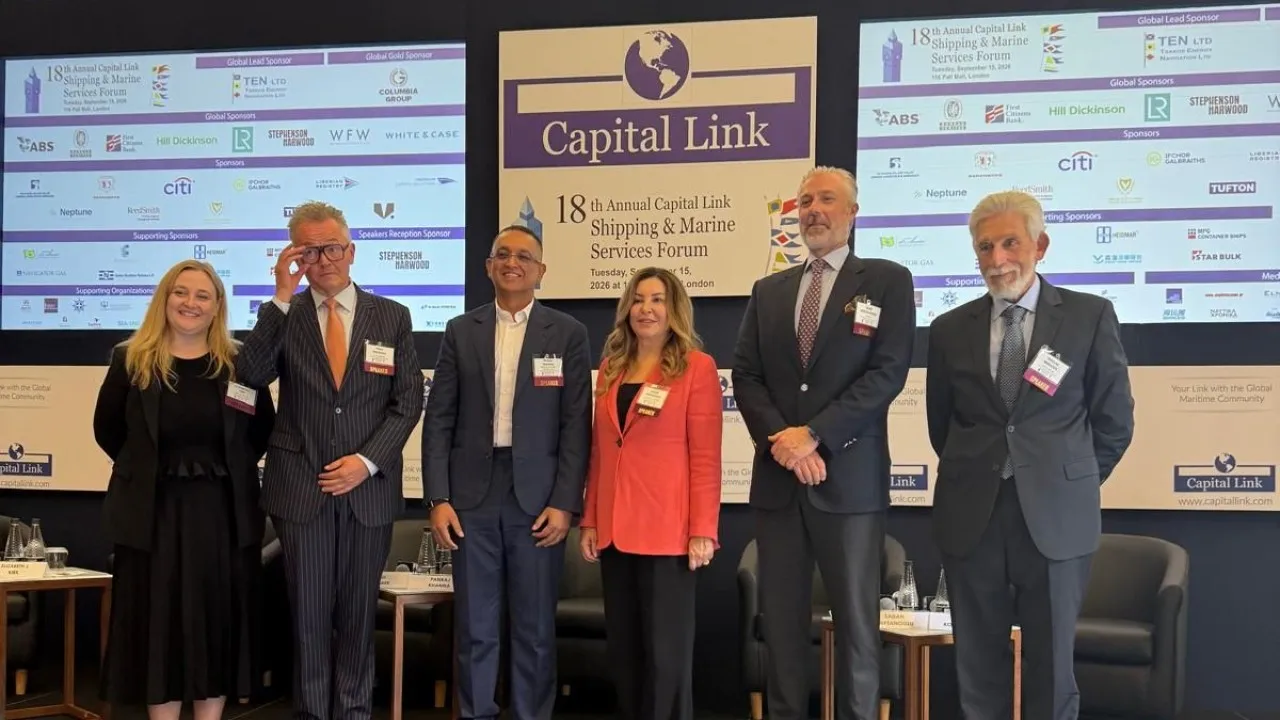
The 18th Capital Link Maritime Conference in London kicked off with a positive tone as Heidmar Maritime Holdings CEO Pankaj Khanna told the conference that the market is very positive for shipowners.
The industry is on a healthy economic path, with vessel owners benefiting from higher earnings. The good news, however, is tempered by the growing realization that today’s market conditions can no longer be assumed to continue. Companies are looking more carefully at how they can position themselves strategically for whatever is next.
Khanna’s playful description of the sector going “gangbusters” summed up the current market, which is so strong. But the conversation quickly turned to the human cost behind those profits.
“Ships cannot sail without seafarers and crews are paying a heavy price for the revenues being generated by shipowners,” Bimco president Sadan Kaptanoglu told conference delegates.
“This is unacceptable,” he said, adding that one of the most serious figures presented during the morning session is the death of 23 seafarers in the Black Sea in the last four months.
The insecurity that the crews are facing is not only human and operational. It has economic consequences as well. V. Group CEO René Kofod-Olsen said that the instability in global shipping is putting inflationary pressure on seafarers’ wages. “There are cases where we have had to increase wages for seafarers three times, considering the difficulties in the global industry,” he said.
The impacts could carry over into this year. “The world market will probably look quite different next year when the effect of large price rises becomes more visible,” Kofod-Olsen said. He also mentioned the fertilizer shortage this year which he said could affect food supplies in 2027.
More money would also accelerate the departure of many of the seafarers currently at sea. Kofod-Olsen said the development could add to the burden on an industry already struggling to find enough qualified people.
Crewing remains a strategic issue
The scarcity of maritime talent isn’t exclusively about ship crews.
“Artificial intelligence can help a lot of the seafarers of the future and can help solve some of the workforce challenges that the industry is faced with,” Khanna said. “But there is also a lack of competent people on shore”, he pointed out at the same time.
This shortage is becoming an even more pressing concern as shipping companies try to navigate a market impacted by geopolitical disruption, changing trade patterns and technological transformation.
“The flow of trade will change,” said Folk Maritime CEO Poul Hestbaek, adding that the industry has to accept that world trade will continue, but the patterns of that trade will not necessarily be the same.
Future disruptions will come in shapes that operators cannot know, so shipping companies have to become more agile and improve their ability to respond rapidly as circumstances evolve, Hestbaek said.
“Today the environment is a survival of the fittest mode,” Kaptanoglu said, pointing to the paradox shipowners are faced with.
“We know volatility is good for shipping, we love this market [shipowners], but we can’t enjoy it, we need stability and we need the green transition.”
Energy security: Flexibility is the key
Flexibility was also a clear need on a prior Capital Link panel on energy security.
Navigator Gas CEO Mads Zacho said his company was intentionally reducing debt. “The strategy is designed to position the company to be more responsive to what’s next in the global marketplace.”
The move is symptomatic of a broader malaise across the industry: strong profits today do not trump the need for financial and operational flexibility in an environment of uncertain geopolitical and trade conditions.
Still shipping executives think maritime transport will remain a core part of the global economy.
“McKinsey data has shown that 96% of the world relies on energy imports,” said AET VP President and CEO Nick Potter. At the same time, he pointed out another weak spot in the international trading system: 70 percent of world trade passes through maritime chokepoints.
The figures highlight the strategic importance of shipping but also the industry’s vulnerability to disruption. The operating environment is changing, with geopolitical instability, crew shortages, changing trade flows and the green transition. Flexibility is becoming more and more important for companies that want to navigate the next phase in the market.