



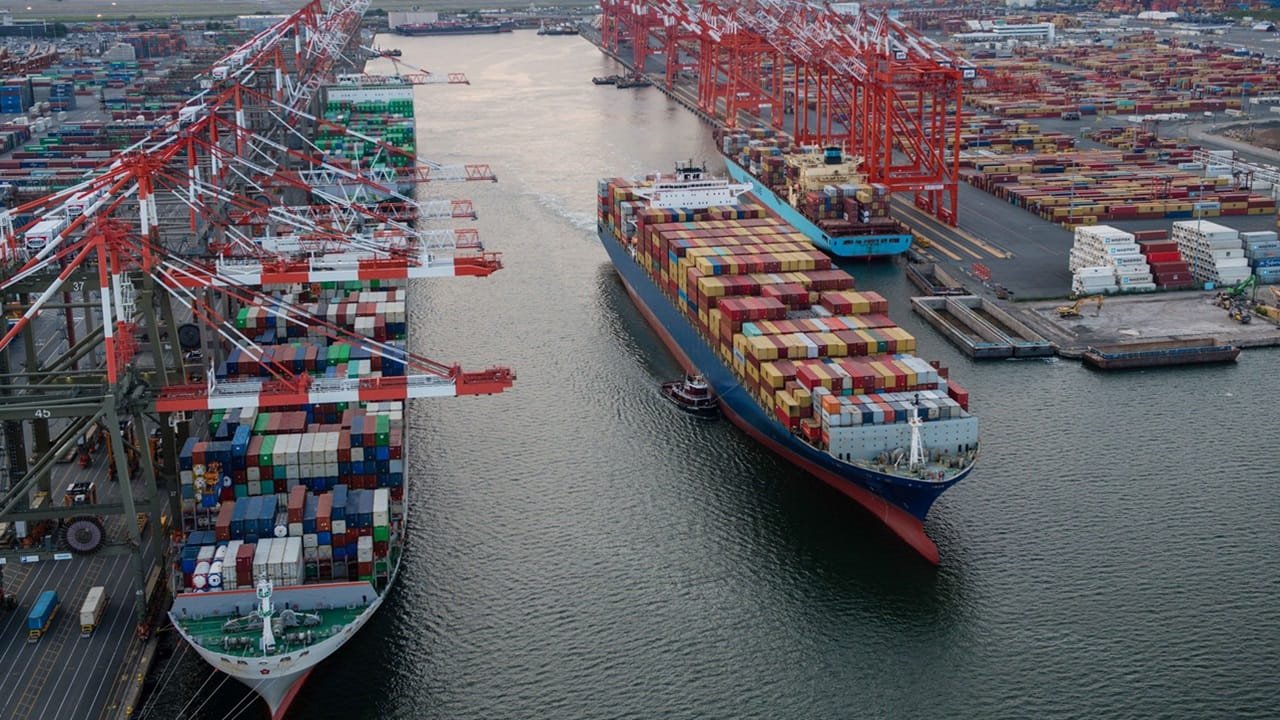
Freight rates on the transpacific trades are continuing their sharp ascent, and carriers could make another push for higher prices in early October as they seek to take advantage of the disruption created by geopolitical tensions.
Both Drewry and Xeneta expect spot rates across the Pacific to increase further, although the two consultancies point to different forces behind the current market. Drewry attributes the rise largely to effective capacity management by carriers, while Xeneta identifies a broader combination of geopolitical pressures. Dynamar, meanwhile, is highlighting congestion linked to climate-related disruptions as another factor influencing the market.
Xeneta chief analyst Peter Sand said carriers are taking advantage of the current strength of the market by deploying additional capacity to the US East Coast ahead of a potential turning point over the next two to three weeks.
Offered capacity on the Far East–US East Coast trade was 6-7% higher in September than in August, according to Sand.
Drewry’s Container Capacity Insight monitor, however, recorded nine cancelled sailings for the coming week, compared with eight the previous week.
Drewry expects rates to increase moderately during the week beginning September 21, driven by demand ahead of China’s Golden Week holiday and continued carrier efforts to manage capacity.
In its latest spot-rate report, published on September 17, Drewry said rates from Shanghai to Los Angeles had risen 5% week on week to $7,712 per FEU. Shanghai–New York rates increased 7% to $10,394 per FEU.
The consultancy expects the upward trend to continue as the market approaches China’s October 1 Golden Week.
Freight Rates Moving Toward Historic Highs
Xeneta’s latest weekly rate newsletter showed that spot rates to the US West Coast and US East Coast were respectively just 18% and 11% below the all-time highs recorded during the Covid-19 disruption.
With bunker prices pushing fuel surcharges to new levels, Xeneta said there is now a real possibility that the previous pandemic peak could be exceeded.
“Surpassing the pandemic peak cannot be ruled out, which would be an extraordinary market development.”
Should a new record be established, Xeneta expects the US East Coast trade to be the most likely candidate.
Sand said that even without a new record, the fact that such a scenario is once again being considered illustrates just how exposed major ocean container trades are to geopolitical developments. A conflict in the Middle East, he noted, can have consequences reaching far beyond the region and affecting global shipping markets.
According to Xeneta, strong spot rates on the Pacific are encouraging carriers to add capacity and maximise revenues before conditions potentially turn within the next two to three weeks. Offered capacity has increased 6-7% this month compared with August.
Sand expects another attempt to lift freight rates at the beginning of October, as shippers accelerate cargo movements out of Asia ahead of the Golden Week shutdown.
“We should expect one more freight rate push at the start of October as shippers rush cargo out of Asia ahead of the Golden Week shutdown, before rates start to soften, or at least the pace of growth will slow,” he said.
Beyond the traditional supply-and-demand fundamentals, Dynamar analyst Darron Wadey stressed the continuing influence of weather-related disruptions across Pacific services.
Chinese Port Congestion Adds Further Pressure
A succession of typhoons has disrupted Chinese port operations, with the effects continuing long after the storms themselves have passed.
Xeneta analyst Destine Ozuygur reported that 1.1 million TEU were waiting at anchor around three Chinese gateways at the end of August. Average delays are expected to exceed four days during September.
At the same time, around 3.25 million TEU were more than 10 days late, while only 6% of Asia–Europe capacity achieved its scheduled arrival time during the previous month.
Ozuygur said recovery from each week of disruption can require between one and three weeks, depending on the size of the port and the strategy adopted by individual carriers. Four storms arriving in relatively quick succession left terminals with insufficient time to recover between disruptions.
Dynamar’s Wadey also pointed to the growing impact of El Niño on water levels and vessel draught restrictions at the Panama Canal, another critical global shipping chokepoint.
“The Panama Canal restrictions will also have an influence on the flow of goods,” Wadey said. Redirecting cargo flows toward the US West Coast, he added, can only provide a temporary solution because sustained diversion could eventually generate congestion at those gateways as well.
Ships Risk Becoming Floating Warehouses
Further congestion could have another effect on the market: ships may increasingly be forced to serve as floating warehouses, a situation seen during the pandemic.
Wadey noted that storage comes at a cost and that vessels are among the most expensive forms of warehouse capacity. Even if all other market conditions remained unchanged, prolonged congestion would therefore add further pressure to freight rates.
He also acknowledged that there has been “something of a rush” among shippers seeking to beat various US trade measures that are either about to take effect or are approaching their expiration dates.
Dynamar expects any slowdown in freight-rate growth around Golden Week to be little more than a temporary “blip” when viewed against broader developments. The consultancy is also monitoring US scrutiny of transhipment ports in relation to tariff charges.
Another major issue is approaching later in the year. One month after Golden Week ends, the 12-month truce covering charges on Chinese-built vessels calling at US ports and corresponding measures involving US-linked shipping interests is due to expire.
“The disruption in the Middle East is affecting Europe and Africa too,” Wadey said, adding that the breadth of simultaneous disruptions is making forecasting and operational planning exceptionally difficult.
“To borrow [a phrase] from popular culture, we really are seeing everything… everywhere… all at once. That makes any form of prediction or planning nigh-on impossible unless someone, somewhere, takes a lead.”