



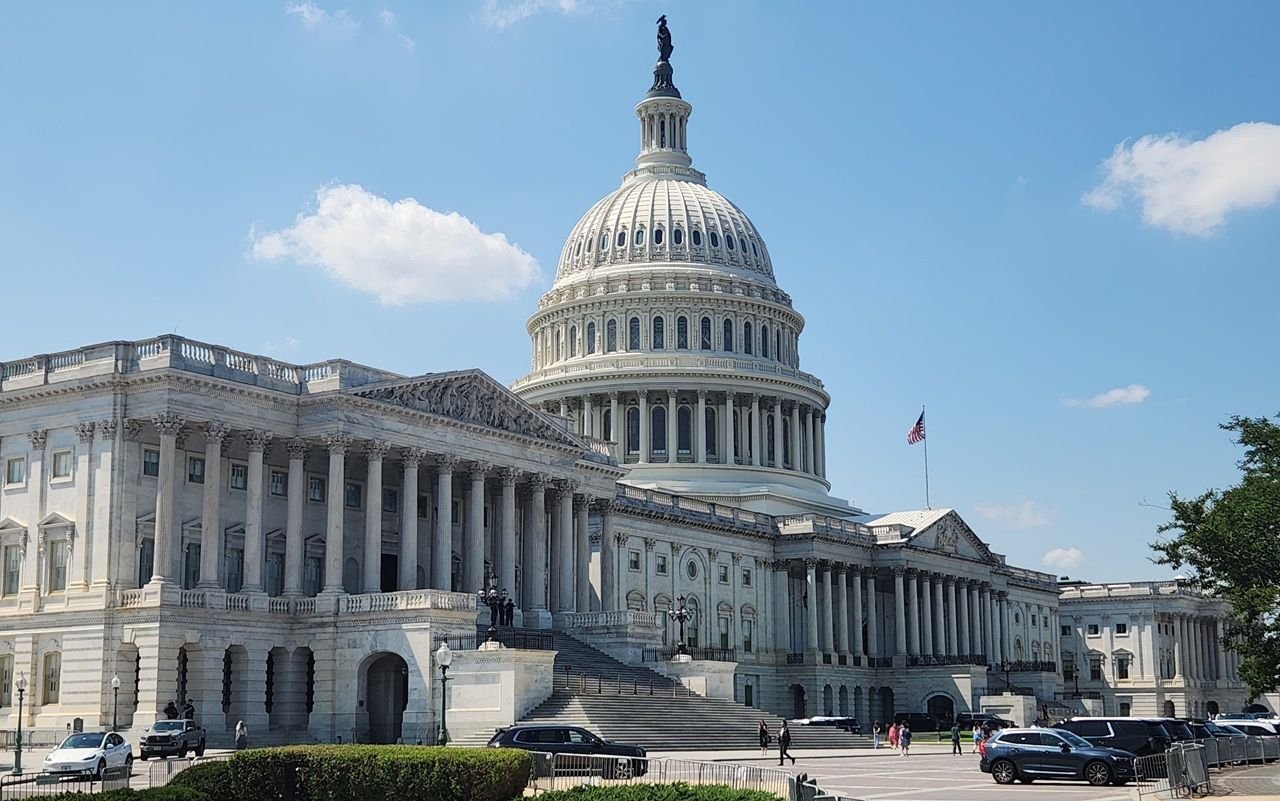
The U.S. House of Representatives has voted to overturn the federal authorisation that allows California to enforce its emissions requirements for oceangoing vessels while they are berthed at ports in the state.
The measure, House Joint Resolution 210, passed on September 15 by a vote of 216-211. Sponsored by Representative Vince Fong, Republican of California, the resolution was introduced in August under the Congressional Review Act. It seeks to invalidate the Environmental Protection Agency’s October 2023 authorisation of California’s expanded Ocean-Going Vessels At-Berth Regulation.
The resolution would still need to pass the Senate and receive the President’s signature before it could take effect.
The federal authorisation gives the California Air Resources Board (CARB) authority to apply stringent emissions-control requirements to vessels operating at berth, including containerships, refrigerated cargo vessels, roll-on/roll-off ships and tankers. Under the regulation, operators must reduce diesel emissions by connecting vessels to the electrical grid while in port, using state-approved emissions-control technology, or contributing to a remediation fund. Non-compliant vessels can face penalties of about $50,000 per ship per day.
Billions in compliance costs and health benefits
Fong argued during the debate that the financial impact of the rules would extend beyond shipping companies and could ultimately move through the wider supply chain to consumers.
California’s financial analysis estimates that infrastructure, administrative and other compliance costs for vessel operators, ports and terminals could total about $2.3 billion through 2032. At the same time, the state has estimated health-related benefits at approximately $2.64 billion. California’s regulatory analysis has also identified major reductions in pollution-related health impacts as a key benefit of the programme.
The House debate also focused heavily on fuel prices, which have risen sharply in California and across the United States.
Representative Kevin Kiley, an independent from California, said he was supporting the resolution because of concerns that additional requirements could contribute to higher fuel prices. He pointed to California’s statewide average approaching $6 per gallon and argued that residents already face high living costs.
The resolution has received support from the American Petroleum Institute, the Western States Petroleum Association and the National Association of Manufacturers. Vessel-operator representatives were contacted for comment.
Democrats challenge the measure
Democratic lawmakers opposed the resolution and argued that removing the requirements would increase reliance on diesel rather than reducing emissions at ports.
Representative Zoe Lofgren, Democrat of California, questioned how encouraging ships to use diesel could help households facing high costs.
During the debate, Democrats also linked elevated fuel prices to the war involving Iran and argued that plugging ships into shore-side electricity can be less costly for operators than running engines on marine diesel while alongside.
Lofgren said diesel prices had reached as high as $8.99 per gallon at one station she had recently passed and argued that oil and gas companies, rather than households, would be among the principal beneficiaries of removing California’s rules.
The House action forms part of a broader 2026 congressional effort concerning California’s authority to impose emissions requirements on maritime and other mobile sources. The EPA said in July that it had transmitted California waiver rules covering marine vessels and ports to Congress for review under the Congressional Review Act.
California, meanwhile, continues to defend the environmental and public-health rationale behind its At-Berth Regulation. CARB said its 2020 regulation was designed to reduce pollution from ocean-going vessels while they are docked at the state’s busiest ports and estimated substantial health benefits from the resulting emissions reductions.
The House vote therefore leaves the future of California’s port-emissions framework pending in the Senate, while the debate continues to centre on how the rules should balance vessel operating costs, fuel use, supply-chain impacts and emissions and health objectives.