



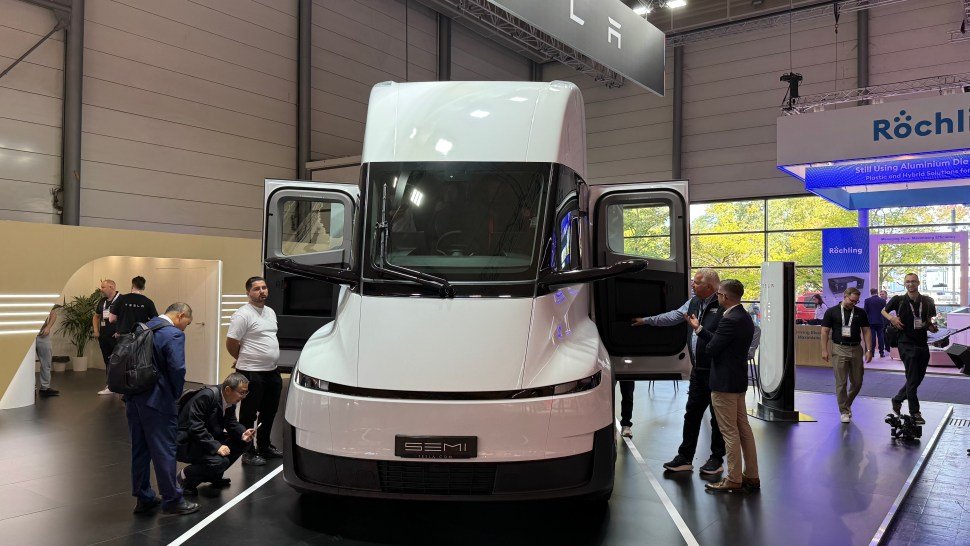
Tesla has secured the lead supplier position in a 2,500-truck battery-electric Class 8 order that organizers say will nearly double the size of the U.S. electric Class 8 fleet.
The order was announced Tuesday by Catalyst Mobility, the clean transportation nonprofit formerly known as CALSTART, and the Smart Freight Centre. The two organizations described it as the largest electric truck order placed in the United States to date.
The trucks are being procured through ZET SCALE, or the Zero-Emission Truck Shipper-Carrier Alliance Leading Electrification, a joint program operated by the two nonprofits. Microsoft and PepsiCo are among its founding shippers, while the alliance has set its sights on eventually reaching 10,000 trucks or more.
The scale of the order stands out against the current U.S. market. According to reporting by Electrive, citing the International Council on Clean Transportation’s August 2026 global market monitor for zero-emission trucks and buses, just 875 zero-emission heavy trucks were sold in the United States during 2025, representing only 0.3% of the market.
Pooled freight demand drove the bid
ZET SCALE built its procurement strategy around aggregated freight demand. Freight volumes from participating shippers were pooled and then presented to manufacturers through an independent request for proposals.
“You can have good technology and still not have a market,” said Michael Berube, president and CEO of Catalyst Mobility. He said the distinguishing feature of ZET SCALE was its ability to organize demand at sufficient scale to allow manufacturers to price more competitively.
The alliance evaluated proposals using four main criteria: price, range, charging capability and production capacity. Tesla ultimately emerged as the lead OEM.
“The Tesla Semi is designed for lower cost per mile operations than diesel,” said Dan Priestley, director for the Tesla Semi program. He added that ZET SCALE’s objectives could reinforce the operational cost advantage and predictability offered by electricity by applying them across a larger deployment.
Kenworth, RIDE and Volvo were selected as secondary OEMs for carriers whose operating requirements call for a different truck configuration. Catalyst has not disclosed how many of the 2,500 vehicles will be Tesla Semis.
Tesla is scheduled to inaugurate its Semi factory in Sparks, Nevada, on Sept. 24. The facility is designed to produce 50,000 trucks annually.
ZET Lease shifts residual-value risk away from carriers
ZET Financial, a strategic partner of the alliance, is issuing the purchase order for all 2,500 trucks and will then place the vehicles with carriers through its fair market value lease program.
Known as ZET Lease, the structure is intended to remove residual-value risk from fleet operators. Catalyst said uncertainty around what electric trucks will be worth at the end of their useful life has been one of the factors keeping some carriers and fleets from committing to the technology.
ZET Financial will also develop a cost analysis tailored to each participating fleet’s duty cycle and operating data. According to Peter Flynn, the company’s CEO and founder, the calculation will take into account financing, electricity compared with diesel fuel, and maintenance costs.
The first deployment phase will concentrate vehicles across 10 major freight hubs: Los Angeles, Stockton and Bakersfield in California; Seattle-Tacoma; Houston, Dallas and San Antonio; the Chicago area; Atlanta; and the Newark-New York City area.
At the same time, ZET SCALE is recruiting additional shippers and carriers as it works toward expanding the program into more regions.
Advocacy groups use the order to challenge legacy truck makers
Environmental organizations including the Natural Resources Defense Council, the Sierra Club and Transport & Environment are using the 2,500-truck commitment to call greater attention to electric truck pricing among established manufacturers.
In a joint release emailed to FreightWaves by the Sunrise Project, the groups pointed to the widening price gap between battery-electric and diesel Class 8 tractors.
According to the ICCT’s September 2025 working paper, “Battery electric commercial vehicle pricing in the United States,” the median price of a battery-electric Class 8 tractor increased by 27% between model years 2020 and 2025, reaching $411,200. The corresponding median price for a diesel tractor in the dataset was $172,500. Both figures are expressed in 2022 dollars.
California also moved on the policy front this week. Gov. Gavin Newsom signed SB 1213 on Sept. 20. His office said the legislation is intended to improve transparency around state incentives for zero-emission trucks. The advocacy groups said the law requires manufacturers to disclose vehicle pricing information as a condition for receiving state subsidies.
“Fleets are tired of the financial whiplash from unpredictable diesel prices, and the ZETScale announcement is a clear sign that buyers are ready to move,” said Guillermo Ortiz, senior clean vehicle advocate at NRDC.
Ortiz described the order as a major signal to the market, arguing that buyers are already prepared to commit significant purchasing power and urging legacy manufacturers to respond more aggressively to the emerging demand.
Charging infrastructure and workforce preparation are the next challenges
While the scale of the truck order is significant, neither of the announcements identifies a charging provider for the 10 freight hubs.
ZET Financial will instead provide participating fleets with advisory support covering infrastructure and charging requirements.
Hight Logistics CEO Rudy Diaz pointed to the operational experience already gained with electric trucks in real-world drayage applications.
“After more than 2 million electric miles in real drayage operations, we know that Class 8 electric trucks can perform at scale,” Diaz said in the advocacy groups’ release.
He stressed that deploying the vehicles is only one part of the transition. Reliable charging infrastructure, detailed route planning, trained drivers and technicians, and operating models aligned with the capabilities of electric equipment will all be required for successful implementation.
“Large orders like this are an encouraging sign for the industry, but the focus must remain on putting trucks into service and keeping them productive every day,” Diaz said.
Why it matters
The U.S. market recorded only 875 zero-emission heavy truck sales in 2025. The 2,500-truck ZET SCALE order therefore represents a deployment considerably larger than last year’s total sales volume.
By combining pooled shipper demand with financing through a lease designed to remove residual-value risk from carriers, the program will provide a significant test of whether electric Class 8 trucks can move beyond pilot projects and become part of everyday freight operations at scale.