



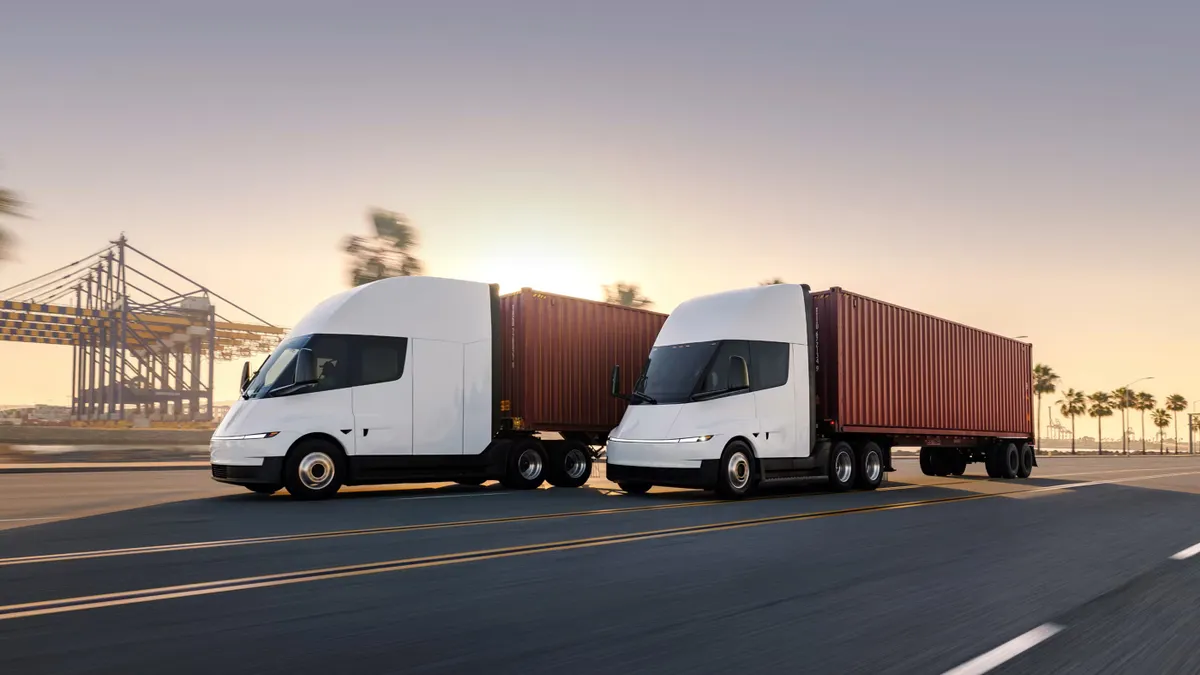
A coalition of cargo-owning shippers is moving ahead with a major push to expand the use of battery-electric Class 8 trucks, placing an order for 2,500 vehicles as companies seek a more affordable path toward lower-emission freight transportation.
The order was announced in a Sept. 22 press release from the Zero-Emission Truck Shipper-Carrier Alliance Leading Electrification, known as ZET SCALE, a program jointly operated by Catalyst Mobility and the Smart Freight Centre.
The coalition brings together major freight-owning companies including Ikea, Red Bull, Microsoft and PepsiCo. For the initial 2,500-truck order, Tesla has been selected as the primary original equipment manufacturer, while Volvo, Kenworth and RIDE will serve as secondary OEMs.
For shippers, the move addresses one of the central challenges surrounding the deployment of Class 8 battery-electric trucks: cost.
While companies are increasingly looking to reduce emissions across their supply chains, purchasing electric heavy-duty trucks at competitive prices can be difficult. ZET SCALE is designed to address that issue by aggregating shipper demand, allowing manufacturers to price vehicles at scale, Catalyst Mobility President and CEO Michael Berube said in the release.
For Microsoft, the model offers a way to connect corporate sustainability commitments with day-to-day transportation operations.
“Our participation in ZET SCALE does that for road freight, by signaling real demand for electric trucks so the low-carbon option becomes competitive for moving our cloud infrastructure,” Nico De Golia, director of sustainability for cloud supply chain global operations at Microsoft, said in the release.
The 2,500 trucks are being purchased by ZET Financial, a finance company that works with corporate fleets and carriers to integrate the vehicles into the ZET SCALE network, according to Cristiano Façanha, head of road freight electrification of North America at the Smart Freight Centre.
Once integrated, shippers can lease the electric trucks through ZET Financial’s leasing program rather than purchasing the vehicles directly.
The model also changes how participating shippers access transportation services. They can procure freight services from fleets operating the electric trucks, allowing them to benefit from potentially more competitive freight rates while reducing emissions linked to those movements.
“Shippers then procure freight services from those participating fleets operating the electric trucks, and can thus benefit from more competitive freight rates and fewer emissions associated with those movements,” Façanha said in an email.
ZET SCALE is focusing its initial deployments on high-density freight hubs, where concentrated freight activity can help improve utilization rates for both the trucks and their charging infrastructure.
The first deployment locations include Los Angeles, Seattle, Chicago, New York City and several markets across Texas.
The initiative is not intended to stop at the first 2,500 vehicles. ZET SCALE is targeting 10,000 or more electric trucks, with the broader objective of creating a scalable blueprint that other companies across the freight industry can follow.
To support that expansion, the organization is continuing to recruit additional shipper and carrier partners.
The initiative comes as other major technology companies are also helping accelerate electric truck deployment. Earlier this month, Google announced that it was supporting the deployment of an additional 25 electric trucks in Texas through a partnership involving electric truck startup Nevoya and the Center for Green Market Activation, a shipper nonprofit seeking to finance additional zero-emission infrastructure.
That partnership is focused on accelerating truck deployment along the important freight corridor linking Dallas and Houston. As part of the arrangement, Google will receive environmental certificates that it can use to claim emissions reductions toward the company’s sustainability goals.