



Madras, Oregon – As the trucking industry awaits a final resolution on the U.S. Environmental Protection Agency’s revisions to the nitrogen oxide (NOx) emissions rules for heavy- and medium-duty vehicles, Daimler Truck North America is expressing concern about one aspect that could lessen the regulatory burden on manufacturers.
At a media gathering at Daimler Truck North America’s proving ground and test track in Oregon’s High Desert, company officials spoke about the EPA’s proposed amendments issued in July. The regulatory debate set the stage for the event’s primary goal: the launch of Daimler’s Detroit 6 engine to meet the coming emissions requirements.
Daimler officials repeatedly said the Detroit 6 already meets applicable standards, no matter what happens in the amendment process.
The comment period on the proposed amendments closed in late August. That amendment process did not include the key requirement coming into play next year: the NOx standard will become more stringent from 0.2 brake horsepower-hour (bhp-hr) to 0.035 bhp-hr. This is still required.
Industry support for warranty changes is broad
Much of the trucking industry has welcomed some aspects of the proposed changes.
One of the biggest is the removal of the need for a long-term emissions warranty. Under the proposal, manufacturers would revert to the existing warranty structure: five years or 100,000 miles, not the proposed 10 years or 450,000 miles.
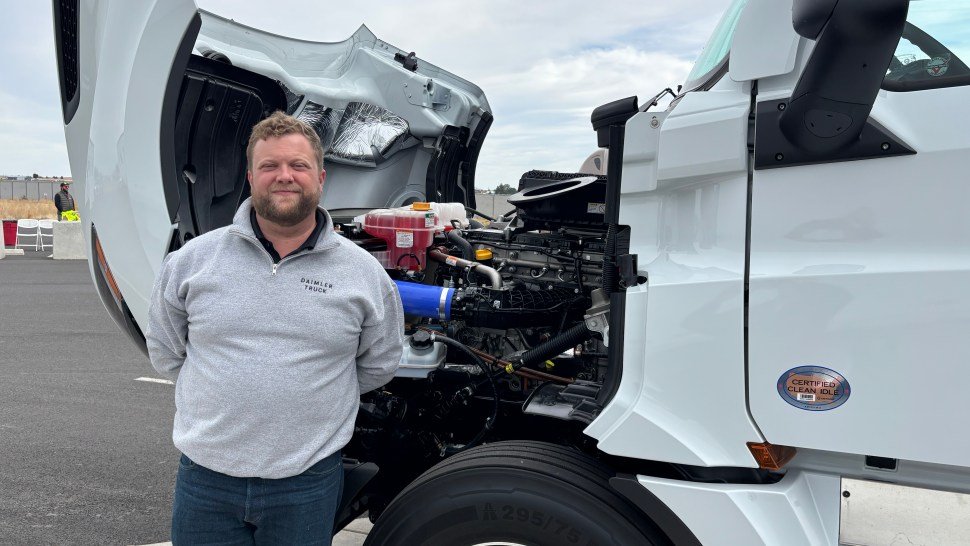
Daimler’s manager of product compliance and regulatory affairs, Dan Potter, said in a presentation in Oregon that the company believes the EPA offered useful flexibility in writing the original rule.
“Daimler believes the EPA did a good job when they wrote this rule, creating flexibility, building it into the rule, and we believe it helps support the product we are intending to bring in 2027 and further years,” Potter said.
Potter also said in a separate interview with FreightWaves that keeping the current warranty requirement would have a “particularly significant financial impact” on customers.
“We think of impact to the customer, and the proposal to get rid of the warranty extension for 2027 is going to have the biggest bottom line impact,” he said.
DEF policy, subject to change
EPA proposals would make big changes to how engines respond when diesel exhaust fluid (DEF) levels are low.
The amendments would see a sequence of warnings instead of the current system which can see a vehicle dramatically derated to a slow.
But def is not being killed.
Claims online that DEF was being phased out are incorrect. Instead, the proposed amendments would be yet another major change to DEF policy this year.
Earlier this year, removing DEF sensors was proposed as a way to fix derate issues, particularly in agricultural applications.
But even more worrying for Daimler is the provision around the proposed use of non-compliance penalties (NCPs).
Daimler casts doubt on penalties for non-compliance
Under the proposed NCP regime, an engine manufacturer could pay a monetary penalty, but could fully disclose that its engines do not meet the applicable NOx standard.
That would be different from the non-compliant engine maker in the current case, who could face potentially harsher penalties under the Clean Air Act after enforcement action by the EPA.
“NCPs are an authorized tool under the Clean Air Act,” Potter said, but said they are intended for certain situations.
“Federal law tells the EPA how and why they’re supposed to use them,” Potter said. They may or must be used where a manufacturer is unable to meet standards for technological reasons.
“All the major engine makers had previously said they were prepared to meet the 0.035 NOx standard,” Potter said.
“I’ve had quotes from all of them saying we are well prepared,” he said.
Daimler now thinks the situation is different.
Potter did not name a manufacturer. But a Daimler spokeswoman pointed to comments made by PACCAR CEO R. Preston Feight during the company’s second-quarter earnings call.
Feight said NCPs could give manufacturers more time to validate products and roll them out to customers in phases.
“Maybe the situation is very leveling now and maybe to our advantage a little bit in that the NCPs are allowing everybody to make sure we get the right products out there validated so the customers get the experience with the products, they get the experience with our products and the quality of product we’re able to introduce in a more gradual way versus it being a step change,” Feight explained.
Is the penalty the cheaper way?
Feight said the NOx rule penalties related to the NCP could total about $6,000 to $7,000.
That number is more meaningful when compared to estimates that suggest building an engine to meet the NOx standard could cost $15,000.
It might be financially attractive for manufacturers facing that economics to pay the penalty.
“This would change the purpose of the NCP mechanism,” said Potter.
“Using these NCPs for economic reasons rather than technological reasons,” Potter said, “would create a risk to the rule. “So we think there’s a risk to the rule here. “We believe that this is contradictory to what Congress specifically lays out as to what performance penalties should be used for.”
The Manufacturers of Emission Controls Association, or MECA, has similar concerns.
The association said in its comments on the proposed amendments that an expanded NCP program could put companies that have made large investments in technologies required to meet the new standards at a disadvantage.
“Clean mobility suppliers have invested in developing technologies and manufacturing capacity for the past 10 years in advance of implementing these model year 2027 and later heavy-duty standards and rely on policy stability to prevent stranded investments,” the association wrote.
The group said increased credit allowances and NCPs could jeopardize the investments and associated jobs. It also stated that the 2022 regulation already provided manufacturers with sufficient lead time and compliance flexibility for heavy-duty engines.
A coalition of attorneys general from so-called blue-leaning states also objected in their comments.
The proposal could allow manufacturers to use NCPs to meet the emissions standard for 2027 and later model-year heavy-duty vehicles, they contended, though they did not believe the criteria for establishing those penalties had been met.
State officials say this would violate the Clean Air Act’s requirement that EPA standards represent the greatest degree of emissions reduction achievable, because it could provide a way for manufacturers to ignore the standard from the get-go.
EPA rule remains unclear
Potter stressed repeatedly that the EPA amendments are still proposals and it could be months before the final regulatory framework emerges.
Daimler is confident the Detroit 6 engine is ready for the new NOx regulations, whatever the outcome.
The engine will be offered for the upcoming model year in the Freightliner Cascadia.
A dramatic demonstration of safety
The show was largely centered around the Detroit 6 engine and how it would meet the upcoming NOx requirements. Daimler also used the Oregon proving ground to demonstrate the latest capabilities of its Active Brake Assist (ABA) system.
Daimler is not the only company to have technology that is supposed to stop a truck automatically when a collision is about to happen.
The system is designed to react to a number of potentially dangerous situations, such as another vehicle running a stop sign or red light, a vehicle turning into oncoming traffic or a stopped vehicle that could be hit from behind by a truck whose driver does not stop in time.
The demonstration was heavy on purpose
A Daimler test driver, with a freight journalist in the passenger seat, sped straight at a small car-shaped target of soft material. The demo was run a few times, with media members getting a chance to try the system from the passenger seat.
GPS positioning is key in the setup. The ABA-equipped truck and crash-test vehicle dummy were positioned at precisely calibrated starting points on the Oregon test track.
The demonstration was staged so the truck would just miss its target.
But on one run the truck did lightly hit the mock vehicle. This caused a long pause as the location system was recalibrated.
The demonstrations continued, with a series of deliberately close encounters that demonstrated the system’s ability to automatically brake to the assembled media.