



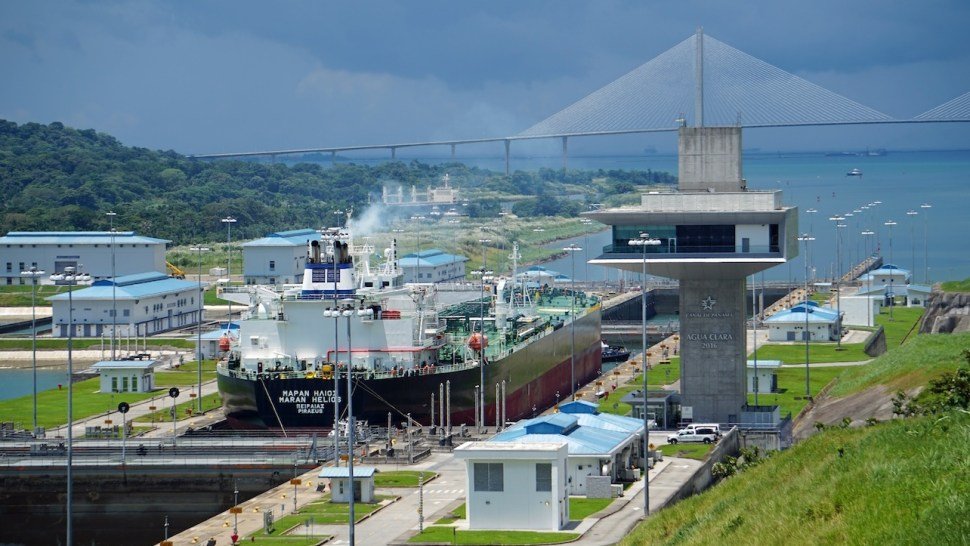
The Panama Canal Authority is easing some of the operating restrictions imposed during the prolonged water shortage, announcing that it will increase the number of daily Neopanamax-lock transits to 10 beginning Oct. 15.
The move will bring total daily capacity across the canal’s Neopanamax and Panamax locks to 33 slots, as water conditions continue to improve.
The authority said the increase is based on current and projected water levels in Gatun Lake, following near-average rainfall across the canal watershed as well as water-conservation measures implemented at the locks.
At the same time, the authority has immediately restored the maximum authorized draft for Neopanamax vessels to 49 feet, allowing larger ships to load more cargo when transiting the canal.
The latest changes represent another step in the gradual relaxation of drought-related restrictions that have affected the canal’s operations. A prolonged shortage of water had reduced Gatun Lake, the canal’s principal reservoir and the source of water used to operate its locks.
The authority had previously reduced the number of vessels permitted to transit each day while also imposing restrictions on vessel draft. By mid-September, total daily capacity had fallen to as few as 32 ships.
More capacity for major U.S. ports
The changes have direct implications for ports that depend heavily on Panama Canal traffic, including New York-New Jersey, Norfolk, Savannah, Charleston, Miami, Houston and New Orleans.
Delays in canal transits can extend well beyond the waterway itself. Late vessel arrivals can lead to delayed berth appointments, disruptions to rail connections, chassis imbalances and less predictable workloads at terminals.
The restoration of the 49-foot draft limit also gives carriers additional cargo-carrying capacity.
According to one industry estimate, a 10,000-TEU containership can lose roughly 450 TEUs of carrying capacity for every foot of draft restriction. Restoring the additional draft therefore provides carriers with more flexibility to load vessels closer to their available capacity when navigating the canal.
Water deficit remains a concern
Despite the additional transit slots and the return to the deeper draft allowance, the Panama Canal Authority cautioned that the watershed remains in deficit.
The authority also emphasized that its transit reservation, or booking, system remains the only way to guarantee a crossing date.
Ships arriving without a reservation may still face indefinite delays, meaning that the increase in available capacity does not eliminate the need for carriers and shippers to secure transit slots in advance.