




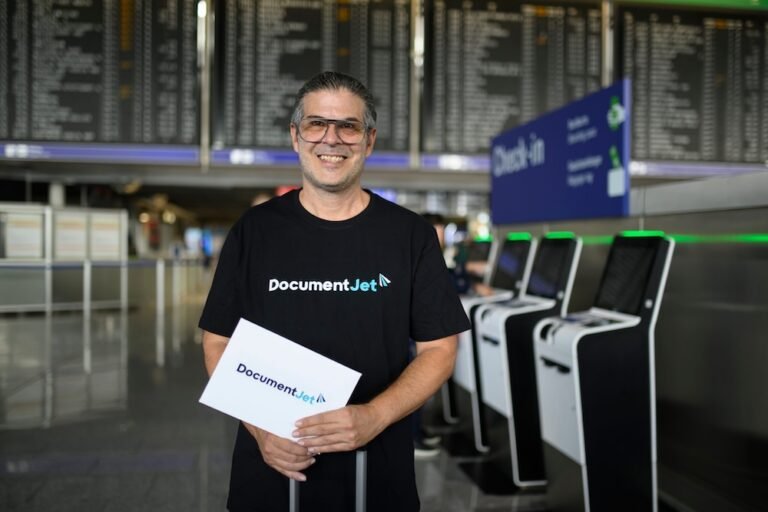
Time-critical logistics provider FLYTRIX has launched DocumentJet, an online booking service designed to give businesses and private customers direct access to international On-Board Courier (OBC) transportation for urgent documents.
The new service brings a traditionally specialist logistics solution to a wider customer base by removing the conventional quotation process associated with hand-carry shipments. Users enter their collection and delivery details online and receive a price and estimated delivery window within seconds. They can then confirm the shipment and pay by credit card.
At launch, DocumentJet supports pickups and deliveries across approximately 120 countries.
Behind the automated booking process, FLYTRIX handles the operational planning by assigning an available courier, identifying suitable scheduled passenger flights and coordinating the first- and last-mile transportation.
The transport itself remains deliberately personal. A dedicated courier accompanies the document throughout its journey, travelling as a passenger on scheduled flights from the point of origin to the destination.
A document-only service designed to simplify customs
DocumentJet is specifically restricted to documents with no commercial customs value. Eligible shipments include contracts, passports, court documents and civil-status records.
FLYTRIX founder Adrian Kaesberg said the service was intentionally designed around a narrowly defined shipment category that could be booked online with minimal complexity.
Shipments containing commercial goods or requiring more complicated customs procedures will continue to be handled individually through FLYTRIX’s established channels.
The concept was partly inspired by an emergency situation previously handled by the company.
Kaesberg recalled receiving a call from a woman in the United States whose mother had become stranded at Zurich Airport after inadvertently travelling with an expired passport. FLYTRIX was able to send a courier carrying the correct passport within approximately an hour.
The case highlighted the limitations of conventional courier networks when a document has to move immediately and with a high degree of certainty.
Designed for customers without logistics expertise
FLYTRIX has also focused on making DocumentJet accessible to people who have no professional background in freight or logistics.
The company deliberately avoided designing the service like traditional freight-forwarding software, according to Kaesberg. The platform does not require complicated logistics terminology or lengthy account-registration procedures.
The objective is to make the booking experience as familiar as booking a flight or hotel online.
Customers do not need an account to place a DocumentJet booking. The platform is available in English, German, Spanish, French and Italian.
Depending on the available routing and flight schedules, most shipments are expected to reach their destination either on the same day or the following day.
Automated technology evaluates around 40 operational parameters
A central component of DocumentJet is FLYTRIX’s automated pricing and feasibility engine.
The platform combines scheduled flight information, current courier availability and an operational data matrix developed from experience gained through thousands of FLYTRIX shipments.
This information is processed to determine both the price and estimated transit time within seconds.
For time-critical shipments, however, FLYTRIX says pricing cannot simply be calculated by taking the cost of an airline ticket and adding a margin. Numerous operational factors must work together, including airport accessibility, connection times, immigration requirements and the availability of an appropriate courier.
DocumentJet runs on ticris, FLYTRIX’s technology platform for digitising and automating workflows associated with time-critical logistics.
Its integrated decision-support system assesses approximately 40 operational parameters when planning a shipment. According to FLYTRIX’s internal evaluations, the technology has reduced error rates across sales, fulfilment and operations by more than 90%.
The company plans to make ticris available to other time-critical logistics providers as a Software-as-a-Service platform from 2028.
For FLYTRIX, DocumentJet is also a way of demonstrating externally how far complex urgent-logistics processes can be automated, while retaining the human element required for the physical movement of the shipment.
The company’s longer-term ambition is to make the technology available to other logistics businesses and help make urgent transportation faster, more reliable and more economical.
A specialist solution rather than an express replacement
FLYTRIX does not position DocumentJet as a direct replacement for conventional express parcel networks.
Kaesberg described the service as one that will remain focused on exceptional situations where speed and predictability are more important than price.
International DocumentJet shipments generally cost between US$2,500 and US$6,000, although the final price can vary considerably according to distance, flight availability and routing.
For shipments that can afford to arrive a day or two later, Kaesberg acknowledged that a traditional express carrier will generally remain the more practical and significantly cheaper choice.
DocumentJet is instead aimed at situations where conventional express options are no longer sufficiently fast or predictable.
By combining online booking, automated planning and a dedicated courier travelling with the document, FLYTRIX is seeking to bring a highly specialised OBC model into a simpler digital booking environment while preserving the speed and operational control that define time-critical transport.