



HANNOVER, Germany – Coretura is betting that the next generation of commercial vehicles will need a fundamentally different electronic architecture if trucks are to keep gaining capabilities after they leave the factory.
A heavy truck currently carries between 100 and 150 small computers. Keeping all of those systems synchronized and updated with the latest software once the vehicle has left the assembly line is a significant challenge. Coretura, the 50-50 joint venture formed by Daimler Truck and Volvo Group, was created in part to address that problem, according to CEO Johan Lundén.
The Gothenburg, Sweden-based company describes its role as “essentially an enabler.” It is developing standardized software for high-performance computers, including what can be viewed as a truck operating system, the application programming interfaces on which manufacturers can build their own software and the toolchain used by their developers.
Lundén discussed the company’s approach with reporters at IAA Transportation.
One of the weaknesses of the current architecture is connectivity. Not every small computer in a truck has its own connection, meaning an over-the-air update can have to travel through several electronic units before reaching the system that needs it.
That complexity can also produce unexpected consequences.
“You can change something you hadn’t intended to. Say you’re updating the infotainment system, and suddenly the vehicle won’t start,” Lundén said.
Coretura wants to reduce that risk by moving more computing activity onto two central high-performance computers. The first would handle advanced driver-assistance and safety functions, which represent the largest computing workload. The second would manage infotainment. Vehicle-control functions could be assigned to whichever computer is appropriate because they require less computing capacity.
Lundén stressed that this division is Coretura’s current proposal and is not yet a fixed industry standard.
The proposed architecture could nevertheless substantially simplify software management. Instead of potentially having to update 150 computers, manufacturers might have roughly 40 systems to manage, according to Lundén, requiring considerably less orchestration.
Coretura’s position in the truck’s software stack
Coretura is focused on the operating-system layer of the vehicle. Everything above that level, including transportation management systems and features developed specifically by individual truckmakers, would remain under the responsibility of the manufacturers or third-party software suppliers.
The company recently selected a Vector-QNX software platform as the foundation for its high-performance computers.
“In simplistic terms: the operating system on your computer, but for the truck — that’s us — and then of course the layers above,” Lundén said.
He is more cautious about another common description of software-defined commercial vehicles: the “iPhone on wheels.”
The comparison overlooks the consequences of software failures in a heavy truck, particularly when safety-critical functions are involved.
“When your phone freezes or an app won’t load, you get a bit annoyed, but life goes on,” he said. “In a truck, a failure in a safety-critical system is a different matter.”
Coretura’s platform is designed to isolate safety-critical systems from routine software updates. The company will also be responsible for cybersecurity covering the computers and connectivity unit it supplies.
Its starting point for automated driving is Level 2-plus. At a later stage, the autonomous-driving organizations of Daimler Truck and Volvo Group would be able to add computing capacity and a virtual driver on top of the platform as they move toward Level 4 automation.
Moving from trucks that age to vehicles that can improve
The broader objective is to change what happens to a truck after it leaves the production line.
According to Lundén, today’s vehicles can effectively begin to deteriorate from a software perspective once they leave the factory because updates are generally focused on maintenance requirements.
A software-defined truck could follow the opposite trajectory, with new software potentially improving its performance throughout its life.
“In a software-defined world, you could say it’s at its worst when it rolls off the production line, and then every software update, every addition will just improve the performance of the vehicle, or could improve the performance of the vehicle,” he said.
Software still cannot change the physical configuration of a vehicle.
“If you bought a 4×2 tractor, there’s no software in the world that’s going to make it a 6×2 or a 6×4,” Lundén said.
Battery-electric trucks may have greater potential for software-based optimization. Lundén said battery use can be tuned for a particular application with relatively little certification involved. By contrast, modifying a diesel engine’s injection system can require new emissions certification.
For drivers, whether a truck is technically classified as software-defined may not matter much. The practical benefits are more important.
Those could include over-the-air updates scheduled so they do not interfere with vehicle uptime, as well as new functions introduced after delivery. Driver-assistance systems, for example, could be updated to improve safety, while other software changes could enhance vehicle quality and efficiency.
The joint venture wants to serve the wider commercial vehicle market
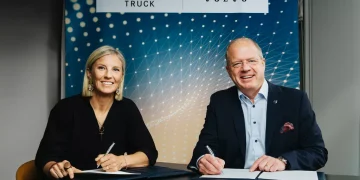
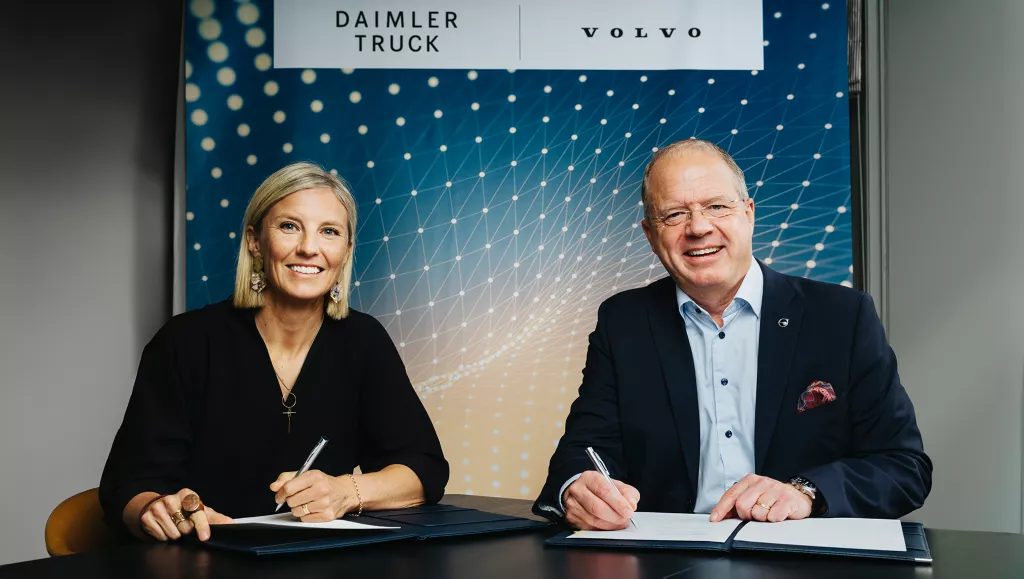
Daimler Truck and Volvo Group are Coretura’s first customers, but the company intends to take its platform beyond its two founders.
Lundén said Coretura is “here to sell to any and all commercial vehicle players” seeking an operating system and a base software platform.
The combined presence of Daimler Truck and Volvo Group gives the venture substantial coverage of the commercial vehicle market. Lundén said this puts Coretura “very close to a standard.”
Adoption by other truck manufacturers will nevertheless require a significant commitment. Replacing the core electronic architecture of a vehicle and relying on an external company for that foundation is a major decision.
“Taking the leap of faith and saying, yeah, we’re going to replace the core of our vehicle’s electronics and rely on you is a pretty big step for many,” Lundén said.
Several truckmakers have already expressed interest, he added, although Coretura still has considerable ground to cover before the technology becomes broadly adopted.
Coretura is scaling toward the end of the decade
The company’s expansion is also continuing. Coretura began with about 50 employees in June 2025. Lundén said the workforce is now approaching 170 people, all based in Gothenburg.
The company expects to reach between 400 and 450 employees by the end of the decade.
Coretura develops its technology entirely as code stored in a repository, a model that allows it to automate a large part of the development and testing process.
A toolchain for developing applications in Linux and Android environments is already operational.
Lundén also pointed to comments from Daimler Truck CEO Karin Rådström at the show. She said Daimler would have its first vehicle running Coretura software toward the end of the year.
Autocar Professional reported that this vehicle will be a demonstration vehicle.
That milestone will still be some distance from full production deployment. Coretura must pass through multiple stages of software maturity, particularly as the technology moves from development environments toward production-like and ultimately production-hardened systems.
The company expects those crucial stages to come closer to the end of the decade.
“There’s a lot of maturity steps where the really important ones are when you get into production-like and production-hardened software, which will be closer to the end of the decade,” Lundén said.