



Optimism remains alive within the shipping industry over the prospects of the International Maritime Organization’s (IMO) Net Zero Framework (NZF), but political uncertainty continues to raise questions about whether the long-awaited agreement will ultimately be adopted.
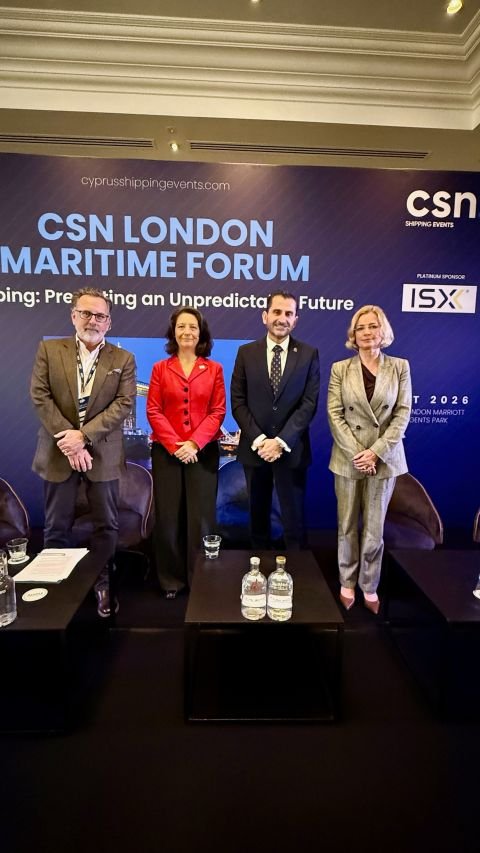
At a shipping conference in London organised by Cyprus Shipping News, senior industry representatives expressed confidence that the United States remains engaged with the regulatory framework being developed by the IMO, the global maritime regulator. Their assessment suggests that, although the technical discussions have largely progressed, the final outcome will depend on political decisions.
Speaking on the sidelines of the conference, one senior industry figure indicated that the technical questions had effectively been resolved, leaving politicians to determine the next steps. The warning points to the risk that political opposition, including US President Donald Trump’s rejection of the climate challenge, could still undermine the NZF process.
Industry leaders point to continued US engagement
Thomas Kazakos, secretary general of the International Chamber of Shipping, joined Dorota Lost-Sieminska, the IMO’s director of legal affairs, and the president of the UK Chamber of Shipping in a panel discussion on the framework’s prospects.
Responding to questions about Washington’s position, Kazakos argued that the US administration’s actions demonstrate a degree of continued engagement with the IMO, despite its reservations.
He noted that the administration had the opportunity to derail the NZF process but had not done so. Its active participation, including financial involvement, was, in his view, an indication that the United States remained engaged with the organisation.
Kazakos also referred to the latest US positions on submissions presented to the IMO, which he understood were still under consideration. He described the outlook as offering a degree of conservative but genuine optimism.
Lost-Sieminska offered a more qualified assessment of the American position. She acknowledged that the United States had consistently opposed the Net Zero Fund, but argued that Trump had been more outspoken about that opposition than previous administrations or representatives might have been.
She nevertheless stressed that the broader technical measure remained under discussion and said she strongly hoped a compromise could be reached at the IMO’s November meeting.
A distinction between the Net Zero Fund and the wider framework
The debate highlighted an important distinction between opposition to the proposed Net Zero Fund and participation in the IMO’s wider regulatory programme.
Lost-Sieminska pointed to several IMO initiatives covering maritime safety and operational efficiency that have received full US backing. She also highlighted a US donation of $5.4 million to support the organisation’s security initiatives, describing the contribution as generous.
For the IMO, these areas of cooperation provide evidence that disagreements over decarbonisation financing have not necessarily translated into a broader withdrawal of American support for international maritime regulation.
Following the extraordinary session held in October last year, during which discussions on decarbonisation were delayed, the United States returned in November with renewed support for the IMO’s work. That support extended to safety and security, including maritime security, as well as seafarers’ welfare and training.
Lost-Sieminska reiterated that, although Washington had never supported the Net Zero Fund, the country remained fully engaged with the regulatory framework the IMO was developing.
IMO postponement seen as an opportunity for compromise
Karrie Trauth, president of the UK Chamber of Shipping and executive vice-president of Shell Shipping and Maritime, defended the IMO’s decision to postpone the vote during the extraordinary session of the Marine Environment Protection Committee (MEPC) in October last year.
She described the postponement as a “stroke of genius”, arguing that the additional time allowed discussions to continue through the spring, summer and autumn, giving stakeholders more opportunities to find common ground.
Trauth said the extended negotiating period had created an opportunity to establish a workable agreement on maritime decarbonisation, even if the final outcome required compromise. She added that the process could follow a path similar to other IMO regulations, where negotiations have helped bring different positions together.
For the UK shipping industry, however, the stakes remain high. Trauth said failure to adopt the Net Zero Framework at the beginning of December, during the follow-up to last year’s extraordinary session, would be disappointing.
Nevertheless, she cautioned against interpreting another delay or an unsuccessful vote as a defeat for the global regulator. The IMO’s authority, she argued, continues to rest on the wider body of work it has delivered across international shipping regulation.
Political decisions remain the decisive factor
Despite the positive signals from industry representatives, the future of the NZF remains uncertain. Support for the IMO’s wider regulatory activities does not necessarily translate into agreement on the financing mechanisms and decarbonisation measures at the heart of the framework.
The discussions in London reflected both sides of that equation: industry leaders see continued American participation as a reason for cautious optimism, while acknowledging that opposition to the Net Zero Fund remains unresolved.
With negotiations continuing ahead of the expected decision in early December, the challenge will be to turn that broader cooperation into a compromise acceptable to the parties involved.
For shipping companies and the wider maritime sector, the outcome will determine whether the IMO can move forward with its proposed global decarbonisation framework or whether political divisions will prolong uncertainty over the industry’s regulatory direction.