



Volvo Trucks is counting on a stronger presence in vocational vehicles to achieve its ambition of capturing 15% of the North American heavy-duty truck market. The strategy marks a significant push into construction and other specialized applications, where the manufacturer currently holds only an estimated 2% to 3% share.
Peter Voorhoeve, president of Volvo Trucks North America, outlined the approach during a keynote address at Volvo Construction Equipment’s Customer Center in Shippensburg, Pennsylvania. The company’s plans build on a broader investment program that has already introduced new long-haul and regional-haul models and now extends to vocational operations.
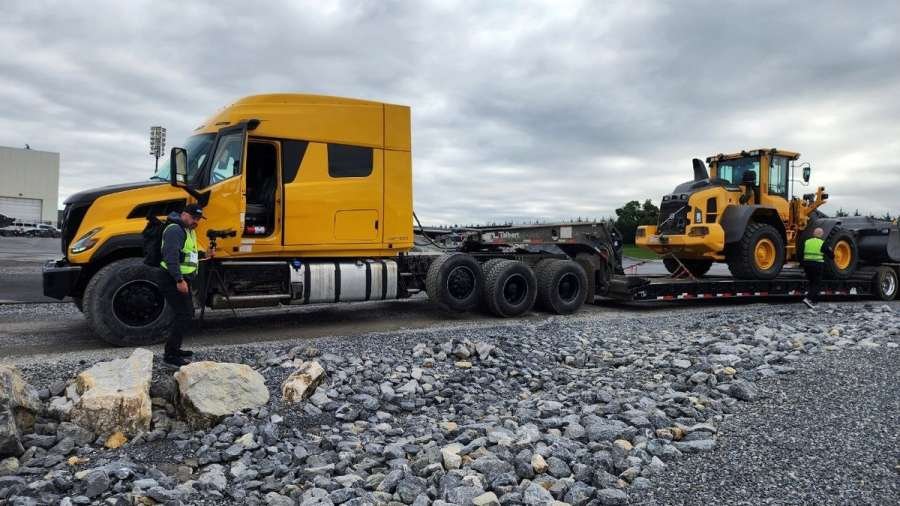
Although vocational trucks represent approximately 25% to 30% of North American heavy-duty truck sales, Volvo has historically concentrated on other segments. The company aims to close that gap with the VNX, unveiled on Wednesday, which completes a three-model lineup built around a shared North American vehicle platform.
A common platform for three truck segments
The VNX joins the VNL, designed for long-haul operations, and the VNR, developed for regional transportation. All three trucks share a chassis and electrical architecture, while retaining individual cab designs tailored to their respective applications, Voorhoeve explained in an interview with FreightWaves.
The platform forms part of Volvo’s largest North American product investment program, which includes more than $2 billion in new products. The company previously reported the investment in March, putting the total commitment at $3 billion when manufacturing investments are included.
For Volvo, developing a common platform across the three segments is essential to making the investment pay off.
“When we then decided to put in a two-billion-dollar investment program platform, of course we need the whole market,” Voorhoeve said. “So let’s make now a platform where we can do the long haul, the regional haul, and the vocational.”
The strategy reflects a market in which vocational applications account for a substantial and relatively stable share of demand. Volvo has already established a stronger position in this category outside North America: its cab-over FMX captures approximately 30% of the vocational truck market in both Europe and Brazil, according to Voorhoeve.
The FMX is part of Volvo’s global vocational portfolio, alongside the long-haul FH and regional FM models used in cab-over markets. In North America, the VNX now takes on the equivalent role alongside the VNL and VNR.
“Twenty-five percent, or anyway between twenty-five and thirty percent, is vocational—construction—which is a fairly stable segment,” Voorhoeve told FreightWaves. He explained that Volvo had developed products for long-haul transportation, which accounts for roughly half the market, and regional operations, representing about a quarter, while maintaining a limited presence in vocational applications.
Why North America required a different truck design
Volvo’s historical product strategy also reflects differences in truck regulations and operating conditions between Europe and North America.
In Europe, regulations limit the overall length of the tractor-trailer combination. Manufacturers have therefore adopted cab-over-engine configurations, placing the driver above the engine to maximize the space available for freight.
North American rules work differently. Although trailer length is regulated, the overall length of tractor-semitrailer combinations operating on the National Network is not subject to state-imposed limits of the same kind. Federal law restricts states from setting overall length limits on these combinations along the designated network of truck routes.
That regulatory framework allows manufacturers to build longer tractors, including conventional trucks with the engine positioned in front of the cab.
“Here in the US, the trailer length is regulated, but the combination length is not regulated,” Voorhoeve said. “So you can make a much longer tractor.”
Longer operating distances also influence truck design. Voorhoeve cited a mail transportation operator running Volvo trucks daily between Miami and Los Angeles, a journey that takes approximately two and a half to three days and includes desert driving.
“That’s two and a half, three days, and they do the desert,” he said. “So you need to be able to live in your truck.”
Volvo’s North American history began with its acquisition of the White truck factory. The company continued producing White trucks under the Volvo brand for 10 years before introducing the VNL in 1996. Voorhoeve described that model as the first truck in the North American market to feature an integrated sleeper.
The VHD followed in 2000 as Volvo’s construction-oriented truck. While he characterized it as a strong product, Voorhoeve said its applications remained relatively limited.
The new VNX is intended to broaden Volvo’s reach across the vocational market with a wider range of available applications.
Infrastructure spending and data centers support demand
Recent demand trends have provided Volvo with additional reasons to expand its vocational offering.
According to Voorhoeve, vocational truck demand has performed somewhat better than the wider market in recent years. He attributed part of that resilience to the bipartisan infrastructure law and its funding for bridges, airports and highways.
Construction activity associated with data centers could provide further support. Although demand initially moved closer to normal levels after a period of strength, Voorhoeve expects the expansion of data center infrastructure to sustain activity.
“Then we saw it coming back to normal a little bit, but of course now, with the whole data center boom, we will see a continuation of strength in that segment,” he said.
He stopped short of predicting an extraordinary surge in demand, but expects the sector to remain strong.
“Will it explode? That I don’t really believe, but I think it will remain a very strong segment.”
Volvo is targeting the VNX at several customer groups, including agriculture, municipalities, concrete producers, construction companies and operators involved in roll-on/roll-off work.
Nevertheless, the broader North American truck market remains difficult to forecast. Voorhoeve described a market that can fluctuate between 220,000 and 300,000 trucks annually before moving back in the opposite direction. Such swings create challenges for manufacturers trying to determine production levels and maintain appropriate factory staffing.
Volvo Construction Equipment offers a commercial advantage
Volvo’s vocational expansion also benefits from its relationship with Volvo Construction Equipment (Volvo CE). The two businesses serve overlapping customers, particularly at construction sites where trucks transport materials to and from excavation areas.
Voorhoeve believes that this connection gives the group an opportunity to strengthen its commercial position by offering customers a more integrated portfolio.
“If you have a Volvo Construction Equipment loader, why wouldn’t you look at the Volvo trucks VNX?” he said.
The businesses share a back office, which Voorhoeve said can simplify commercial relationships. Their financing capabilities also allow a wheel loader and a truck to be included in the same contract.
In addition, Volvo Group’s US parts warehouses stock components for both construction equipment and trucks. Both businesses also benefit from engine technology supplied through the group’s global powertrain division.
The relationship influenced the development of the VNX itself. During his keynote, Voorhoeve said Volvo combined its international vocational truck experience with Volvo CE’s knowledge of construction-site operations, including the way wheel loaders and trucks interact.
However, customers do not all operate the same type of business. Some specialize in heavy hauling, transporting machinery or even moving houses, while others run integrated operations involving both construction equipment and trucks.
“Some operators have both the yellow machines and the trucks, and some don’t,” Voorhoeve said. “But we have now the opportunity at least to combine there where necessary if the customer asks for that.”
The objective is therefore not to impose a combined equipment-and-truck package on every customer, but to offer an integrated solution where it meets operational needs.
The challenge of reaching 15% market share
Volvo Group established its North American market-share ambition at its Capital Markets Day in November 2024, held at the Volvo Trucks Customer Center in Dublin, Virginia.
The target comes as the company works to rebuild its position in a competitive market. According to Volvo Group’s fourth-quarter 2025 report, Volvo Trucks held an 8.4% share of the North American heavy-duty truck market in 2025, compared with 9% in 2024.
Voorhoeve declined to forecast Volvo’s vocational market share for the coming year. Instead, he reiterated the company’s broader ambition to reach 15% across the combined long-haul, regional-haul and vocational segments.
“Let’s see where we end up,” he said. He added that Volvo remains “fairly firm that we believe that with Volvo Trucks we should be able to get to fifteen percent market share, and that combines long haul, regional haul, and vocational.”
The VNX is therefore a central component of the strategy: Volvo must expand its presence in vocational applications while maintaining its position in the other two segments.
Asked whether autonomous trucks could eventually be introduced onto construction sites, Voorhoeve declined to speculate about future developments.
“First of all, our main focus is now to continue in the vocational segment and to strengthen our position with a range that has far more applications available,” he said.
For now, Volvo’s priority is to establish the VNX across a broader range of vocational operations and use the expanded lineup to move closer to its 15% market-share goal.










Comments 1