



A new platform for a segment Volvo wants to conquer
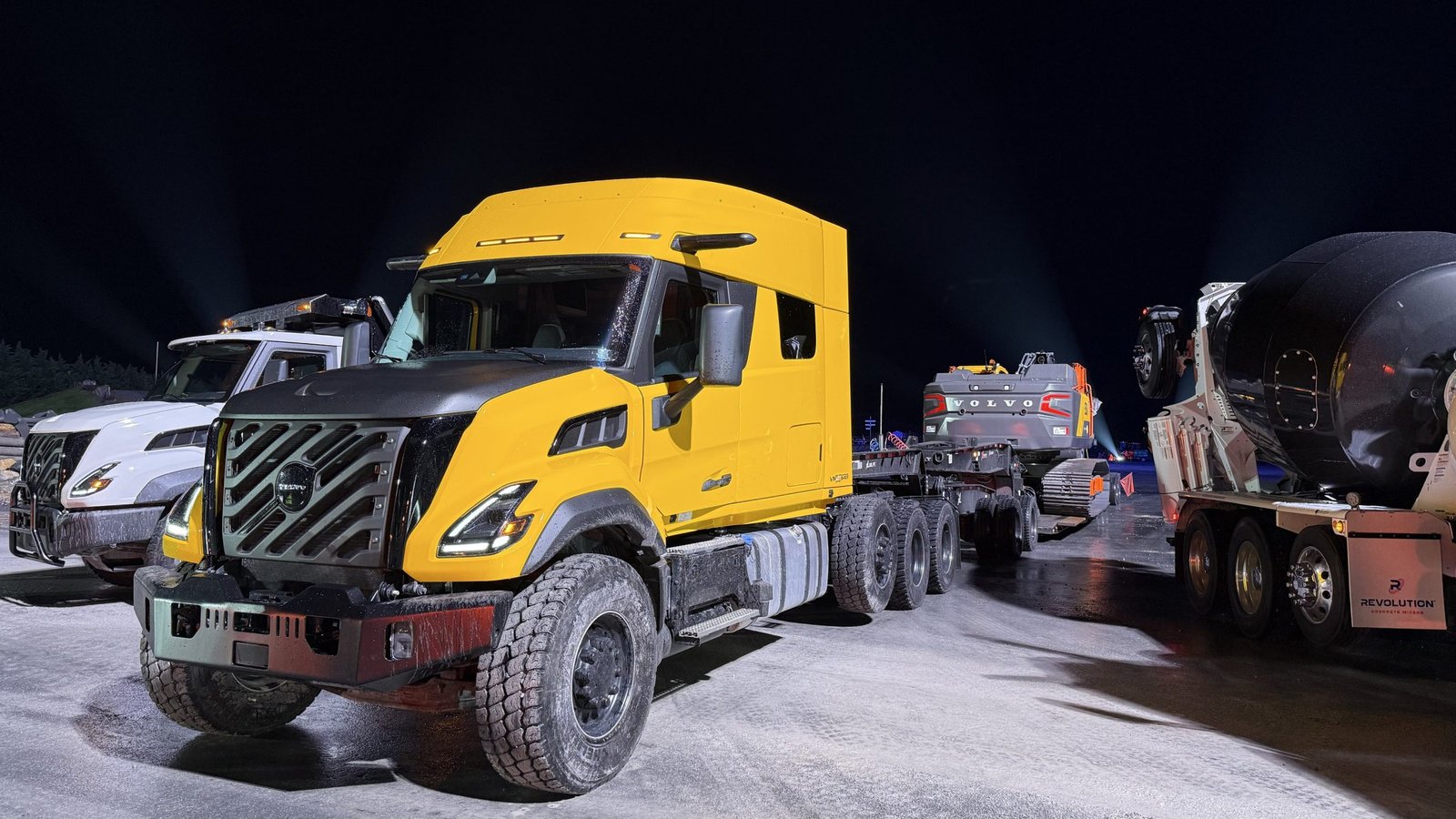
SHIPPENSBURG, Pa. — Volvo Trucks North America is stepping up its ambitions in the vocational truck market with the launch of the all-new VNX, a model designed for demanding worksite operations and heavy-haul applications.
The announcement marks another step in the manufacturer’s product renewal strategy. The VNX is Volvo’s third entirely new North American truck in less than three years, following the introduction of the long-haul VNL in 2024 and the regional-haul VNR in 2025.
Despite its established presence in other truck segments, Volvo remains a relatively small player in North American vocational vehicles. Peter Voorhoeve, president of Volvo Trucks North America, estimates the company’s share of this market at just 2% to 3%.
Speaking at a preview event held at Volvo Construction Equipment’s Customer Center, Voorhoeve highlighted the commercial opportunity. Vocational trucks account for approximately 25% of the North American truck market, while long-haul vehicles represent 50% and regional-haul trucks make up the remaining 25%.
“We don’t really play in that vocational segment. We have like a two or three percent market share,” Voorhoeve said. He questioned why Volvo should remain underrepresented in one of the world’s largest markets, outside China, when vocational trucks already play a substantial role in the company’s international business.
The manufacturer’s position is considerably stronger elsewhere. Volvo’s FMX accounts for approximately 30% of the vocational truck market in both Europe and Brazil, according to Voorhoeve.
In North America, the company has offered the VHD since 2000. Although the model has developed a loyal customer base, its range of applications has remained limited, prompting Volvo to pursue a broader offering.
The VNX was developed using feedback from VHD customers, experience gained through Volvo’s vocational truck operations in international markets, and the practical knowledge of Volvo Construction Equipment. The latter has been building and selling machinery in the United States for more than 50 years.
“Growth in vocational is a natural next step for Volvo Trucks, right as we’re seeing stable demand for trucks on construction sites, infrastructure projects and industrial builds across the country,” Voorhoeve said in a statement.
The VNX also shares its electrical architecture with the VNL and VNR. Volvo said the development of these new truck platforms forms part of a $3 billion investment in product development and manufacturing.
Remote control and improved handling on difficult terrain
The VNX introduces technologies designed to simplify demanding job-site maneuvers, particularly where space is restricted or ground conditions make precise vehicle positioning difficult.
One of the key additions is Remote Steer, which allows an operator to control the truck from outside the cab at speeds of up to 5 mph. The system is intended for applications involving concrete mixers, cranes, vacuum units and other equipment that requires accurate positioning.
John Moore, product marketing manager at Volvo Trucks North America, described the technology as effectively turning the vehicle into a large remote-controlled truck.
He explained that concrete mixer drivers often need another person to guide them when reversing close to buildings or positioning their vehicles near concrete-pouring operations. Remote Steer can eliminate the need for that additional guide by allowing one operator to maneuver the mixer independently.
Another feature, Terrain Brake, is designed to keep the truck stationary on steep or rocky ground when the driver releases the accelerator. It prevents unwanted forward or backward movement by holding the vehicle in place before the driver could react by applying the service brakes.
Volvo has also introduced a direction-change function that allows drivers to switch between forward and reverse without pressing the brake pedal. According to Moore, this feature is particularly relevant to dump truck operators who repeatedly move back and forth throughout the working day.
Multiple configurations and a 540-hp powertrain
Volvo is offering the VNX in several configurations to accommodate different vocational and heavy-haul requirements.
The lineup includes the 300, equipped with a day cab, and the 440, which comes with a 42-inch sleeper. Both models are available as tractors or straight trucks. A 640 tractor configuration, featuring a 62-inch midroof sleeper, completes the initial range.
Every model can be ordered with either an axle-forward or axle-back configuration. The truck’s heat-treated steel frame rails are rated for a gross vehicle weight of up to 160,000 pounds.
Power comes from Volvo’s D13 engine, which delivers up to 540 horsepower and 1,950 pound-feet of torque. The engine is certified to meet EPA 2027 emissions standards across all 50 U.S. states.
Moore said the power rating places the VNX within 60 horsepower of the 600-hp big-block engines at the top of its class.
The 2027 D13 also features a substantially upgraded engine brake. Its braking power rises to 630 horsepower, compared with 500 horsepower previously, exceeding the engine’s maximum rated output of 540 horsepower.
“Typically engines rate their engine brake the same as their horsepower. This one is different—we have extra braking,” Moore said.
The additional braking capability is particularly valuable on steep downhill stretches, where excessive reliance on conventional service brakes can cause overheating.
Transmission performance has also been improved. The new I-Shift shifts 30% faster, according to Moore, and is available in 13-speed and 14-speed versions. Both configurations include crawler gears to support low-speed operation and demanding worksite maneuvers.
Enhanced safety systems and factory-installed connectivity
Volvo has incorporated a series of safety technologies into the VNX as part of its effort to improve protection for drivers and people working around the vehicle.
Standard forward pedestrian detection monitors an area extending from 23 to 230 feet ahead of the truck. The system is complemented by blind-spot detection on both sides and a 360-degree camera that provides a comprehensive view around the vehicle.
The cab also contains one-third more ultra-high-strength steel than Volvo’s previous-generation vocational trucks, strengthening its structural design.
Volvo further stated that the VNX is the only vocational truck in North America from an original equipment manufacturer (OEM) to offer driver-side curtain airbags as standard equipment.
Connectivity is another component of the new model. Every VNX comes equipped from the factory with a 4G telematics gateway, enabling remote diagnostics and over-the-air software programming.
These capabilities allow operators and service teams to access vehicle information remotely and update software without always requiring a physical intervention at the truck.
Volvo Trucks North America said it will announce the start of sales later this year. With the VNX, the manufacturer is targeting a broader range of construction, infrastructure and industrial applications as it seeks to translate its international vocational truck experience into stronger market share in North America.