



A.P. Moller-Maersk is looking into the potential for nuclear propulsion for commercial container shipping, and is involved in industry studies trying to determine what would be needed for nuclear-powered ships to make regular visits to major ports. The focus is on regulations, safety, security and port operations, not on any immediate commitment to order or deploy nuclear-powered ships.
The Danish carrier, the world’s second-largest container shipping company by capacity, is investigating whether nuclear power could be a viable long-term option for reducing emissions from the maritime transport sector. In 2024, Maersk joined forces with Lloyd’s Register and reactor developer Core Power to investigate whether it would be possible under existing regulations to operate a containership powered by a fourth-generation nuclear reactor at a European port.
In the first study, researchers looked at a feeder vessel, a smaller container ship that links regional ports with large hub terminals. This gave the participants a chance to think about practical issues of integrating nuclear propulsion into their existing maritime operations.
Rotterdam study sheds light on regulatory challenges
The following case study analyzed the Port of Rotterdam, and assessed the possible port calls of a fictitious Maersk feeder vessel with a capacity of 3,600 TEUs.
The results showed that the main problems were not only technical. Instead, the participants identified regulatory and governance issues as the most important barriers to the commercial introduction of nuclear-powered container ships.
These include the establishment of nuclear-specific port safety procedures, emergency preparedness arrangements, physical security measures, liability frameworks and insurance requirements. Such vessels could not operate commercially until effective coordination between maritime authorities and nuclear regulators was established.
Maersk has emphasized that its participation in these studies should not be interpreted as a move to commission nuclear-powered ships into its fleet. Instead the company is studying nuclear propulsion as one possible long term route to zero emission shipping, while looking at the issues of safety, nuclear waste, legal liability and public acceptance.
Proposed: Transatlantic Nuclear Shipping Corridor
Since then the initiative has gone global. In September, Maersk and Lloyd’s Register announced a concept project for a potential nuclear-powered container shipping service across the Atlantic – the US-UK “Pink Corridor”.
The planned corridor would link the Port of Felixstowe, United Kingdom, with the Port of Charleston, South Carolina, U.S. The aim is to lay out the safeguards, security arrangements and regulatory conditions that would need to be in place before any such route could become operational.
The first phase of the project will comprise a number of areas for exploration, including vessel security, nuclear safeguards, cyber security resilience, emergency response, insurance and compatibility of maritime regulations with nuclear legislation.
The results could provide the basis for a second phase that examines engineering requirements, legal and legislative frameworks, and more detailed safeguards arrangements.
“This initiative provides an opportunity for the port hub to investigate the possibility of creating a nuclear-powered freight corridor,” said SC Ports, the state agency that manages South Carolina’s port system. Lloyd’s Register has said the project was a way of finding out the practical requirements and the gaps still to be filled before a commercial service could be contemplated.
US interest in nuclear-powered maritime transport is growing
The Charleston effort comes as the US government and maritime industry are ramping up the volume on the potential use of nuclear energy in commercial shipping and port infrastructure.
The US Department of Energy and classification society ABS have signed an agreement to study nuclear-powered vessels, floating nuclear power applications, and the infrastructure needed to support those technologies. The work includes ports, shipyards and other industrial facilities that might be required to support any future nuclear-powered maritime operations.
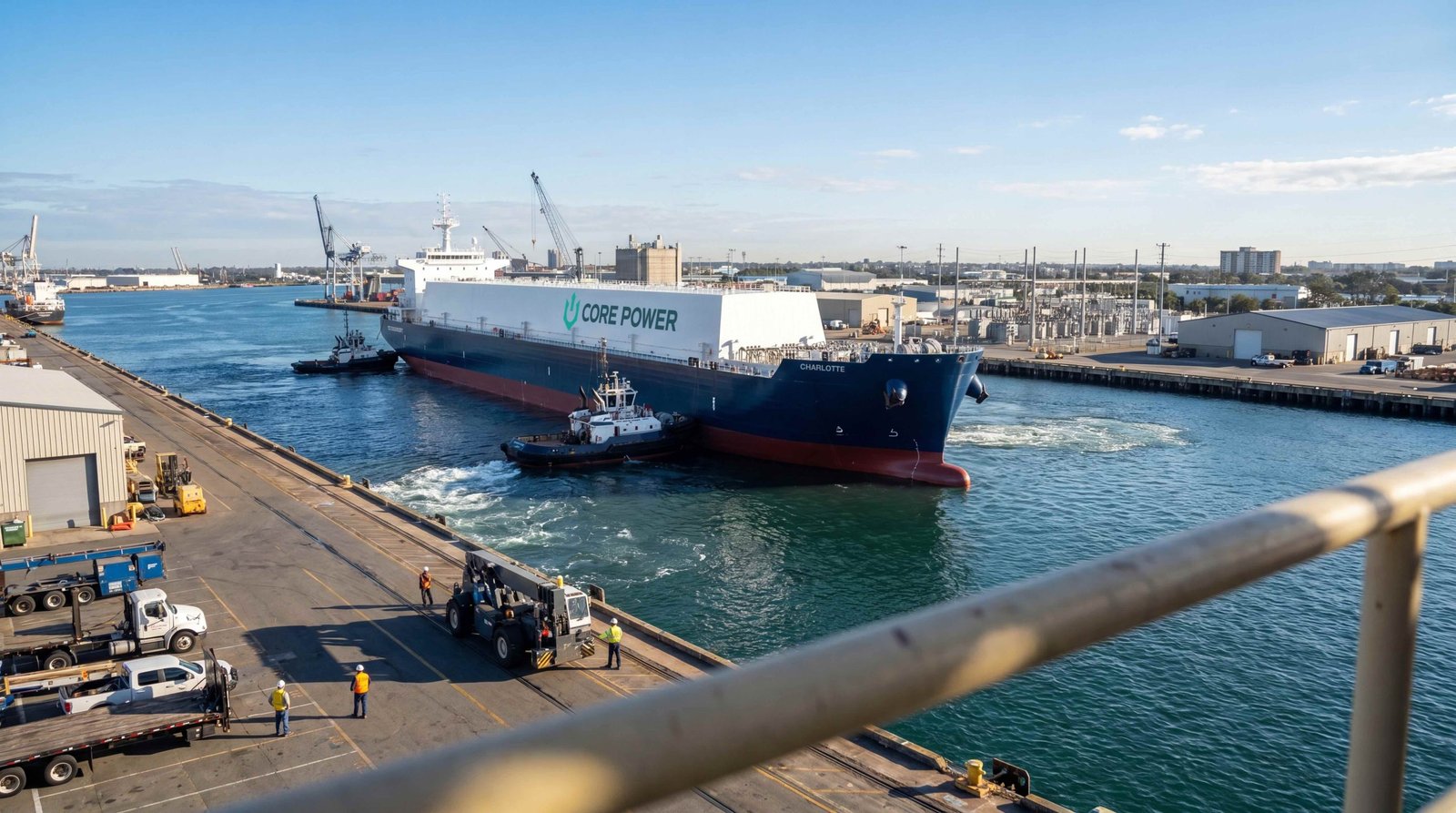
Meanwhile, the US Maritime Administration (MarAd) and Core Power have signed a cooperation agreement to develop maritime-nuclear frameworks for a potential US-flagged fleet.
The framework is intended to speed up the commercial, industrial and regulatory work needed to support the possible introduction of nuclear-powered merchant vessels, Core Power has said.
Long Beach advances standalone reactor plan
The Port of Long Beach is also looking into the potential of nuclear energy for commercial maritime operations. The port and MarAd recently inked a first-of-its-kind partnership to develop small modular reactors for commercial vessels, port activities and other maritime applications.
Bluecore Energy is working on a concept for a 10 MW floating reactor at the port as part of the broader effort. But the project is still a work in progress. There is no operational reactor today and no regulatory approval.
Taken together, these initiatives show a growing interest in nuclear power as a future option for decarbonizing maritime transport and supporting port operations. But there are significant regulatory, technical, safety and infrastructure hurdles to overcome before nuclear-powered commercial container shipping becomes a realistic prospect.
For Maersk, the proposed US-UK corridor is another step in testing those waters. At this stage the aim is not to put a nuclear-powered service in place but to find out what it would take to make one possible.