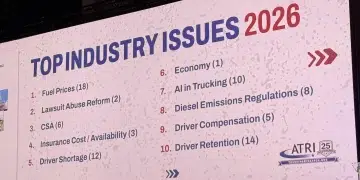




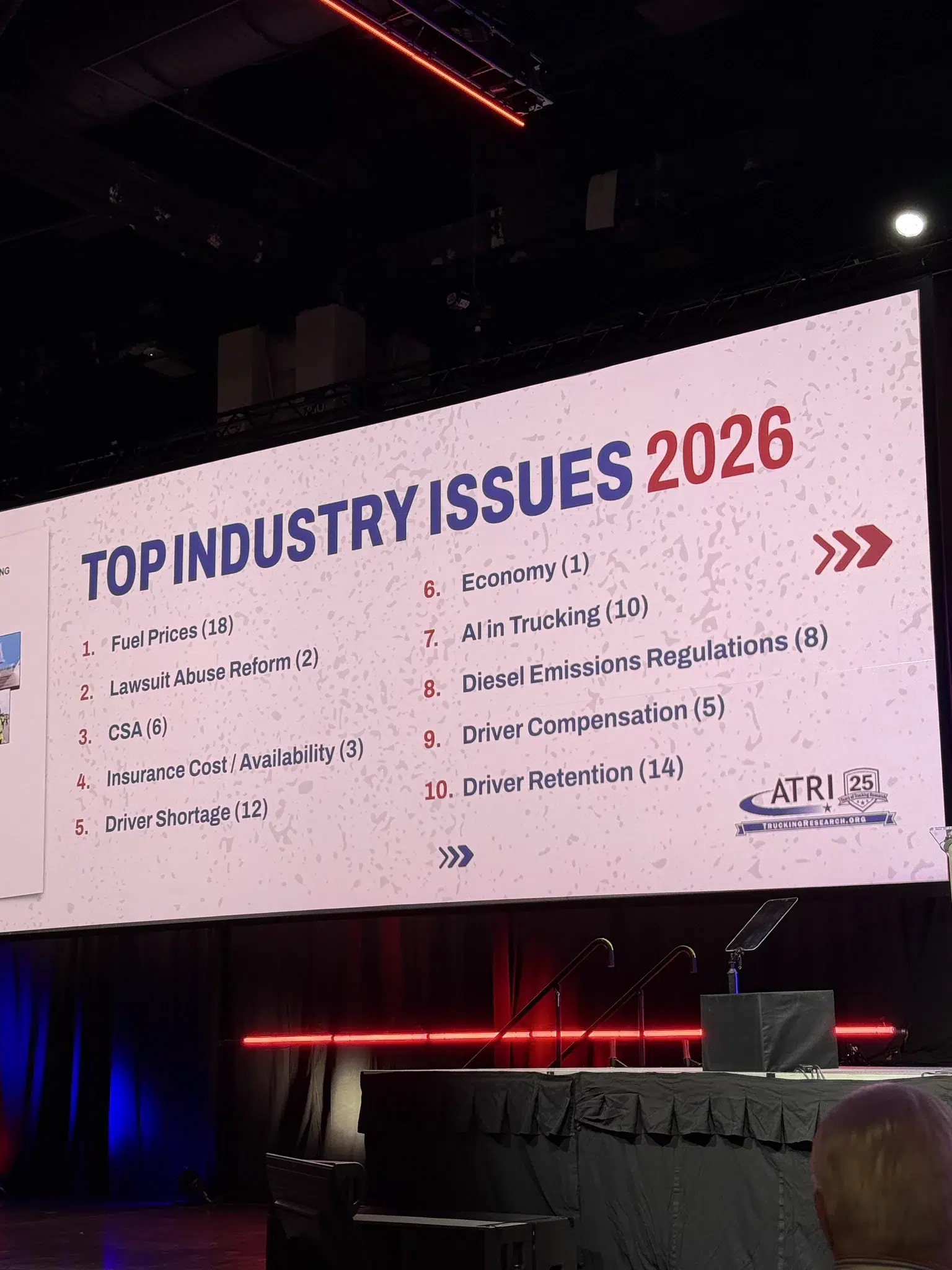
Fuel prices are on the trucking industry’s radar again, returning to the top 10 of the American Transportation Research Institute’s (ATRI) latest annual survey after not appearing in the top 10 in either of the last two years. The results underscore the growing pressure on the sector from rising diesel costs, as well as escalating concerns about legal exposures and regulatory compliance.
The survey results were released Sunday at the American Trucking Associations’ (ATA) annual Management Conference & Exhibition in Charlotte. Fuel prices were second among motor carriers and topped drivers’ concerns, taking the overall number-one spot.
The results also challenge the assumption that fuel surcharges can always pass along higher fuel costs to shippers with little impact on carriers. The surcharges are designed to offset price increases but the survey indicates that operators are still feeling the financial squeeze of pricier fuel.
ATRI, the research arm of the American Trucking Associations, pointed out that 2026 is only the fourth time in the 22-year history of its annual Top 10 survey that fuel prices have been the leading industry concern.
Diesel prices back in the spotlight
Fuel prices ranked last in ATRI’s rankings in 2023, as diesel prices hit new highs. That year it ranked third of all drivers and fifth of all carriers. It fell out of the top 10 in 2024 and 2025, before reclaiming the top of the overall ranking this year.
Historical price data shows the magnitude of the pressure. On October 24, 2022, the US Energy Information Administration (EIA) reported the highest weekly retail diesel price of $5.341 per gallon. Prices fell in 2023 but stayed over $4 a gallon until May, then rose back above $5 most of the time between August and November.
In 2026, the situation is worse. The highest weekly average so far this year was $6.529 per gallon on September 22, the highest figure in the EIA’s historical data series. The American Automobile Association (AAA) also reported a new daily average fuel-price record in September.
Those changes make diesel a hot topic, once again, for trucking firms, affecting operating costs and squeezing already thin margins.
Legal liability reshaping safety priorities and selection of carrier
Litigation risks are becoming more important to trucking operations beyond the fuel prices, the survey shows, especially after the US Supreme Court ruling in Montgomery v. Caribe Transport II.
The case seems to have served to underline a number of safety problems in the rankings. For example, motor carriers’ Compliance, Safety, Accountability (CSA) scores ranked fourth among carriers in 2025 and fifth in 2026, placing the issue third overall this year.
The move comes amid increasing concern among freight brokers about their potential liability if a crash involves a carrier they have contracted with. As a consequence of the post-Montgomery environment, brokers are now under greater pressure to show they conducted sufficient due diligence when choosing transportation providers.
The Lipe v. Lupus Superior case exemplifies the stakes, with a nuclear verdict against C.H. Robinson and a motor carrier with a Satisfactory rating from the Federal Motor Carrier Safety Administration (FMCSA).
FMCSA officials have said in the past that the agency’s CSA scores are not designed to be used as carrier ratings. But the ATRI survey shows the industry still sees those scores as potentially meaningful evidence in court proceedings.
CSX has been one of the top 10 trucking industry concerns in 16 of the 17 years since the system first appeared on the list in 2010, when it was ranked second overall, ATRI says. The institute said the Supreme Court ruling was largely responsible for the return to the number-three position this year, its best since 2015.

Survey participants called on the FMCSA to address enforcement disparities and geographical variations in its work. At the same time, the findings suggest that brokers and carriers increasingly believe safety records may play a decisive role in defending themselves against negligent-hiring allegations.
ATRI explained that brokers will need documented evidence showing they selected the safest available carriers to reduce their exposure to such claims. Carrier CSA scores are one potential source of supporting documentation.
Drivers, carriers spar over industry’s biggest challenges
Drivers and carriers do have a common concern in fuel prices, but they don’t agree on a lot of other things.
Drivers still say truck parking is a top issue, ranked second in their responses, even as the industry continues to try to increase parking options. But for carriers the issue didn’t even make the top 10.
For the second straight year, lawsuit abuse ranked second overall and was the top issue for carriers. Drivers didn’t list it as one of their top 10 concerns.
The driver shortage also highlighted a stark difference in opinion: carriers ranked it third, but drivers didn’t even list it as a top issue. Broker-related concerns placed eighth among drivers, but didn’t make the carriers’ top 10.
Similar results were found for delays and detention at customer facilities. The problem was seventh on the list of drivers, but didn’t make the top 10 for carriers.
Driver pay has also bounced around in the yearly rankings. It was ranked first, second, first and third among drivers, respectively, between 2023 and 2026. Compensation made the carriers’ top 10 this year at ninth place, its first appearance on that list in four years.
The differences highlight how the operating environment can be the same, yet pose different challenges for the drivers behind the wheel and the companies that run fleets.
ATRI points to ways to curb lawsuit abuse
“At the same time, ATRI asked respondents to name the biggest concerns of the industry and offer solutions. The leading suggestion for improving the lawsuit process was to pass state laws to cap the amount of noneconomic and/or punitive damages that can be awarded to plaintiffs in crashes involving trucks.
Another step would seek to rein in so-called phantom medical losses. They happen when claims are made on the original amount billed for medical treatment, not the amount that was actually paid. “Overblown medical costs can result in larger jury awards and bigger settlements,” ATRI said.
Laws to curb lawsuits over these disputed medical bills are already on the books in several states including Florida and Georgia.
Respondents also called for action on third-party litigation funding, in which an outside attorney or team of attorneys provides upfront financial support to fund a lawsuit. Another approach that ATRI identified as a possible way to combat lawsuit abuse is efforts to address this funding model.
More expensive insurance
The fourth overall concern for the industry was the cost and availability of insurance. Again the implications of the Montgomery ruling were mentioned by respondents.
The effects of the decision are only beginning to be felt, ATRI cautioned, but the group expects the impact will be higher insurance costs for motor carriers and freight brokers.
The institute’s top recommendation to alleviate this pressure was to develop a framework in which insurers could potentially reduce premiums when drivers and carriers used proven safety technologies.
The proposal links the money spent on safety improvements to the potential for savings on insurance costs, offering the industry a possible way to deal with rising costs and improve operational safety at the same time.
Overall, the survey results reflect an industry grappling with many interconnected challenges. Fuel prices are a top concern again, as are litigation exposure, insurance affordability and regulatory compliance. But drivers and carriers have different needs, so solutions will need to address the unique pressures each group feels.
But trucking businesses don’t just have to contend with the cost of diesel. It also means managing legal and insurance risks, improving safety practices and dealing with the operational challenges that continue to beset drivers and fleet operators.