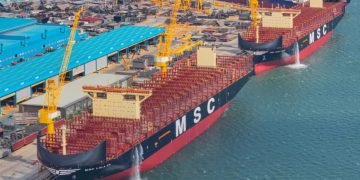




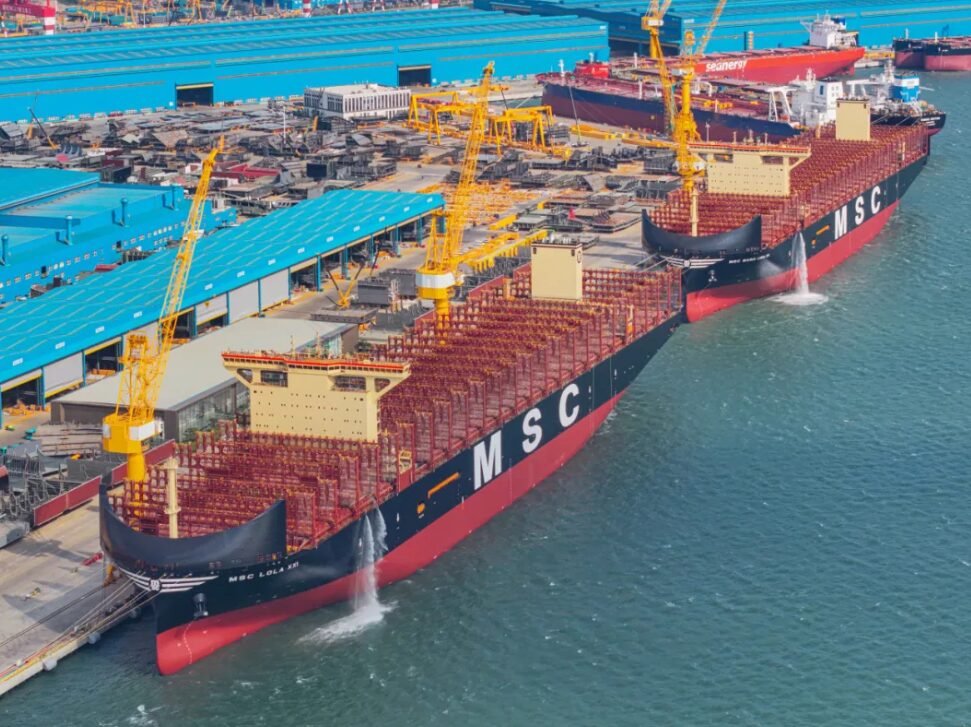
Hengli Heavy Industry has secured shipbuilding contracts with several of the world’s leading container shipping operators, bringing its orderbook to 52 ultra-large dual-fuel container vessels, according to an announcement from the Chinese shipbuilder.
The contracts cover three vessel sizes: 20 ships with a capacity of 19,000 teu, 12 vessels of 22,000 teu and another 20 units capable of carrying 24,000 teu. Among the latest agreements, MSC contracted Hengli Heavy Industry last week to build 20 container ships, each with a capacity of 24,000 teu.
The shipyard said its growing partnerships with major international liner operators and shipping groups were supporting the transition towards greener maritime transport. Its activities span several segments, including container shipping, oil transportation, dry bulk and emerging ammonia-related trades.
Although the latest order intake represents a significant expansion in the ultra-large container ship segment, Hengli Heavy Industry’s newbuilding portfolio extends well beyond container vessels. The company is also pursuing contracts for high-value, environmentally focused tonnage, including crude oil tankers, product tankers, ammonia gas carriers and more energy-efficient bulk carriers.
All 52 container ships covered by the latest batch of contracts will be equipped with LNG dual-fuel propulsion systems designed to comply with the latest international environmental regulations. The configuration is expected to deliver substantial reductions in carbon emissions per teu of container capacity.
The container ship agreements follow another major development in the shipbuilder’s orderbook. Earlier in October, Hengli secured contracts for 11 Very Large Ammonia Carriers (VLACs), representing one of the largest batches of new ammonia carrier orders recorded in the global shipbuilding industry.
Together, these contracts highlight the breadth of Hengli Heavy Industry’s shipbuilding activity as the company expands across major commercial vessel segments and invests in tonnage designed to meet increasingly stringent environmental requirements.