



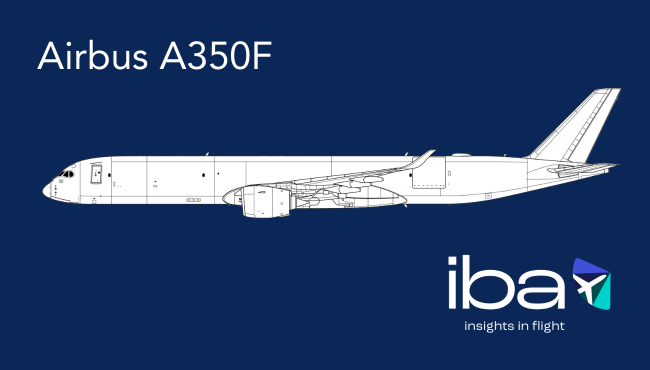
Tuesday, 29 September, will be remembered as a landmark day for aviation. The Airbus A350F test developmental aircraft, MSN 700, made its first flight. Airbus celebrated the moment and showcased its latest product, which paves the way for the manufacturer’s entry into the large-capacity cargo sector. The analysts at IBA, the aviation advisory firm, consider the event highly significant, as Jonathan McDonald, Manager – Classic & Cargo Aircraft, explains.
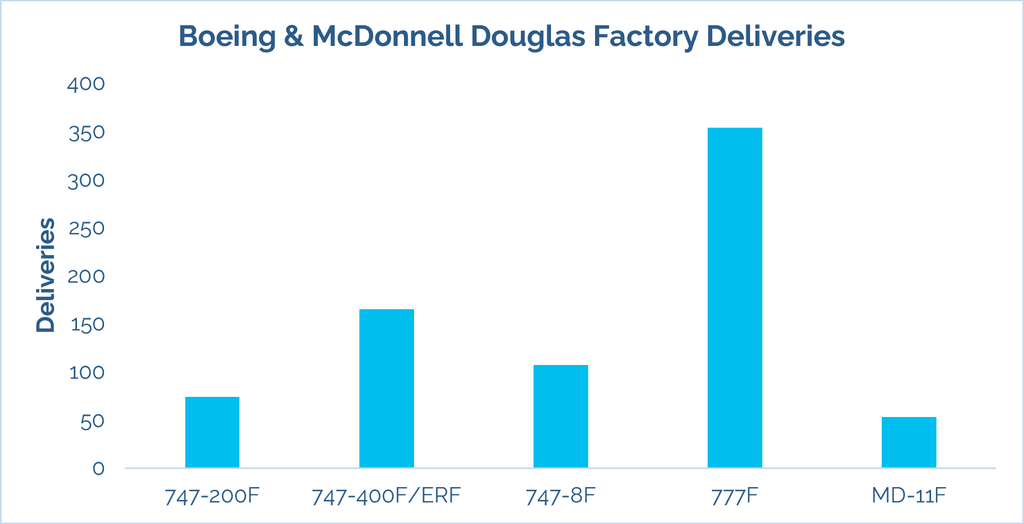
Five decades of Boeing and McDonnell Douglas dominance
To grasp the scale of the moment, it helps to look back at the 90-tonne-plus freighter segment. Boeing and McDonnell Douglas have dominated it since the first Boeing 747-200F entered service in 1972, and together the two manufacturers have delivered more than 750 freighters. That figure does not include the 346 passenger and combi Boeing 747s and MD-11s that were later converted to freighters.
The converted Boeing 777 freighters, namely the 777-200LRMF, the 300ERSF Mammoth and the IAI conversions, form a small fleet for now. It is expected to grow only once those programmes ramp up.
Airbus, a cargo player stuck in the middle
Airbus is far from a stranger to air cargo. In the mid-size wide-body segment it has always had a strong presence. According to IBA’s Insight, the manufacturer delivered 144 newly built A300 and A330-200 freighters between 1986 and 2017. It also converted at least 160 passenger A300s, A310s and A330s to cargo use. All of these aircraft work in the 39 to 70 tonne capacity range, well below the much larger market the A350F is aimed at.
Airbus did try to move up the ladder. In December 2000 it launched an A380 Freighter that would have offered a 150-tonne payload. FedEx and UPS placed orders, but the programme was cancelled by 2007. Boeing was left as the only maker of large freighters above 90 tonnes, first with the 747-400ERF/F, then with the 777F and the 747-8F. That near-monopoly lasted until July 2021, when the Airbus board formally approved the A350F. Launch orders followed at the Dubai Air Show in November of that year.
A fast start on the order book
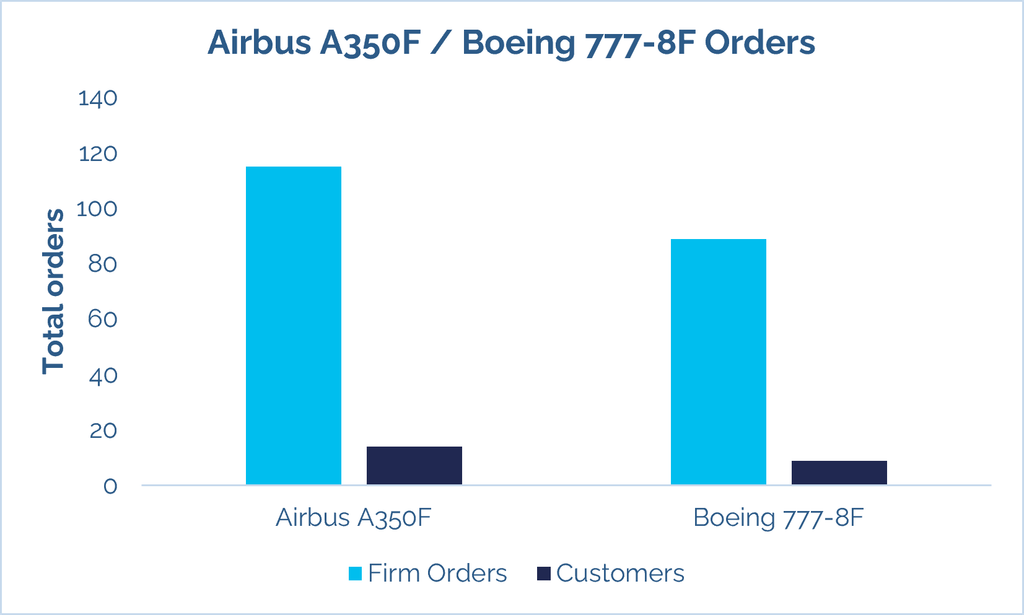
Since then, Airbus has collected 115 firm orders for the A350F, from 14 disclosed customers. Several of them, including Cathay Pacific, Korean Air, Atlas Air and Silk Way West Airlines, operate major or even exclusively Boeing freighter fleets.
The A350F is entering a very competitive market, with the Boeing 777-8F as its closest alternative. Boeing has secured 89 firm orders from 9 disclosed customers for that model. On these figures alone, IBA believes Airbus has made a strong start in the sector.
The large-capacity cargo segment above 90 tonnes is heading into an exciting period, with a strong and closely fought rivalry between Airbus and Boeing in prospect. In IBA’s view, that alone makes the first flight of the A350F so important.
A one-to-two-year head start on the Boeing 777-8F
The Airbus A350F will be the first of the new generation of twin-engine, high-capacity freighters to reach the market, at least a year or two ahead of the Boeing 777-8F. It also shares a great deal with the already popular A350-900 and A350-1000 passenger aircraft, including crew qualifications, systems and parts. That commonality should ease its entry into airline fleets and will no doubt weigh on Airbus’s sales campaigns.
On capacity, the existing benchmark is the very successful Boeing 777F, which carries 103 tonnes. The A350F can lift 111 tonnes, and the Boeing 777-8F offers slightly more. IBA describes a dynamic sector in which values and lease-rate projections look strong for every model.
Winning over operators who have always flown Boeing
Airbus has had its share of hurdles in this segment. The commercial success of the Boeing 777F, the benchmark to beat, is one of them, and Airbus’s aim is to improve on it with newer technology and better efficiency. On the technical side, the engineers had to manage running loads and optimise the position of the cargo door. On the market side, the A350F is entering a sector dominated by the Boeing 747-400F, the 747-8F and the 777F.
Cargo operators have built their logistics, pallets and freight-loading processes around the fuselage cross-sections of the MD-11, the Boeing 747 and the Boeing 777 freighters. Airbus therefore had to design the A350F so that these standard industry pallets could be loaded as smoothly as possible. To win over loyal Boeing customers, it also fitted the largest main-deck cargo door in the industry, measuring 14 ft 1 in wide.
E-commerce and Asia-Pacific keep demand strong
IBA’s outlook for the large-capacity sector, covering aircraft with payloads of 90 tonnes and above, is positive. Sustained e-commerce growth, the need to move bulky, high-tech and time-sensitive cargo, and a resilient, fast-growing Asia-Pacific market all support it. IBA considers the A350F well placed to capture that demand, and expects more orders from carriers planning to retire their Boeing 747-400 series freighters.
The advisory firm adds a note of caution. The converted Boeing 777-200LRMF and 300ERSF Mammoth, along with the IAI conversions, offer an alternative to the A350, albeit with slightly lower capacity, and their much lower acquisition cost is a compelling argument. Yet with comfortably more than 100 orders booked so far, IBA sees the extra capacity, the larger main-deck door, the newer Trent XWB engines and, in some cases, commonality with the passenger A350 as the decisive factors behind operators choosing the A350F.
What a 2027 A350F could be worth
As a point of reference, IBA uses a new-delivery 2026 Boeing 777F, whose values and lease rates are strong and likely to remain so. Such an aircraft is priced at around US$ 170 million, with lease rates near US$ 1.35 million. Allowing for slight escalation, the added capacity and the newer technology, IBA estimates a market value of US$ 197-198 million and a lease rate of US$ 1.53 million to US$ 1.55 million for an Airbus A350F delivered in 2027.
No longer a prospect, but a competitor
With this first flight, the Airbus A350F is no longer a mere prospect. It is concrete proof of a highly competitive product, ready to claim a segment that is completely new to Airbus and that will soon cease to be Boeing’s exclusive preserve. The strong order book alone sends encouraging early signals. With the largest cargo loading door in its class, the A350F is set to open a new and exciting chapter.
All data was sourced from IBA Insight, the market-leading aviation intelligence platform.