



Creating a Reverse Logistics Opportunity from End-of-Life Flooring
Old carpet tiles from commercial flooring replacement frequently make their way directly into construction and demolition waste streams. But Shaw Industries is trying to reclaim its EcoWorx carpet tile instead of sending it to the landfill.
There’s more to it than just recycling the material. Getting it back to the manufacturer in the first place. Commercial carpet tiles typically last seven to 10 years in situ, and by the time they are ripped out the building may have new owners or occupants. Those in charge of the renovation may not know the flooring is recyclable or who made it in the first place.
Shaw, a flooring manufacturer based in Dalton, Georgia, has put in place a number of measures to help close this gap. When the company launched EcoWorx in 1999, it printed a toll-free telephone number and website address on the back of its carpet tiles, so that demolition teams could easily identify the product and arrange for its return.
The company also uses internal operational tools to identify buildings where it has previously installed its products. “It provides us the information to reach out to the building owners and occupants prior to us doing planned renovations, and explain how they can engage with our reclamation and recycling services, which are provided at no cost to our customers,” said Candi Hampton, Shaw’s vise president of global sustainability.
Another obstacle for years was the economics of transportation. It often made little sense to reclaim relatively small amounts of used flooring unless a shipment filled a truck or took up a good part of a truck’s load.
Shaw addressed this limitation with changes developed in 2022 and 2023, using its regional distribution centers to consolidate returned material with its outbound logistics operations.
The company subsequently lowered the minimum quantity needed for free EcoWorx collection in the United States. In November 2023, Shaw announced it had lowered the threshold for its re[TURN] Reclamation Program from 500 square yards to 100 square yards.
The change reflects changes in commercial building design, Hampton said. Less recoverable carpet may be generated in smaller commercial spaces and in floors that combine carpet with hard surfaces, unfinished concrete or polished concrete.
Return products using existing distribution infrastructure
Shaw’s reverse logistics strategy is driven by its existing distribution network. According to the company’s supply chain and logistics information, it makes about 2,700 customer deliveries every day and can reach 99% of the U.S. population in two days or less.
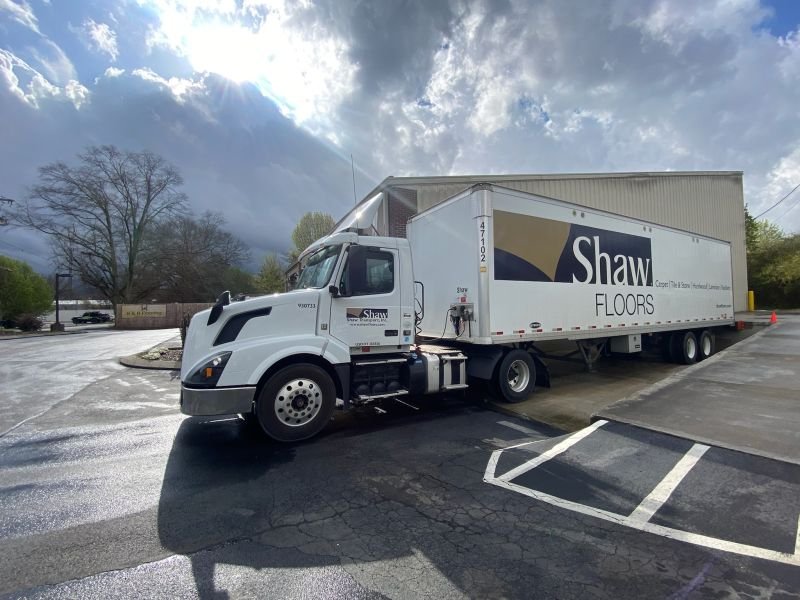
According to a November 2023 release, the company operates 30 regional distribution centers. Shaw also ranked 75th on Transport Topics’ 2026 Top 100 Private Carriers list with a fleet of 689 tractors and 3,191 trailers.
The network was principally conceived to satisfy tight delivery schedules. Sara Martin, Shaw’s vise president of corporate marketing and communications, said the importance of delivering products on time is heightened as it pertains to construction projects that have to meet completion or closing deadlines.
A lot of Shaw’s truckload freight runs between its big hubs and regional distribution centers, FreightWaves said in 2021. And those centers also have local trucks that go between distribution facilities and customers.
Now Shaw is utilizing these local operations to pick up reclaimed carpet tile. Customers who live close to a regional center can also take their used material directly to the center.
Collection sites must meet certain operational requirements, including adequate space for a 53-foot trailer and the ability to accommodate a live load, in accordance with the company’s reclamation program guidelines.
Shaw can aggregate material from several renovation projects into larger shipments for transport to Georgia. “This allows the company to use trucks that would otherwise come back empty, improving freight utilization and limiting additional transportation costs,” Hampton explained.
In the absence of a nearby regional distribution center, third-party logistics partners are still engaged in the operation. Still, Shaw mostly uses its own distribution facilities because it’s a more cost-effective model, Hampton said.
Manufacturing Process that Recycles 100% of Recovered Tile into New Backing
The recovered carpet tiles are shipped to Georgia where they are subjected to an industrial process that chops, melts and makes the material into pellets. These pellets are mixed with other compounded pellets to produce new carpet backing.
Shaw, which used to separate the carpet fibers from the backing and send the two components to different applications. Then the company reworked its process so the entire carpet tile can be incorporated into the backing.
“This change allows Shaw to recycle 100 percent of the reclaimed carpet tile into new backing material,” Hampton said.
The original design of the product also shows a focus on recovery at the end of its life. The young Shaw engineers who studied green chemistry in university developed EcoWorx around principles promoted by Michael Braungart and William McDonough before Cradle to Cradle was published as a book or a product certification, Hampton said.
The basic idea is to look beyond a product’s initial manufacture and use, and look at what happens once it’s reached the end of its useful life. If this planning is not done, the options for recovery and recycling can be considerably more limited.
Shaw has reclaimed and recycled nearly 1 billion pounds of carpet since 2006, including EcoWorx, the company said in its November 2023 release.
The program also aligns with customers’ environmental goals. By using reclaimed carpet tile, construction waste does not end up in landfills, and using recycled content in new flooring reduces embodied carbon, helping customers lower their Scope 3 emissions.
Finding carpet tiles years after installation
Even with the logistical improvements, there’s a big hurdle in getting customers to bring back used flooring. Hampton did not provide a return rate and said awareness among consumers remains a problem.
Commercial carpet has a long service life, which makes it hard. Installation to removal can span seven to 10 years, leaving new owners, tenants or facility managers unaware of the product’s origin and recycling options.
Shaw is addressing this issue by involving architects and designers at the start of construction and renovation projects. The company works with these professionals to include reclamation requirements in product specifications and building documents.
The goal is to have instructions for recovering the flooring available when the material finally reaches the end of its service life. Shaw hopes that by incorporating the recovery process into the initial project specifications, there will be less chance of usable material being thrown away because the information needed to recover it is not available.
Landfill Disposal Costs Influence Recovery Rates
The economics of waste disposal also affect where Shaw can recover the largest quantities of used carpet tile.
Although recycling supports customers’ sustainability commitments, Hampton said the program tends to work more easily in locations where landfill tipping fees are high. She identified California, New York, Massachusetts and Seattle as markets where these disposal costs encourage product recovery.
By contrast, recovering flooring is more difficult in areas such as Alabama and Mississippi, where landfill fees are comparatively low.
The decision often rests with the contractor responsible for removing the flooring. During demolition, separating recyclable materials can require additional time, coordination and handling. Contractors may therefore prefer to place all removed materials in a single dumpster rather than sort them into separate waste streams.
Hampton noted that some contractors assume recovery will be too complicated or expensive, even when a collection service is available at no charge.
To overcome these barriers, Shaw has recruited sustainability specialists serving the Seattle and Boston areas and recently added another position in Dallas. These specialists work with architects and designers but also engage directly with general contractors and demolition companies, which are not typically Shaw’s primary contacts during the original flooring sale.
Their responsibilities include explaining the recovery process, guiding contractors through the required steps and visiting project sites to assess practical collection arrangements.
Hampton said this direct engagement has significantly improved Shaw’s efforts to recover used products by giving contractors the information and hands-on support they need.
The company’s approach ultimately combines product design, distribution infrastructure and contractor education. By making collection easier and using existing freight movements to consolidate returns, Shaw is seeking to ensure that commercial carpet tiles can re-enter manufacturing rather than become another stream of construction waste.