



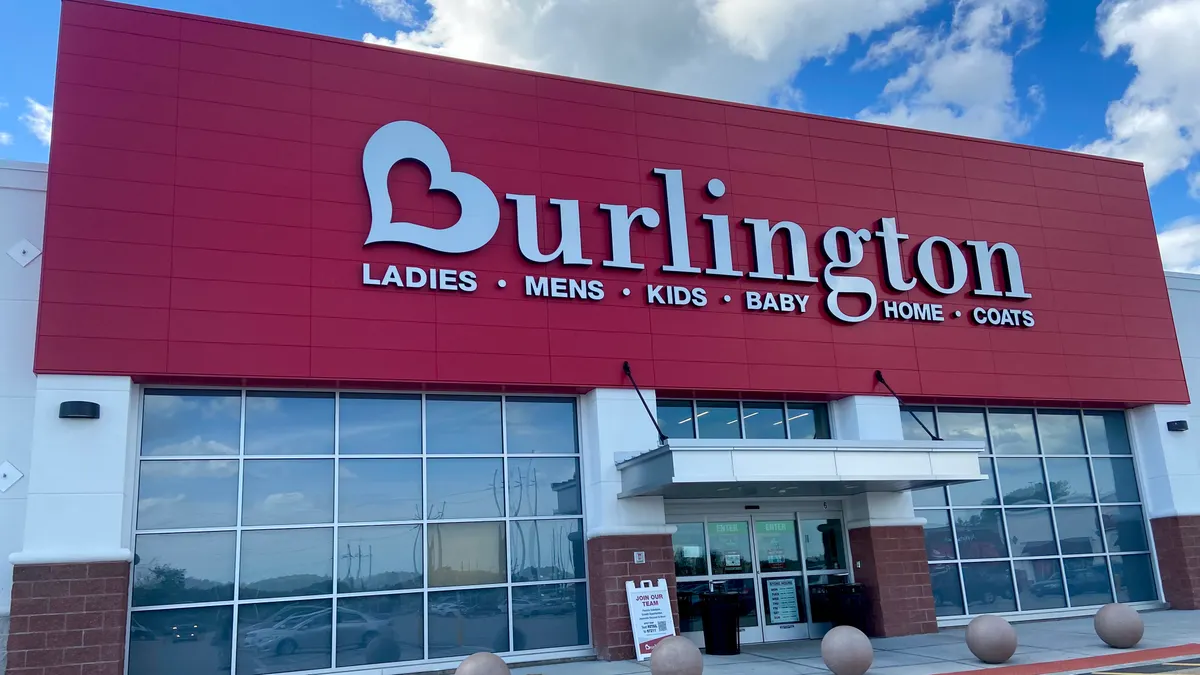
Burlington is continuing to expand its use of on-site solar power across its distribution network, with new projects planned at facilities in Arizona and California and additional solar development underway at an existing warehouse in Georgia.
According to the retailer’s 2025 Corporate Social Responsibility Report, Burlington had expanded several on-site solar initiatives across its distribution center network as part of efforts to reduce both operating costs and its environmental footprint.
By the end of fiscal year 2025, which concluded on January 31, 2026, Burlington had moved forward with plans for on-site solar systems at its new distribution center in Ellabell, Georgia, as well as at an upcoming facility planned for Arizona. The company did not disclose further details about those projects and declined to comment when contacted by Supply Chain Dive.
The retailer is also planning to increase its solar generation portfolio at two new distribution centers in California, both of which are scheduled to come online in 2026, according to the report.
Renewable electricity is gaining ground across Burlington’s operations
Burlington’s solar expansion is part of a broader renewable-energy strategy. During fiscal 2025, the retailer said that 25% of its electricity consumption came from renewable resources, exceeding its previously established target of reaching 20% by 2030.
The company’s sustainability efforts extend beyond its distribution centers. By the close of fiscal 2025, Burlington had entered into agreements covering on-site solar installations across operations in New Jersey, California and Massachusetts.
During the same fiscal year, the retailer also expanded agreements to secure renewable electricity across the Midwest, Mid-Atlantic and West Coast.
Burlington is not alone in using solar power as part of a broader effort to improve energy efficiency and reduce supply chain emissions. A number of retailers are pursuing combinations of on-site and off-site renewable energy projects at logistics and distribution facilities.
Gap continues its renewable-energy rollout
Gap Inc. is targeting 100% renewable electricity for its company-operated facilities by 2030, according to its 2025 Impact Report, published in June.
At the end of fiscal year 2025, which also ended January 31, 2026, 46% of Gap’s electricity consumption across company-operated facilities came from renewable sources. That figure includes a solar installation at the company’s distribution center in Fresno, California.
Walmart expands solar capacity through distribution and retail projects
Walmart is likewise pursuing clean-energy solutions through new construction, remodeling projects and system upgrades at distribution centers and retail locations, according to its fiscal 2026 ESG Report.
The retailer, like Gap, is working toward a goal of obtaining 100% of its energy from renewable sources by 2035.
As of fiscal year 2026, which ended January 31, 2026, more than 53% of Walmart’s global electricity consumption was supplied by renewable energy sources.
In the United States, Walmart’s operations had produced 125 megawatts of on-site solar capacity across 303 facilities as part of those efforts.
Solar projects spread across TJX distribution network
TJX Companies has also introduced on-site solar capabilities at several of its U.S. distribution centers. The projects span facilities in Arizona, Connecticut, Massachusetts, Nevada and Texas, according to the company’s 2025 Global Corporate Responsibility Report.
Meanwhile, Best Buy installed its first solar field at a distribution center in California this year.
The installation is capable of generating nearly 6 million kilowatt-hours of electricity annually to supply the facility. It forms part of Best Buy’s broader strategy to reduce emissions generated across its supply chain.
The growing number of projects among major retailers highlights how distribution centers are increasingly becoming a focal point for renewable-energy investment, with companies using rooftop and on-site solar generation alongside renewable electricity agreements to address energy costs and supply chain emissions.