



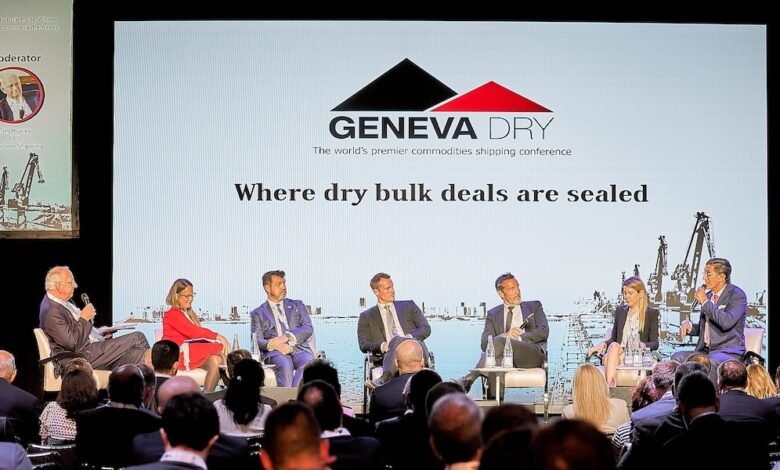
What began as a discussion about iron ore flows and freight rates at last month’s Geneva Dry conference quickly evolved into something much bigger a wide-ranging debate about geopolitics, bunker shortages, de dollarisation, supply chain disruption and the future of global trade itself.
Yet despite the uncertainty dominating international markets, one message came through clearly from the panel: the dry bulk market, especially the capesize segment, continues to show remarkable resilience.
Peter Weernink, chairman of SwissMarine, admitted he had been surprised by how stable the market has remained despite war related disruptions, surging fuel costs and growing geopolitical tensions.
“We are at almost the same levels for Q2 and for the rest of the year as we were before all of this started,” he noted during the discussion, describing the market’s ability to hold firm in such a volatile environment as unexpected.
The session opened on a more emotional note, however, with CTM chairman John Michael Radziwill paying tribute to seafarers operating near the Strait of Hormuz crisis zone.
“As we sit here discussing revenues, they are worrying about their lives,” he said, bringing attention back to the human side of the industry.
From there, the conversation shifted toward China’s iron ore demand, which has remained surprisingly strong despite weaker steel production and continued pressure on the country’s property sector.
Melinda Moore, managing director of Cleanup Commodities, argued that many analysts are underestimating how tight the iron ore market is becoming beneath the surface.
According to her, declining ore grades, weaker domestic Chinese mining output and distorted inventory figures are all quietly reducing effective supply. She noted that depletion alone is removing between 15m and 20m tonnes of usable ore supply each year.
The discussion repeatedly returned to Guinea and the massive Simandou project, which many speakers believe could reshape global tonne-mile demand for decades.
Milena Pappas, commercial director at Star Bulk and head of Oceanbulk Maritime, said China is still likely to favour higher-grade long-haul iron ore imports from West Africa despite the sharp increase in bunker costs.
“I don’t think bunker prices alone will push China back toward Australia,” she said.
That view tied directly into one of the panel’s central themes: in today’s market, tonne-miles matter far more than simple cargo volumes.
With bunker prices still sitting roughly 50% above pre war levels, inefficiencies are growing across the global fleet. Owners described vessels slow steaming, rerouting for fuel and in some cases even sailing backwards to secure bunkers more efficiently.
Weernink revealed that some capesize vessels are now returning to Singapore specifically to refuel before heading toward Guinea, while ultramax bulkers from India are also altering routes for bunker access.
“The fleet is slower now,” he explained. “Capes are sailing around 4% slower.”
Lars-Christian Svensen, chief executive of 2020 Bulkers and Himalaya Shipping, added that strong coal demand from eastern Australia has unexpectedly helped support Pacific capesize freight rates despite higher fuel costs.
The panel later moved into geopolitics and the growing influence of China over commodity trading and settlement systems, particularly through China Mineral Resources Group (CMRG).
Peter Lye, executive head of marketing, shipping and safety at Anglo American, said he does not expect CMRG to dramatically disrupt commodity flows in the short term, although broader structural shifts are clearly underway.
Moore described de-dollarisation and supply chain control as long-term forces that could reshape commodity markets over the next 10 to 15 years.
“This story is far from over,” she warned.
Radziwill went even further, calling de-dollarisation “a huge shift in geopolitical power and trade dynamics.”
Another major topic was the growing trend toward resource stockpiling. Panelists agreed that governments and industrial buyers are increasingly moving away from “just in time” supply chains in favour of “just in case” strategies after Covid, the Ukraine war and now the Hormuz crisis.
“You’re going to continue seeing commodities being stockpiled,” Radziwill predicted.
All of this helped fuel a notably bullish mood around dry bulk asset values.
Svensen pointed to low orderbooks, ageing fleets, Simandou-related cargo growth and expanding bauxite trades as key reasons why the capesize market could remain strong for years.
“This market looks extremely promising going forward,” he said.
Pappas echoed the same view, once again stressing that inefficiencies and longer-haul trades are becoming more important than pure cargo volumes.
Still, there were also warnings against becoming overly optimistic.
Executives from Chinese shipyards reminded owners that Beijing still has the ability to rapidly expand shipbuilding capacity if market profitability improves, with some yards capable of delivering dozens of bulkers annually.
Even with those concerns, the overall tone at Geneva Dry remained firmly optimistic by the end of the session.
Perhaps the most memorable momentcame from Moore, who encouraged delegates to remember five words shaping the future of shipping and commodities: “demographics, decarbonisation, depletion, decoupling and dislocation.”
For many in the room, the message was clear — the next dry bulk supercycle may already be underway.