



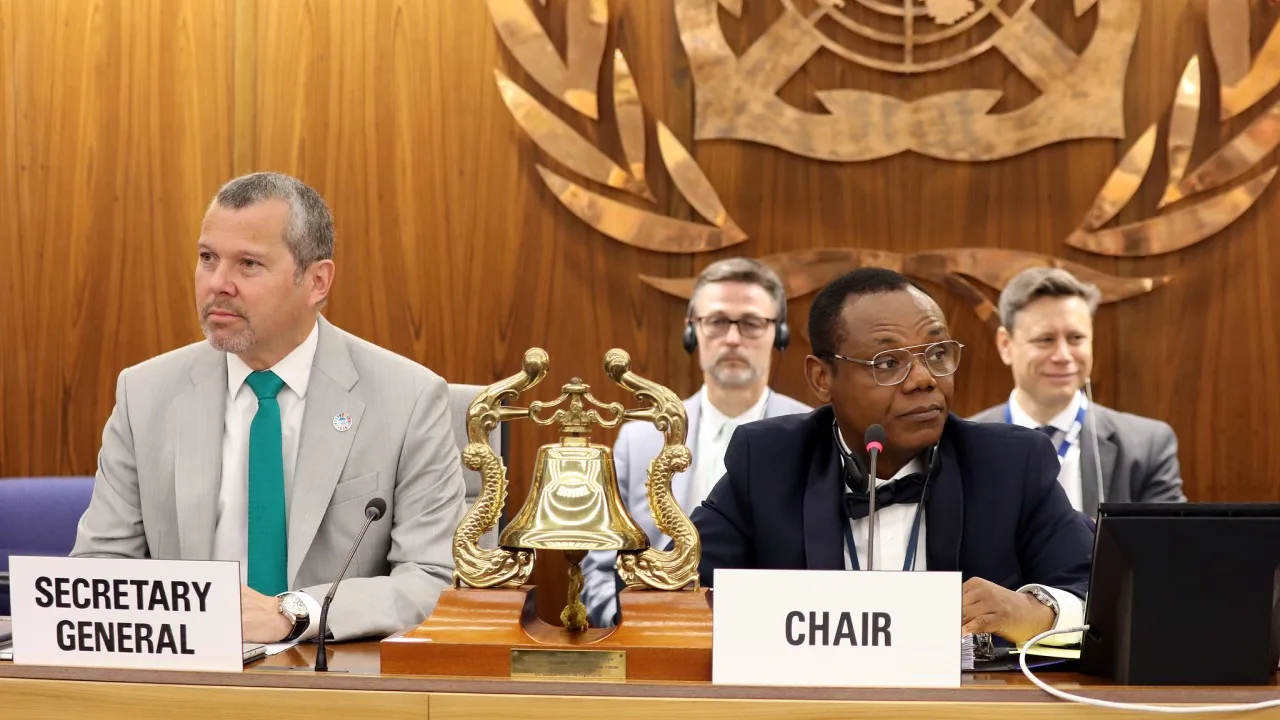
The International Maritime Organization is facing a decisive moment as members gather for the 84th session of the Marine Environment Protection Committee, where the future of the Net Zero Framework is under intense pressure.
The framework is intended to guide the shipping industry’s greenhouse gas reduction pathway, but opposition has hardened from several powerful stakeholders.
Supporters of the Net Zero Framework are trying to maintain momentum after years of negotiation, while the US administration is pushing against the policy, arguing for a less restrictive approach, particularly around LNG and carbon funding.
Environmental groups have also intensified their campaign. Activists planned to transform the IMO headquarters in London into a visible protest site, using large banners directed at delegates arriving by road, rail and river.
IMO Secretary-General Arsenio Dominguez has sought to reduce confrontation, saying his focus is on bringing negotiations back to a constructive format.
The International Chamber of Shipping has also called for consensus. Secretary General Thomas Kazakos said the industry needs a uniform global regulation rather than a fragmented mix of national and regional measures.
A joint statement from major shipping associations, including BIMCO, ICS, Intercargo, Intertanko and the World Shipping Council, supported practical IMO solutions with consistent global application.
However, some shipowners remain strongly opposed, particularly over LNG rules and the proposed carbon fund. Certain Greek shipowners have argued that regulators are turning shipping into a tax collector while pushing the industry toward fuels that are not yet available at scale.
The debate is also geopolitical. Saudi Arabia, the UAE, Argentina and Russia are aligned with the US position, while Cyprus and Greece have also expressed concerns, particularly around LNG.
Supporters of the framework argue that without a single global measure, shipping could face overlapping regional rules and multiple penalties for the same emissions.
The Intersessional Working Group on greenhouse gas emissions recently held discussions involving around 62 countries, with reports of constructive engagement toward finding a consensus.
Clean Shipping Coalition President Delaine McCullough said the framework is not perfect but represents years of compromise and broad support.
Meanwhile, ZESTAs Secretary General Madadh MacLaine warned that weak rules could lock in another generation of vessels using fuels that appear clean on paper but do little to support a real energy transition.
The battle at IMO is therefore not only about regulation. It is about which technologies, fuels and economic models will shape the maritime sector for decades.