



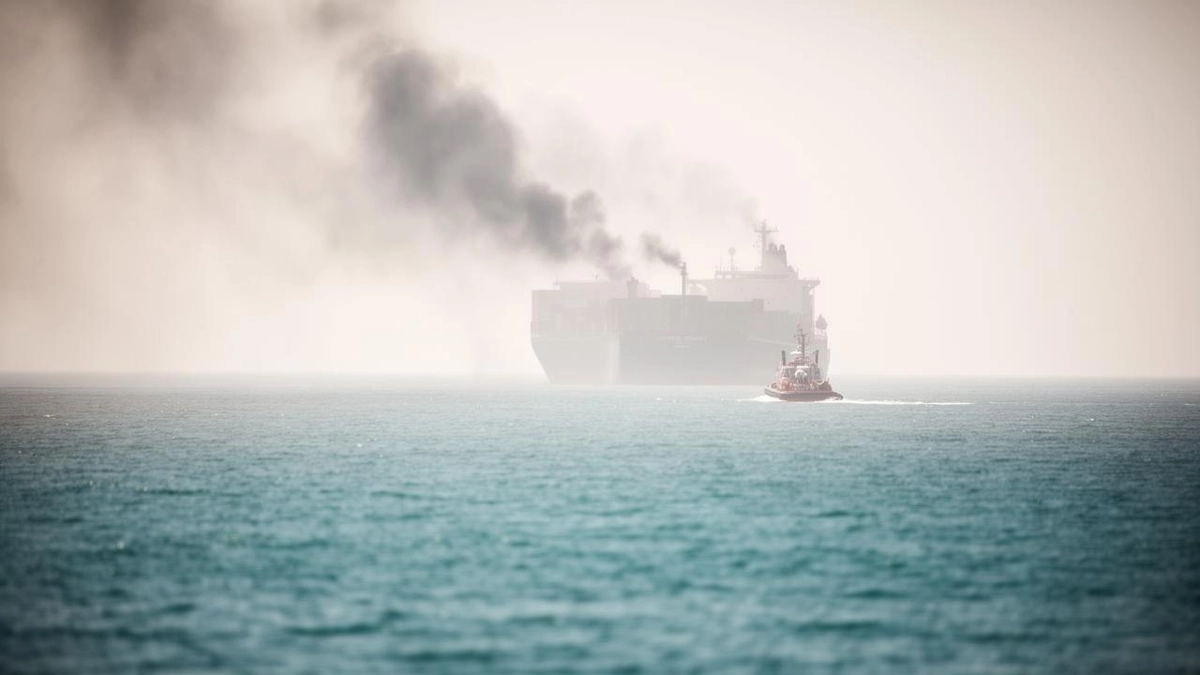
Eight months after the United States and Israel launched strikes against Iran, commercial shipping remains caught in the conflict, with vessels operating across the Gulf region facing persistent security threats. Despite initial expectations that the war would last only a few weeks, the confrontation has continued, and the frequency of attacks against merchant ships has increased significantly over the past month.
When President Donald Trump indicated that the conflict would be relatively short following the attacks launched on 28 February, few anticipated that maritime transport would remain under such sustained pressure. The first attacks against commercial vessels were reported on 1 March, just one day after hostilities began. Since then, shipping has remained a recurring target as the conflict has spread across critical maritime routes.
Strait of Hormuz becomes a focal point of maritime insecurity
For years, governments and shipping companies have considered the possibility that Iran could close the Strait of Hormuz, effectively restricting access to and from the Arabian Gulf. That long-standing concern became a reality early in the conflict, when Iran’s Islamic Revolutionary Guard Corps (IRGC) began attacking vessels in and around the strategic waterway and warning other ships attempting to pass through to turn back.
Verified figures released by the International Maritime Organization (IMO) show the scale of the damage. As of 27 October, a total of 121 attacks had been recorded across the Strait of Hormuz, the Arabian Gulf and the Gulf of Oman, resulting in the deaths of 24 seafarers.
These figures cover incidents involving Iranian attacks as well as US operations enforcing its blockade. Among the deadliest incidents was the 9 June strike on the tanker Settobello, which killed three civilian crew members.
However, establishing the precise number of attacks remains difficult. Reports differ between sources, while some shipowners have become increasingly reluctant to voluntarily disclose incidents to organisations such as the United Kingdom Maritime Trade Operations (UKMTO), which provides security alerts and intelligence to shipowners, operators and seafarers.
Commercial shipping disrupted as transits collapse
The opening phase of the war brought maritime traffic through the Strait of Hormuz close to a standstill. This situation persisted throughout the first couple of months of the conflict, leaving approximately 1,000 vessels and 20,000 crew members stranded in the Gulf. During that period, attempts to navigate the strait were largely limited to a small number of ships seeking to leave the area.
Traffic subsequently began to recover following the signing of a short-lived memorandum of understanding (MoU) between the United States and Iran on 18 June. Yet the improvement came amid competing efforts to control passage through the waterway.
Iran sought to formalise its authority over the strait through the establishment of the Persian Gulf Strait Authority (PGSA). The body was intended to approve vessel transits through a northern corridor running through Iranian territorial waters. At the same time, US forces increasingly facilitated guided passages through a southern corridor in Omani waters.
[Embed suggestion — place the maritime security embed here, in the middle of the article]
Use an official IMO, UKMTO or Joint Maritime Information Center (JMIC) update covering attacks on commercial vessels and navigation risks in the Strait of Hormuz. The embed should reinforce the figures and security developments described above.
Evacuation efforts halted after another vessel attack
Despite attempts to restore maritime movements, commercial vessels continued to come under fire. An IMO evacuation plan designed to help ships stranded in the Gulf leave the area remained operational for less than 48 hours before it was suspended.
The suspension followed the 25 June attack on Ever Lovely, a Singapore-flagged container ship. The incident highlighted the continuing risks facing commercial operators, even as authorities attempted to organise safer departures from the Gulf.
The diplomatic arrangement between Washington and Tehran also proved short-lived. Approximately one month after its signature, the MoU had effectively collapsed, prompting the United States to reinstate its blockade of Iranian ports on 14 July.
Since then, the struggle for control over the Strait of Hormuz has increasingly translated into direct threats against commercial shipping, with the number of reported attacks continuing to rise.
Thirty-four or more attacks in a month
The latest figures suggest a particularly sharp downturn in maritime security. 34 attacks against vessels were confirmed by the IMO between 28 September and 27 October.
Most of the incidents happened in the Strait of Hormuz. But Iranian operations in recent weeks have increasingly also targeted commercial shipping elsewhere in the wider region, expanding the geographical reach of the threat.
Despite the violence, some traffic still moves through the waterway. The latest update from the Joint Maritime Information Center (JMIC) using US Naval Cooperation and Guidance for Shipping (NCAGS) data showed that traffic flows through the strait, assisted by the US, averaged about 28 vessel transits per day.
The U.S. Central Command said earlier this week that more than 95% of vessels transiting the Strait of Hormuz had passed safely, despite what it described as “unwarranted aggression” by the IRGC.
These numbers mean that maritime traffic has not ground to a complete halt, but they do not reduce the dangers to shipowners, operators and crews working in the region.
Iran Expands Its List of Blacklisted Ships
In addition to the attacks, Iran has also been developing a system to restrict access to the Strait of Hormuz through the PGSA. The authority keeps a growing blacklist of vessels it says are banned from transiting the waterway.
Before Iran added the whole fleet of VLCC owner Sinokor, the list had 123 entries. The action highlights the potential commercial ramifications of Iran’s attempts to exert control over maritime shipping.
However, the blacklist does not always signal every threat in advance. Iran has also attacked vessels in the past and later added them to the PGSA’s list, leaving shipowners with little certainty as to which ships may be targeted.
For the maritime industry, this cocktail of direct attacks, restrictions on passage and uncertainty over enforcement complicates voyage planning and security assessments in one of the world’s most strategically vital shipping corridors.
Concerns of all-out fighting persist
The possibility of a broader military escalation continues to be a major concern. There is growing speculation among observers that the US and Israel may launch a full-scale war against Iran next week, after the US midterm elections on 3 November and elections in Israel.
Such a development would add to the pressure on commercial shipping already reeling from months of disruption, security incidents and uncertainty over access to the Strait of Hormuz.
The conflict has already had a major impact on shipping, with 121 attacks reported and 24 seafarers killed by 27 October. The most recent series of incidents illustrates how susceptible commercial shipping is to the wider confrontation, while the specter of renewed hostilities continues to raise questions over the security of key Gulf trade routes.