



A proposed coal export terminal at the former Oakland Army Base is facing another regulatory challenge after California Gov. Gavin Newsom signed legislation requiring a new environmental review. The move adds uncertainty to a project that has recently regained momentum through federal backing and potential financing from Utah.
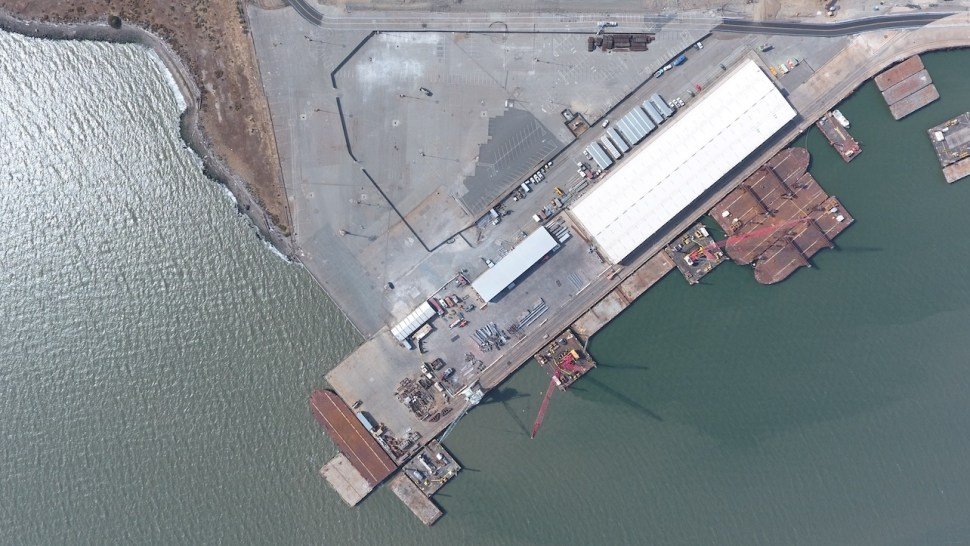
The planned West Gateway Terminal would be built at the Oakland Bulk and Oversized Terminal near the foot of the Bay Bridge. Under the current proposal, coal would arrive by rail from Western states, be stored at the waterfront facility and then loaded onto vessels bound for Asian markets.
Project documents reviewed by prospective investors indicate that the terminal could eventually handle up to 12 million metric tons of coal annually, equivalent to roughly 13.2 million short tons. At that scale, the facility would become the largest coal export terminal on the U.S. West Coast.
For Oakland, where import container volumes have shifted toward larger Southern California and Canadian hubs, the project would represent a significant change for a waterfront site initially intended for broader bulk and oversized cargo operations. For coal producers across the West, meanwhile, the terminal could provide a potential Pacific gateway to international markets as other West Coast coal-handling projects have encountered local opposition or plans to move away from the commodity.
Federal backing and growing interest from Utah
The Oakland terminal is part of the Trump administration’s broader push to support U.S. coal production and exports. In June, the administration announced $75 million in funding for the project as part of a nearly $700 million package aimed at the coal sector.
The Energy Department has characterized the terminal as export infrastructure capable of supporting Western coal producers and meeting overseas demand.
Federal funding, however, would cover only a portion of the project’s projected investment. The Energy Department has estimated construction costs at approximately $231 million, while a feasibility report prepared for a coalition of Utah counties placed the likely cost substantially higher, between $430 million and $625 million.
The same feasibility report estimated that construction and start-up would require approximately 53 months. That timeline could push the beginning of exports beyond the previously projected 2028 opening.
The Rural Utah Infrastructure Coalition, which represents eight counties, has asked Utah’s Permanent Community Impact Fund Board to consider an investment of approximately $45 million in the project. The coalition considers access to Pacific export markets increasingly important as domestic coal demand declines and Western mines seek additional customers.
The board was expected to consider the funding request during an October meeting.
Project-related reports have identified Japan, South Korea, Taiwan, Vietnam and Malaysia among the potential export markets. The terminal could receive coal from Utah, as well as mines in Wyoming and Montana’s Powder River Basin.
California’s new environmental review requirement
Newsom’s signing of Assembly Bill 40 has changed the project’s regulatory path.
The legislation requires a California Environmental Quality Act review for new coal projects and for existing facilities seeking to export more than 5 million tons of coal annually. At its proposed capacity, the West Gateway Terminal would fall within that threshold.
Assemblymember Mia Bonta, D-Alameda, sponsored the legislation amid concerns that the project’s current plans differ significantly from earlier expectations.
The terminal already has a lengthy legal history. In 2016, Oakland adopted a ban on coal storage and handling, a restriction that developers challenged in federal court. In 2018, a judge ruled that the city could not apply the ban to the planned terminal under the terms of its development agreement.
Oakland subsequently appealed, but the California Supreme Court declined to hear the case in 2025, effectively removing a major legal obstacle to the project.
AB 40 does not automatically prevent construction of the terminal. It could, however, require a comprehensive assessment of the project’s environmental and health impacts, alternatives and mitigation measures. The additional review could also create further opportunities for administrative proceedings and court challenges.
Proposed open-air storage becomes a new point of contention
The project’s coal-handling plans have generated another source of opposition.
A July report prepared by Norda Stelo and Wood Mackenzie for potential Utah investors stated that coal would be stored in two open-air bunkers, each capable of holding approximately 150,000 tons. The design would differ from previous public assurances that the terminal’s coal storage would be fully enclosed.
The report also projected peak annual throughput at approximately three times the volume examined in the terminal’s earlier environmental documentation. According to the Los Angeles Times, that previous review addressed bulk commodities but did not specifically evaluate coal.
Environmental justice organizations and residents living near the terminal argue that open coal stockpiles, rail traffic and vessel-loading operations could increase exposure to coal dust and fine-particle pollution in West Oakland.
The neighborhood already experiences emissions associated with port activity, trucking and industrial operations. Opponents have called on the Bay Area Air Quality Management District to impose modern pollution-control requirements and are preparing for additional legal challenges.
Supporters of the terminal maintain that the project would establish a long-sought route connecting coal mines in Utah and Wyoming with international buyers while generating jobs and export activity.
The Trump administration has said the development could create more than 1,400 jobs.