




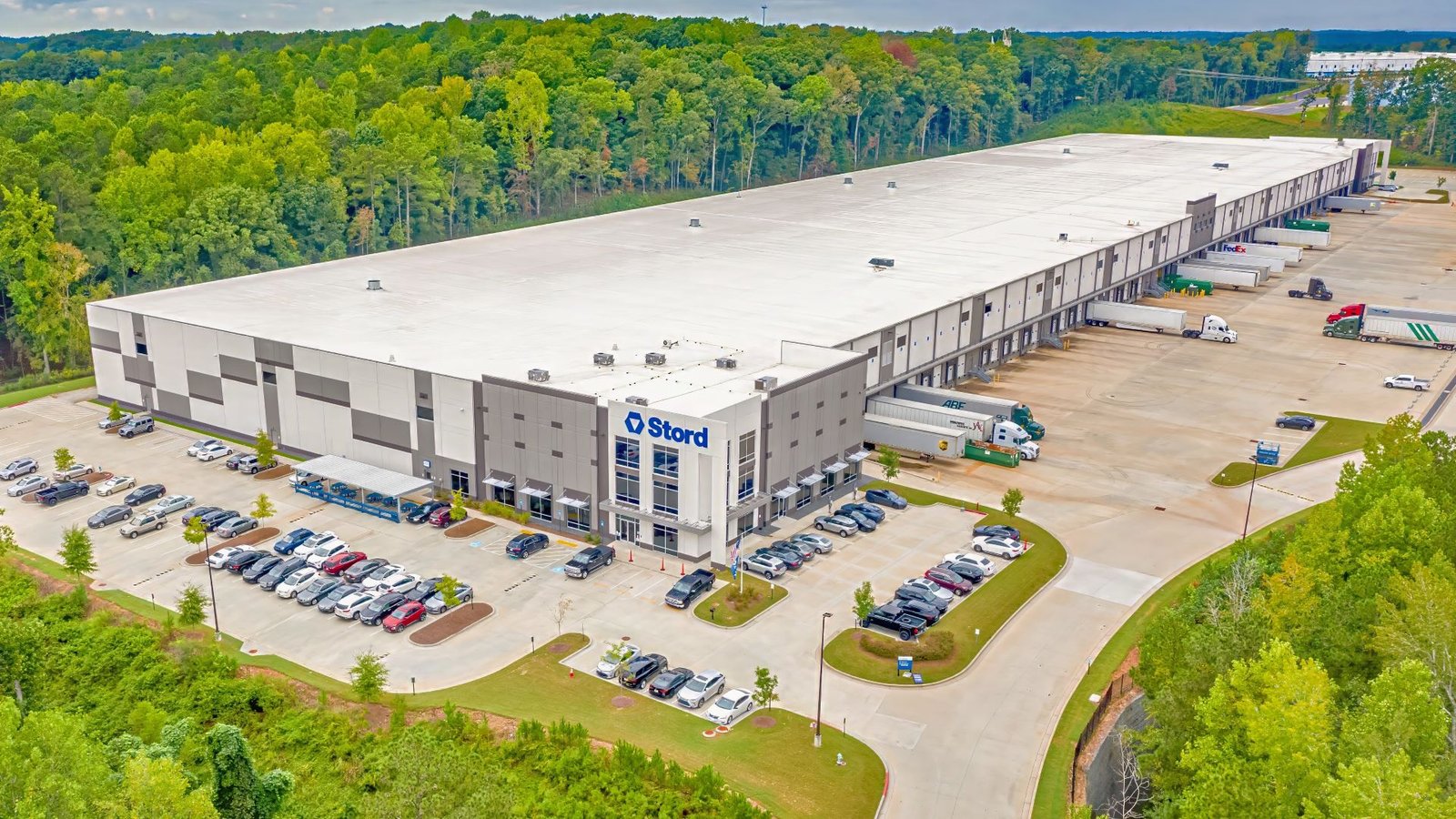
Fast-growing e-commerce logistics company Stord has raised $250 million in late-stage venture capital funding, valuing the business at $3 billion and accelerating its push into artificial intelligence and robotics for fulfillment operations.
The Series F round brings total funding since the company’s creation in 2015 to more than $775 million, effectively doubling its valuation in just 12 months. The round was led by Strike Capital alongside existing investors, and may signal preparations for a future IPO.
Stord currently manages e-commerce inventory for more than 1,000 clients, ranging from small and mid-sized direct-to-consumer brands such as AGI, True Classic and Native, to larger enterprise customers. Its integrated platform covers online checkout, order fulfillment, last-mile delivery and returns, supported by software that coordinates inventory, pick-and-pack operations, order processing and carrier selection across its network.
Over the past six years, the company has completed eight acquisitions, including Ware2Go from UPS, Shipwire from CEVA Logistics, and Penny Black, a SaaS provider focused on personalised post-purchase experiences. It also acquired a former Quiet Logistics facility to strengthen its presence in Dallas.
Analysts note that Stord’s valuation is driven by its positioning as a technology-first logistics orchestrator, connecting a distributed network of warehouses with a unified software layer designed to replace fragmented third-party logistics systems.
The company’s strategy targets e-commerce retailers seeking to avoid dependency on Amazon’s fulfillment infrastructure, while still demanding comparable speed, transparency and reliability.
“For years, every independent brand has been left to figure out on their own how to compete against the consumer experience Amazon has spent decades and hundreds of billions building. By every measure, independent brands have been losing. Stord exists to level that playing field,” said co-founder and CEO Sean Henry. “We give independent brands the complete commerce stack: the fulfillment network, software, and AI, to deliver a consumer experience that surpasses Prime. Our vertical integration and scaled network create compounding advantages that deliver better, faster, cheaper outcomes with every order we touch.”
A central part of the new funding will go toward launching Stord Labs, an R&D hub focused on building and deploying agentic AI, robotics and automation systems using live operational data from the company’s fulfillment network rather than generic datasets. Stord believes this will allow it to train models across nearly 100 facilities and accelerate performance improvements across its logistics network.
In March, the company expanded its AI layer with chat-based tools, search functions and a personalised intelligence stream. Its conversational assistant integrates operational data including orders, inventory, shipments, routing logic and carrier performance, enabling users to query complex operational issues in seconds.
Examples include questions such as: “Why was order #482901 delayed and what carrier was responsible?” or “Which SKUs are trending toward stockout this week?”
Stord says its revenue has grown tenfold over the past four years. While private, estimates from GetLatka place annual revenue at nearly $150 million, while gross merchandise value processed through its platform has reached $15 billion, up 50% since late last year.
The company attributes part of its recent acceleration to the rise of generative AI, noting that its software division has outpaced its logistics operations in growth. Its Stord One Warehouse platform has also evolved from an internal operating system into a broader supply chain software product for external warehouse operators.
Investor sentiment remains divided. Strike Capital partner John Lagomarisino said the convergence of software and physical logistics infrastructure positions Stord well for the “rise of agentic purchasing,” where automated systems make procurement decisions in real time.
However, some industry observers remain cautious. Logistics analyst Eric Pong warned that hybrid models combining acquisitions and software expansion can face valuation pressure over time, citing previous high-growth logistics firms such as Flexport, Convoy and Deliverr as examples of companies whose valuations later compressed after rapid expansion phases.
Stord’s investor base also includes Kleiner Perkins, Founders Fund, Franklin Templeton, Baillie Gifford, G Squared and Bond.







