



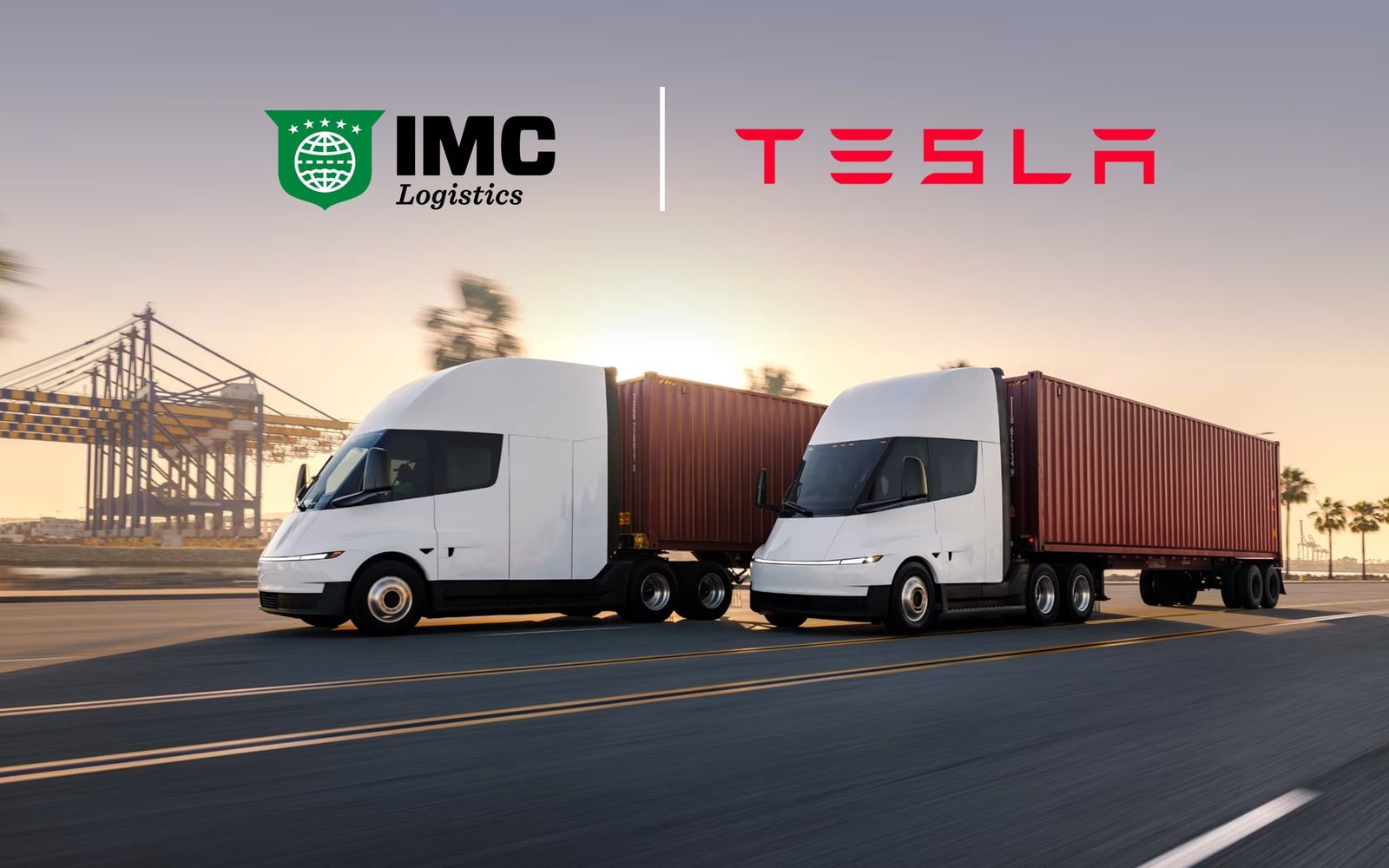
IMC Logistics is expanding its zero-emission trucking strategy with an order for 50 Tesla Semis, which will be integrated into the company’s California operations alongside hydrogen fuel-cell and renewable-diesel vehicles.
The intermodal drayage provider plans to deploy Standard Range versions in port drayage operations, while Long Range Semis will be assigned to routes connecting Southern California with inland destinations. IMC announced the order in a release on Sept. 22, although the company has not specified the breakdown between the two models or provided a timetable for putting all 50 trucks into service.
Jim Gillis, president of IMC Logistics’ Pacific Region, said the investment reflects the company’s decision to pursue multiple technologies as it works to reduce emissions from its drayage operations.
“The addition of 50 Tesla Semis strengthens that strategy as well as allows IMC to establish zero-emission service for long haul lanes,” Gillis said in the company’s announcement.
Tesla rates the Standard Range Semi at 325 miles and the Long Range version at 500 miles when operating at a fully loaded weight of 82,000 pounds. Those specifications were presented during the inauguration of Tesla’s Semi manufacturing facility in Sparks, Nevada.
The 1.7 million-square-foot factory has been designed for annual production of up to 50,000 trucks. Among the companies to receive early deliveries were DHL, PepsiCo and US Foods.
Tesla builds momentum in drayage
IMC’s order comes as Tesla continues to attract major commitments for the use of its electric trucks in drayage operations.
In May, WattEV ordered 370 Tesla Semis for operations linked to its charging infrastructure at the Port of Oakland and in Fresno. The first 50 trucks are scheduled for 2026, with the complete deployment expected by the end of 2027.
Tesla was also named the primary manufacturer for a 2,500-truck electric order announced in September through ZET SCALE, a shipper-carrier alliance whose founding shippers include Microsoft and PepsiCo. Los Angeles is one of the 10 freight hubs targeted first under that order.
Hydrogen trucks remain part of IMC’s strategy
The Tesla vehicles will not replace a single technology across IMC’s California fleet. Instead, they will join an existing mix of battery-electric, hydrogen fuel-cell and renewable-diesel trucks.
IMC invested in hydrogen technology in March 2024, when it purchased 50 Nikola hydrogen fuel-cell trucks with a range of 500 miles. The move was intended to expand the company’s service area. At the time, IMC was also operating Volvo battery-electric trucks.
Gillis has described the company’s approach as a “blended approach to investing in both electric and hydrogen.”
Tesla’s Long Range Semi, notably, carries the same 500-mile rated range as the Nikola hydrogen trucks purchased by IMC.
The economics and availability of hydrogen have nevertheless presented challenges. Nikola filed for Chapter 11 bankruptcy protection in February 2025. By late June that year, 40 of IMC’s 50 Nikola trucks were operating, while 10 remained offline, Gillis told Transport Topics.
He also said the price of hydrogen had increased dramatically, rising from $7.50 to $29 per kilogram.
“Our commitment was to keep the trucks running. So, we took it on the chin with the increased fuel cost,” Gillis told the publication.
IMC’s sustainability strategy includes an ambitious target for California: the company aims to replace all of its diesel tractors in the state by 2028.
IMC sees different technologies serving different applications
Brian Kobza, chief commercial officer at IMC Logistics, offered a similar perspective in a LinkedIn comment, arguing that electric trucks are not yet suitable for every Class 8 application but are becoming practical in specific operating environments.
He said IMC’s deployments on the West Coast demonstrate that zero-emission trucks can operate effectively in drayage when the appropriate operating model, charging infrastructure and financial support are in place.
“The future of trucking is likely a mix of diesel, electric, and hydrogen, each solving different problems,” Kobza wrote. “The key is letting operational results, not ideology, drive adoption.”
For IMC, the Tesla order therefore represents another step in a broader technology-neutral strategy rather than a complete shift away from other alternative-fuel options. The company’s California fleet is increasingly being used to test how battery-electric, hydrogen and renewable-diesel technologies can each serve different operating requirements.