





Transportation capacity remained under pressure in August, although the pace of contraction eased compared with the previous month. At the same time, transportation prices continued to climb sharply, highlighting an increasingly expensive operating environment for supply chain professionals.
The latest Logistics Managers’ Index (LMI) recorded a transportation capacity reading of 40 in August, confirming another month of contraction. However, the decline was 11.6 percentage points slower than in July, when capacity contracted at the second-fastest rate in the index’s 10-year history. The fastest contraction ever recorded came in September 2020, when the index reached 23.8.
The LMI is a diffusion index: readings above 50 indicate expansion, while readings below 50 represent contraction.
Transportation pricing remained one of the strongest sources of pressure. The transportation prices index reached 90, increasing 3.1 points during the month. The indicator has now recorded an extreme growth reading of 90 or higher in four of the past five months.
Transportation utilization also strengthened, rising 5.6 points to 70.6. That represents only the second occasion in the past five years on which the indicator has registered what the LMI defines as “robust” growth, or a reading above 70.
The August findings point to a supply chain environment in which logistics costs are rising regardless of the underlying market conditions.
“Essentially, this month’s report paints a picture of logistics costs that seem to be rapidly increasing no matter what the underlying situation is,” the report said Tuesday.
Truck capacity remains tight as spot rates turn higher
The latest market indicators reinforce the LMI’s assessment of transportation conditions.
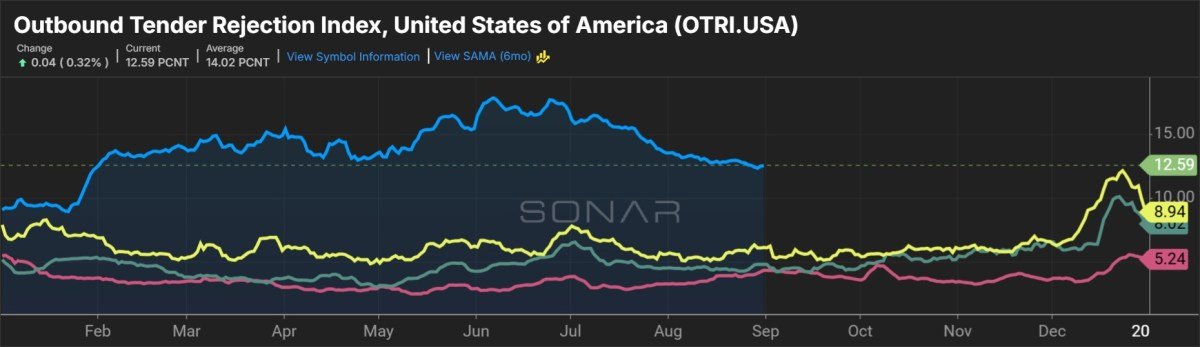
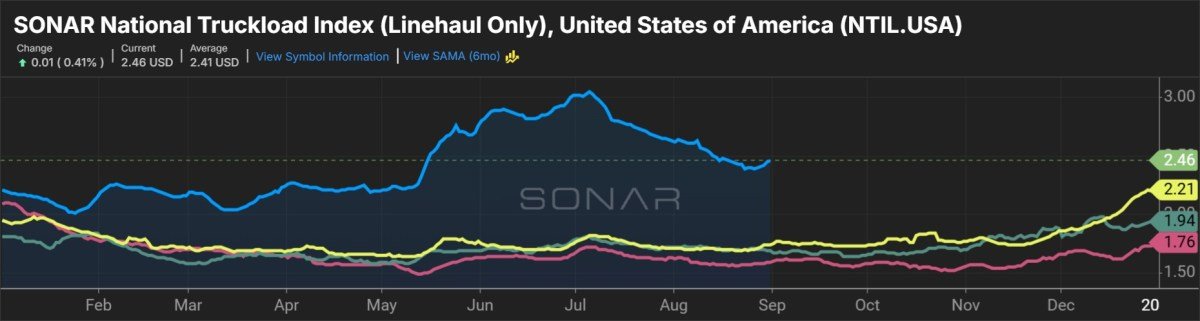
Logistics managers expect these transportation pressures to persist well into the coming year. Their 12-month-forward projections point to a transportation capacity reading of 43, transportation utilization of 71.9, and transportation pricing of 86.1.
Expectations differ significantly depending on where companies sit in the supply chain.
Upstream businesses, including manufacturers and wholesalers, anticipate substantial additional tightening in capacity over the next 12 months, with a projected reading of 38.6.
Downstream businesses, such as retailers, are considerably more optimistic about capacity. Their one-year-forward reading stands at 54.5, indicating that they expect a modest amount of additional supply to become available or enter the market.
Overall logistics growth slows as inventory expansion loses momentum
The overall LMI came in at 66.6 in August, down 2.2 points from July. The decline was largely driven by slower inventory growth rather than a broad easing in logistics costs.
“The major difference between August and readings from earlier this summer is that expansion in inventories has slowed, but logistics cost expansion remains high,” the report said.
Aggregate logistics costs combining inventory, warehousing and transportation reached 243.6 in August. That was 4.1 points higher than the previous month and remained comfortably above the LMI’s 150 breakeven level.
While tariff implementations last year had a modest inflationary effect on the dataset, the report said the Iran conflict has driven all-in supply chain costs sharply higher.
Inventory levels rose to 52.8, although the rate of growth slowed by 2.2 points during August.
The pattern differed between upstream and downstream companies. Downstream businesses recorded a reading of 61.9, indicating meaningful inventory growth, while upstream firms registered 49, pointing to a slight contraction.
That represents a reversal from July, when downstream companies were reducing inventories while upstream businesses were increasing them.
The shift may indicate that retailers are once again building inventory ahead of the fourth quarter after reducing stock levels during the back-to-school period. At the same time, elevated inventory costs — driven by higher goods prices and warehouse rents — appear to be contributing to what the report describes as a “start-stop pattern.”
Inventory costs continued to accelerate in August, reaching 78.6, an increase of 1.6 points during the month.
“It seems that earlier in the year, retailers were waiting until the last minute to bring inventories forward in an attempt to minimize holding costs,” the report said. “It will be interesting to see if the reigniting of tariffs will have an impact on this.”
Warehouse capacity expands, but prices remain elevated
The slower pace of inventory growth also affected the warehousing segment.
Warehousing capacity returned to expansion in August, reaching 53.5, up 7.2 points from July. The increase suggests some modest loosening in warehouse availability.
That improvement, however, has yet to translate into lower prices.
Warehouse prices remained elevated at 75, continuing to increase sharply despite the slightly improved capacity situation. The pace of growth was only 50 basis points slower than in July.
Warehouse utilization moved in the opposite direction, falling 6.5 points during the month to 59.6.
Taken together, the August data portray a logistics market in which capacity conditions may be showing isolated signs of easing, but cost pressures remain firmly entrenched.
The Logistics Managers’ Index is produced through a collaboration between Arizona State University, Colorado State University, Florida Atlantic University, Rutgers University and the University of Nevada, Reno, together with the Council of Supply Chain Management Professionals.
Why it matters
The Logistics Managers’ Index offers a broad view of the major costs affecting supply chains, including inventory, warehousing and transportation.
The August results point to a challenging operating environment for shippers. Although transportation capacity contracted at a slower rate than in July and warehousing capacity returned to expansion, transportation utilization and prices remain exceptionally high.
For logistics operators, the message is clear: capacity remains tight, while the cost of moving, storing and carrying goods continues to put pressure on supply chains.