




Shipping traffic is continuing to move through the Strait of Hormuz despite renewed uncertainty triggered by conflicting political announcements and ongoing regional tensions involving Iran and the United States.
After a confusing sequence of declarations over recent days, shipowners initially received confirmation that the Strait would remain open following a Memorandum of Understanding between the US and Israel on 18 June. However, Iran later announced a closure two days afterwards, linking its decision to Israeli air strikes in Lebanon, which it said violated the ceasefire framework. In parallel, the US military maintained that navigation remained open via the southern route through Omani waters, where it continues to provide maritime guidance.
Unlike previous escalations, Iran’s latest warnings were not followed by reported attacks on vessels attempting to transit the waterway, reducing immediate operational disruption for shipping lines.
Following the first round of US–Iran negotiations held in Switzerland, mediators Pakistan and Qatar reported that progress had been made, including the establishment of a dedicated communication channel aimed at reducing the risk of incidents. According to the statement, “A communication line between the parties has been formed for the period mentioned in paragraph 5 of the MoU to avoid incidents and miscommunication with the aim of safe passage for commercial vessels through the Strait of Hormuz.”
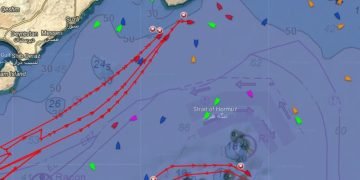
AIS tracking data from 22 June shows vessels continuing to move through both the southern corridor coordinated by US forces and the northern route passing through Iranian waters, which requires authorisation from Iranian authorities.
In the VLCC segment, data from Pole Star Global shows the Liberian-flagged Safrica Prosperity transiting into the Arabian Gulf on 22 June, while the Angola B, also Liberia-flagged, exited the Strait eastbound on 20 June. A French-flagged LNG carrier, Wadi Al Sail, was also recorded transiting westbound.
Meanwhile, eastbound movements through Iranian-controlled waters south of Larak Island include the Botswana-flagged VLCCs Virgor and Virgo, along with the Gambian-flagged Elva, all of which are listed under US OFAC sanctions.
More vessels are seen coming towards the Strait for eastbound transits, but traffic overall is still well below pre-conflict levels, as ship operators remain cautious.
A communication channel between Washington and Tehran to ensure safer passage is a positive step, analysts say, but control over the Strait of Hormuz remains a strategic lever for Iran in broader geopolitical negotiations.
Iran’s Mehr News Agency reported that Iran is demanding a full ceasefire in Lebanon as a precondition to further nuclear and bilateral talks with the United States following talks in Switzerland as regional conflicts continue to shape maritime risk in the area.
- Latest
- Trending
ADVERTISEMENT