

• Latest
  • Trending
Lithium Batteries Are Exposing Structural Weaknesses Across the Air Cargo Safety Chain

Lithium Batteries Are Exposing Structural Weaknesses Across the Air Cargo Safety Chain

March 23, 2026
Jones Act Waiver Could Open Fresh Opportunities for Tanker Owners

Jones Act Waiver Could Open Fresh Opportunities for Tanker Owners

March 23, 2026
Seafarers Are the Overlooked Civilians of the Middle East Conflict

Seafarers Are the Overlooked Civilians of the Middle East Conflict

March 23, 2026
ADVERTISEMENT
Trump Delays Threatened Strike on Iran Power Infrastructure as Hormuz Tensions Shift

Trump Delays Threatened Strike on Iran Power Infrastructure as Hormuz Tensions Shift

March 23, 2026
London Marine Insurers Reaffirm War Risk Cover Availability for Hormuz Transits

London Marine Insurers Reaffirm War Risk Cover Availability for Hormuz Transits

March 23, 2026
CIMC Raffles Enters VLCC Market with First Major Order from Bruton

CIMC Raffles Enters VLCC Market with First Major Order from Bruton

March 23, 2026
APM Terminals Accelerates Growth at Lazaro Cardenas with Phase III Expansion

APM Terminals Accelerates Growth at Lazaro Cardenas with Phase III Expansion

March 23, 2026
Behavioural Science Meets Shipping as NorthStandard Backs Crew-Led Emissions Reductions

Behavioural Science Meets Shipping as NorthStandard Backs Crew-Led Emissions Reductions

March 23, 2026
Airbus Expands Cybersecurity Capabilities with Ultra Cyber Acquisition

Airbus Expands Cybersecurity Capabilities with Ultra Cyber Acquisition

March 23, 2026
EcoCeres Launches Landmark SAF Pilot in China, Advancing Aviation Decarbonisation

EcoCeres Launches Landmark SAF Pilot in China, Advancing Aviation Decarbonisation

March 23, 2026
Dubai Airports Shows Signs of Recovery as Operations Stabilise After Regional Airspace Disruptions

Dubai Airports Shows Signs of Recovery as Operations Stabilise After Regional Airspace Disruptions

March 23, 2026
WFS Cuts Truck Processing Times at Milan Malpensa with Locally Developed SMS System

WFS Cuts Truck Processing Times at Milan Malpensa with Locally Developed SMS System

March 23, 2026
Allstates WorldCargo Acquires ELITeXPO to Strengthen Tradeshow Logistics Offering

Allstates WorldCargo Acquires ELITeXPO to Strengthen Tradeshow Logistics Offering

March 23, 2026
  • Home
  • About Us
  • Press Room
  • Podcasts
  • Media Kit
  • Contact Us
  • Careers
Monday, March 23, 2026
  • Login
  • Register
The Logistic News
  • Logistic
  • Air
  • Maritime
  • Land
  • World
  • Business
  • Tech
  • Events
  • Advertise
No Result
View All Result
  • Logistic
  • Air
  • Maritime
  • Land
  • World
  • Business
  • Tech
  • Events
  • Advertise
No Result
View All Result
The Logistic News
No Result
View All Result
Home Air

Lithium Batteries Are Exposing Structural Weaknesses Across the Air Cargo Safety Chain

As e-commerce drives rising volumes of battery-powered products into airfreight networks, new incident data suggests the industry is struggling to keep safety controls aligned with the scale and complexity of modern supply chains.

The Logistic News by The Logistic News
March 23, 2026
in Air, Logistic, Tech
Reading Time: 3 mins read
0
Lithium Batteries Are Exposing Structural Weaknesses Across the Air Cargo Safety Chain
ADVERTISEMENT

Lithium batteries have become a routine part of global air cargo. They have also become one of its most persistent and concerning safety risks.

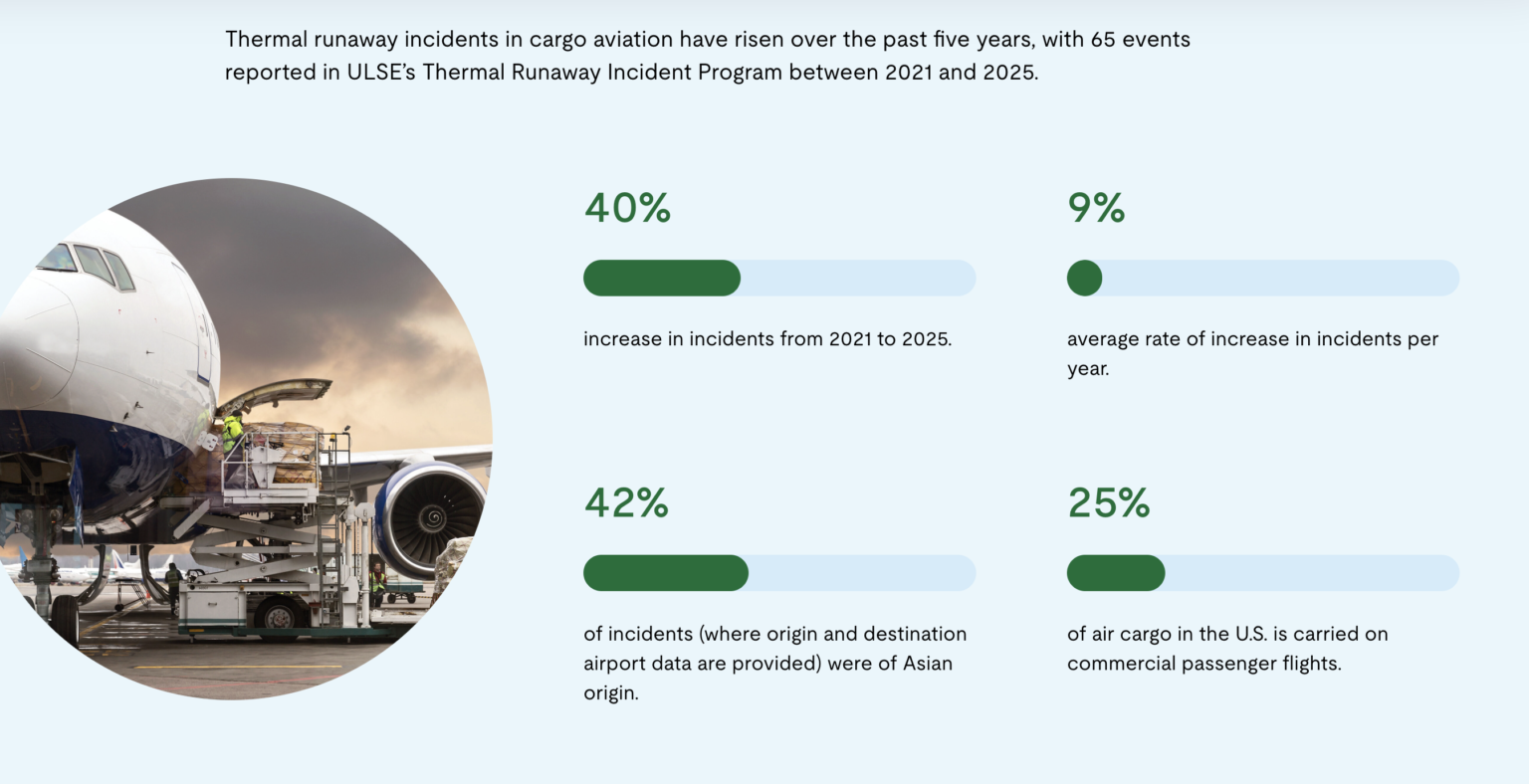
New data from UL Standards & Engagement shows that reported thermal runaway incidents in air cargo increased by 40% between 2021 and 2025, pointing not only to growing shipment volumes, but also to deeper structural weaknesses in the way these products move through the global logistics system.

The issue is no longer limited to dangerous goods compliance alone. It has become a broader supply chain problem, reflecting a system that is struggling to keep pace with the scale, speed and fragmentation of modern logistics — especially as e-commerce continues to drive unprecedented flows of battery-powered goods into air cargo networks.

ADVERTISEMENT

Unlike many traditional hazardous materials, lithium batteries are embedded in everyday products, from smartphones and laptops to power banks and household devices. That makes them both ubiquitous and difficult to control. They move in enormous volumes and often through highly layered supply chains, making end-to-end monitoring increasingly difficult.

UL Standards & Engagement’s Thermal Runaway Incident Program shows that 65 thermal runaway incidents were recorded between 2021 and 2025, representing an average annual increase of 9%. The rise is closely tied to strong consumer demand for low-cost electronics, which continues to bring more volume — and more variability — into cargo systems.

The challenge is intensified by inconsistent standards in packaging, labelling and handling. Regulations do exist, but compliance remains uneven and enforcement is fragmented across jurisdictions.

At the heart of the problem is a widening gap between responsibility and visibility. Airlines remain ultimately accountable for transporting dangerous goods safely, yet in many cases they have only limited visibility into what they are actually carrying. They are heavily reliant on declarations, documentation and upstream compliance — all of which become more fragile in a fragmented supply chain.

Lithium battery shipments often pass through multiple intermediaries before reaching an aircraft, including manufacturers, consolidators, freight forwarders and e-commerce platforms. At every handover point, oversight can weaken and opportunities for misdeclaration, error or non-compliance can increase.

The result is a system in which accountability is widely dispersed. When incidents occur, responsibility is often shifted up or down the chain rather than clearly assigned.

The report identifies two main drivers behind the rising risk: battery quality and shipper behaviour.

Non-conforming batteries, especially those produced outside recognised safety standards, are more likely to fail. At the same time, many small or individual shippers lack the technical knowledge needed to classify, package and declare these shipments correctly. In many cases, they do not even recognise lithium batteries as dangerous goods.

That lack of awareness leads directly to mislabelling, incomplete documentation and improper packaging — all of which increase the risk of thermal runaway.

Commercial pressure is another major factor. Demand for cheaper products and faster delivery creates incentives to cut corners, particularly among smaller players shipping at scale through e-commerce platforms.

Geography also matters. Around 42% of incidents with known origin data were linked to shipments from airports in Asia. That reflects both the concentration of production in the region and differences in regulatory oversight, manufacturing quality and enforcement standards.

Even so, the report makes clear that this is not a problem confined to one geography. It is the outcome of a global system marked by uneven standards, inconsistent enforcement and intense commercial pressure.

The issue is made more complex by multimodal transport. Lithium batteries often move across air, sea and road networks, each governed by different regulatory regimes. Those differences create gaps that can be exploited — intentionally or otherwise.

For the industry, the challenge is not simply to tighten the rules. It is to make compliance workable at scale.

Stakeholders point to several priorities: a clearer allocation of responsibility across the supply chain, stronger education for shippers and more consistent enforcement globally. Safety, they argue, must be treated as a commercial imperative rather than a financial burden.

Current practice suggests the opposite. Too much of the system still depends on trust — a model that becomes harder to sustain as shipment volumes rise and supply chains grow more complex.

For air cargo, the implications are immediate. A significant share of freight still moves on passenger aircraft, meaning failures in packaging, declaration or handling upstream can translate directly into in-flight risk.

Aviation remains one of the safest transport modes overall, but the nature of the risks is evolving. Airbus data shows that the global network carried more than five billion passengers in 2025, alongside an estimated 20 to 25 billion electronic devices, many of them powered by lithium batteries. That makes battery-related fire risk a serious safety issue requiring collective industry attention.

As volumes continue to grow, the challenge is no longer about isolated incidents alone. It has become a reflection of how modern supply chains are evolving under increasing commercial and operational pressure.

UL Standards & Engagement recommends three main areas of action: first, establishing clear and enforceable responsibility across the supply chain so that all stakeholders understand and uphold their role in compliance, safety and documentation; second, strengthening education and global coordination to reduce ambiguity, improve shipper understanding and limit misdeclaration; and third, aligning safety and cost by ensuring that regulations, training and enforcement make compliance the most economically rational choice.

Shipping batteries that meet recognised safety standards, the organisation notes, can materially reduce risk, as compliant batteries have consistently proven to be safer and less prone to fire.


Previous Post

Trailer Storage Gains Momentum as Tariffs and Nearshoring Redefine Supply Chain Needs

Next Post

Air Cargo Rates Jump as Middle East Conflict Tightens Capacity and Pushes Fuel Costs Higher

Next Post
Air Cargo Rates Jump as Middle East Conflict Tightens Capacity and Pushes Fuel Costs Higher

Air Cargo Rates Jump as Middle East Conflict Tightens Capacity and Pushes Fuel Costs Higher

Leave a Reply Cancel reply

Your email address will not be published. Required fields are marked *

A D V E R T I S E M E N T

Popular News

  • Drone Delivery Takes Flight: Amazon Partners with UPS for Trial Program

    Drone Delivery Takes Flight: Amazon Partners with UPS for Trial Program

    0 shares
    Share 0 Tweet 0
  • Rail Cargo Group Strengthens European Network with Captrain Netherlands Acquisition

    0 shares
    Share 0 Tweet 0
  • Automotive Inbound Logistics Market: Navigating Future Challenges

    0 shares
    Share 0 Tweet 0
  • Global Inflation Cools to Target After Three Years, Central Banks Face Policy Dilemma

    0 shares
    Share 0 Tweet 0
  • Dubai Mercantile Exchange Rebrands as Gulf Mercantile Exchange Following Saudi Tadawul Group Acquisition

    0 shares
    Share 0 Tweet 0

Recent News

Jones Act Waiver Could Open Fresh Opportunities for Tanker Owners

Jones Act Waiver Could Open Fresh Opportunities for Tanker Owners

March 23, 2026
Seafarers Are the Overlooked Civilians of the Middle East Conflict

Seafarers Are the Overlooked Civilians of the Middle East Conflict

March 23, 2026
Trump Delays Threatened Strike on Iran Power Infrastructure as Hormuz Tensions Shift

Trump Delays Threatened Strike on Iran Power Infrastructure as Hormuz Tensions Shift

March 23, 2026

Discover a new era of logistics reporting with The Logistic News, your go-to platform for breaking news, insightful features, and exclusive interviews shaping the global logistics and freight landscape. Trust us to deliver accurate, timely, and relevant information that empowers professionals and enthusiasts alike in navigating the intricacies of this vital sector.

Navigation

  • Home
  • About Us
  • Press Room
  • Podcasts
  • Media Kit
  • Contact Us
  • Careers
  • Privacy Policy
  • Terms of Use

© 2024 - thelogisticnews.com

Welcome Back!

Login to your account below

Forgotten Password? Sign Up

Create New Account!

Fill the forms below to register

All fields are required. Log In

Retrieve your password

Please enter your username or email address to reset your password.

Log In

SIgn Up Newsletter

This will close in 20 seconds

Manage Cookie Consent
We use technologies like cookies to store and/or access device information. We do this to improve browsing experience and to show (non-) personalized ads. Consenting to these technologies will allow us to process data such as browsing behavior or unique IDs on this site. Not consenting or withdrawing consent, may adversely affect certain features and functions.
Functional Always active
The technical storage or access is strictly necessary for the legitimate purpose of enabling the use of a specific service explicitly requested by the subscriber or user, or for the sole purpose of carrying out the transmission of a communication over an electronic communications network.
Preferences
The technical storage or access is necessary for the legitimate purpose of storing preferences that are not requested by the subscriber or user.
Statistics
The technical storage or access that is used exclusively for statistical purposes. The technical storage or access that is used exclusively for anonymous statistical purposes. Without a subpoena, voluntary compliance on the part of your Internet Service Provider, or additional records from a third party, information stored or retrieved for this purpose alone cannot usually be used to identify you.
Marketing
The technical storage or access is required to create user profiles to send advertising, or to track the user on a website or across several websites for similar marketing purposes.
Manage options Manage services Manage {vendor_count} vendors Read more about these purposes
View preferences
{title} {title} {title}
No Result
View All Result
  • Logistic
  • Air
  • Maritime
  • Land
  • World
  • Business
  • Tech
  • Events
  • Advertise

© 2024 - thelogisticnews.com