



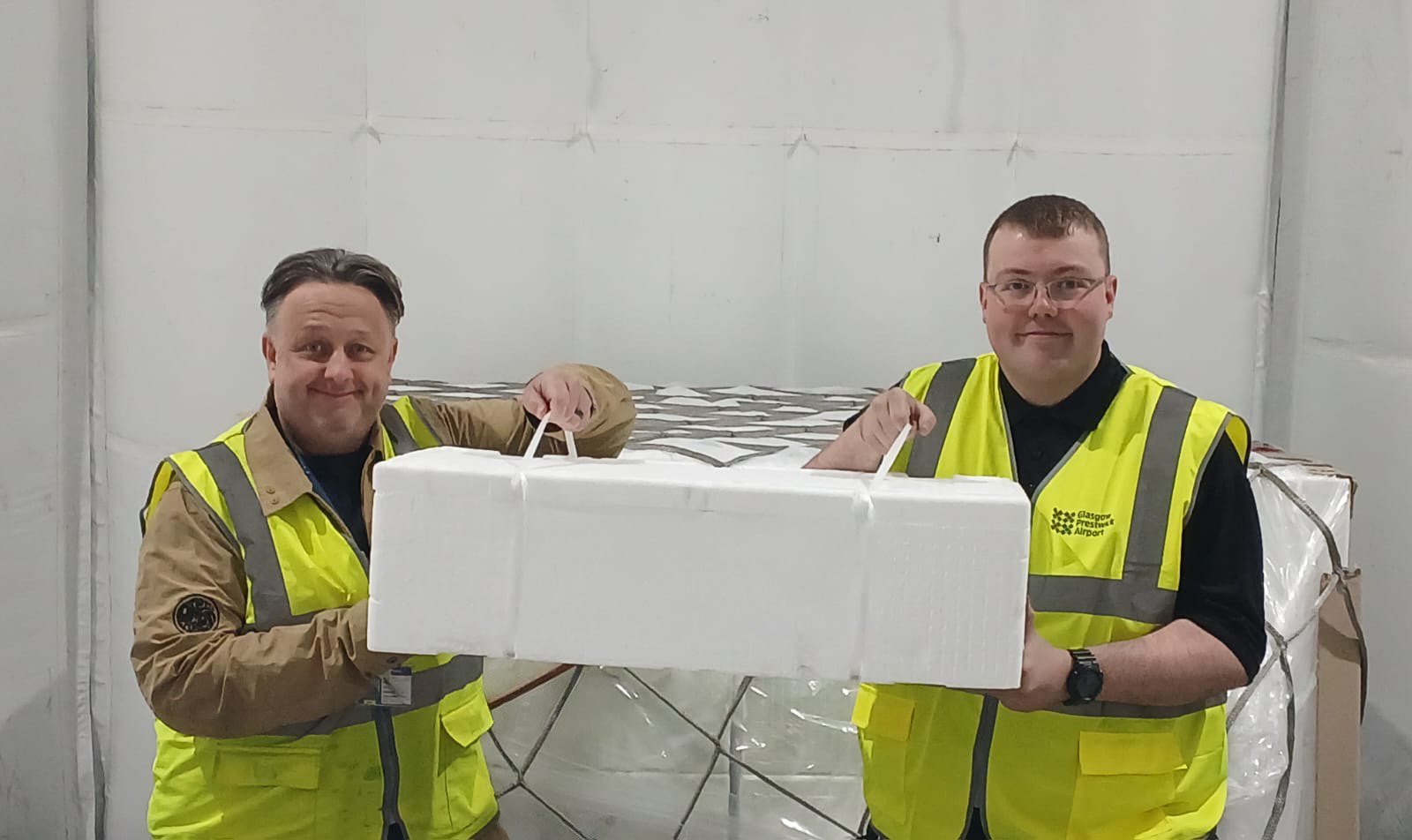
Glasgow Prestwick Airport (PIK) has reached a significant milestone, handling one million kilograms of Scottish salmon exports since 1 January 2026, underlining the rapid growth of its specialised seafood export corridor.
This performance follows the launch of the airport’s Scotland-to-China seafood export service last September, a route supported by major investment in dedicated equipment, cold-chain staffing and temperature-controlled infrastructure designed for time-sensitive goods.
The airport’s seafood handling setup now includes high volume metal detection systems, temperature exposure and tracking tools, as well as 87 tonnes of chiller capacity, all aimed at preserving product quality from origin to destination.
According to Ian Forgie, Chief Executive Officer of Glasgow Prestwick Airport, the milestone reflects both scale and efficiency gains in the export chain.
He said exporters are increasingly using the service at volume, and that recent investments in facilities, personnel and specialist handling have helped create a faster and more resilient route to international markets.
He also highlighted the importance of speed in the seafood supply chain, noting that reducing time between catch and final market directly impacts quality, shelf life and overall export value.
The achievement comes amid continued expansion of cargo activity at Prestwick, supported by growing scheduled freighter capacity.
Air China Cargo has significantly increased its operations on the Prestwick–Chengdu route, expanding from four weekly flights to a daily service in March. This brings total direct scheduled cargo flights between Prestwick and mainland China to 15 per week, with 11 operated by Air China Cargo and four by China Southern Logistics.
Ethiopian Airlines has also strengthened connectivity, adding three weekly cargo flights to Hong Kong earlier this month. This expansion further reinforces Prestwick’s position as a logistics gateway for Asian trade flows, while also opening additional export opportunities toward fast-growing markets such as South Korea and Vietnam.
Together, these developments are positioning the airport as a growing hub for high-value, time-sensitive agri-food exports, particularly within the Scottish seafood sector.