



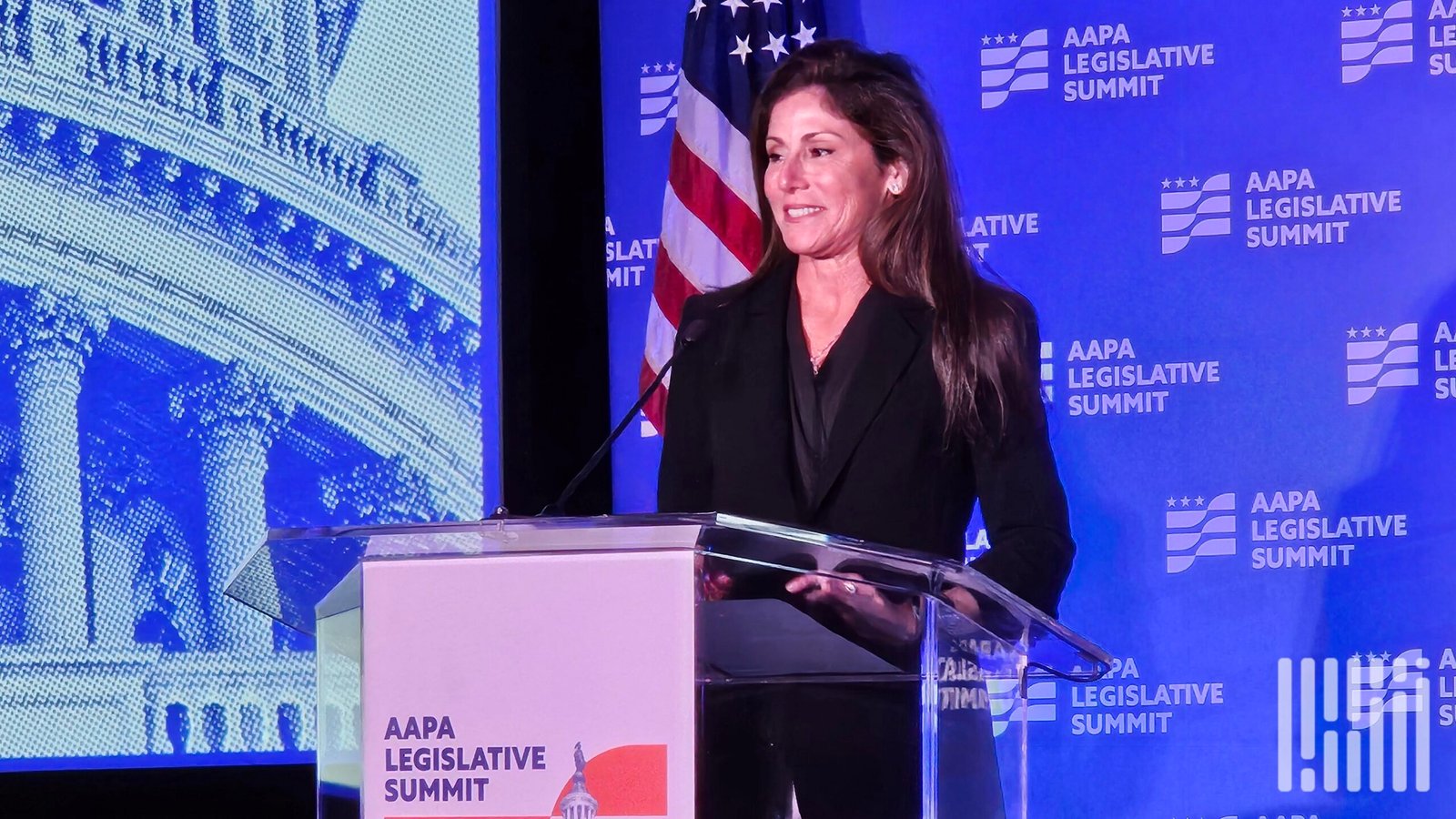
Federal Maritime Commission Chair Laura DiBella has described the current moment as a rare and critical opportunity to rebuild the strength of the US shipping industry and reinforce the port infrastructure that underpins both freight movement and economic security.
Speaking at the American Association of Port Authorities legislative summit in Washington, DiBella said the Trump administration is making what she called the strongest push in decades to support the maritime sector.
DiBella, who previously served as Florida’s first female Secretary of Commerce, as well as president and chief executive of Enterprise Florida and president of business development at the Florida Department of Commerce, said the pandemic-era supply chain crisis permanently changed how the world sees seaports.
In her view, ports are essential to economic development, economic security and economic stability. She stressed that there are simply not enough planes, trains or trucks to move the volumes of freight carried by ship, and said seaports function as indispensable hubs for logistics, consumer goods, energy and raw materials, while also generating jobs, driving innovation and serving as strategic national security assets.
DiBella noted that more than 80% of global trade moves by sea, while more than 95% of US import cargo enters by ship, making ports vital economic engines for both local communities and the national economy.
She also argued that the role ports play in supporting small businesses is often overlooked. That segment, she said, represents 98% of all businesses, and seaports help those firms access international markets, diversify operations and compete globally by connecting them with businesses of every size.
While saying she supports the Maritime Opportunity Zones included in the MAP, DiBella stressed the need for balance. She said policymakers must not lose sight of what she called today’s existing maritime opportunity zones — namely, the nation’s seaports.
She listed a wide range of urgent investment needs, including dredging, channel deepening, berth enhancements, crane upgrades, and road and rail improvements, and said she looks forward to seeing the financial support needed to move these priorities forward.
DiBella was nominated by President Trump in September 2025, confirmed by the Senate in December, and elevated to chair in January. She is the third woman to lead the FMC, following Helen Delich Bentley and Elaine Chao.
She also highlighted the commission’s bipartisan structure, saying party lines are rarely visible in the agency’s work. The FMC currently includes Republicans Rebecca Dye and Robert Harvey, who is awaiting confirmation, alongside Democratic commissioners Daniel Maffei and Max Vekich.
Reflecting on the agency’s role, DiBella said the FMC’s roots go back to World War I, with its mission further strengthened during the Kennedy administration. She described the FMC as complementary to the Maritime Administration (Marad), which focuses primarily on Jones Act and US-flag shipping, while the FMC is more directly concerned with cargo and with protecting consumers, shippers, importers and exporters.
She underscored that when it comes to US shippers, the FMC’s jurisdiction follows the cargo wherever it is in the world.