




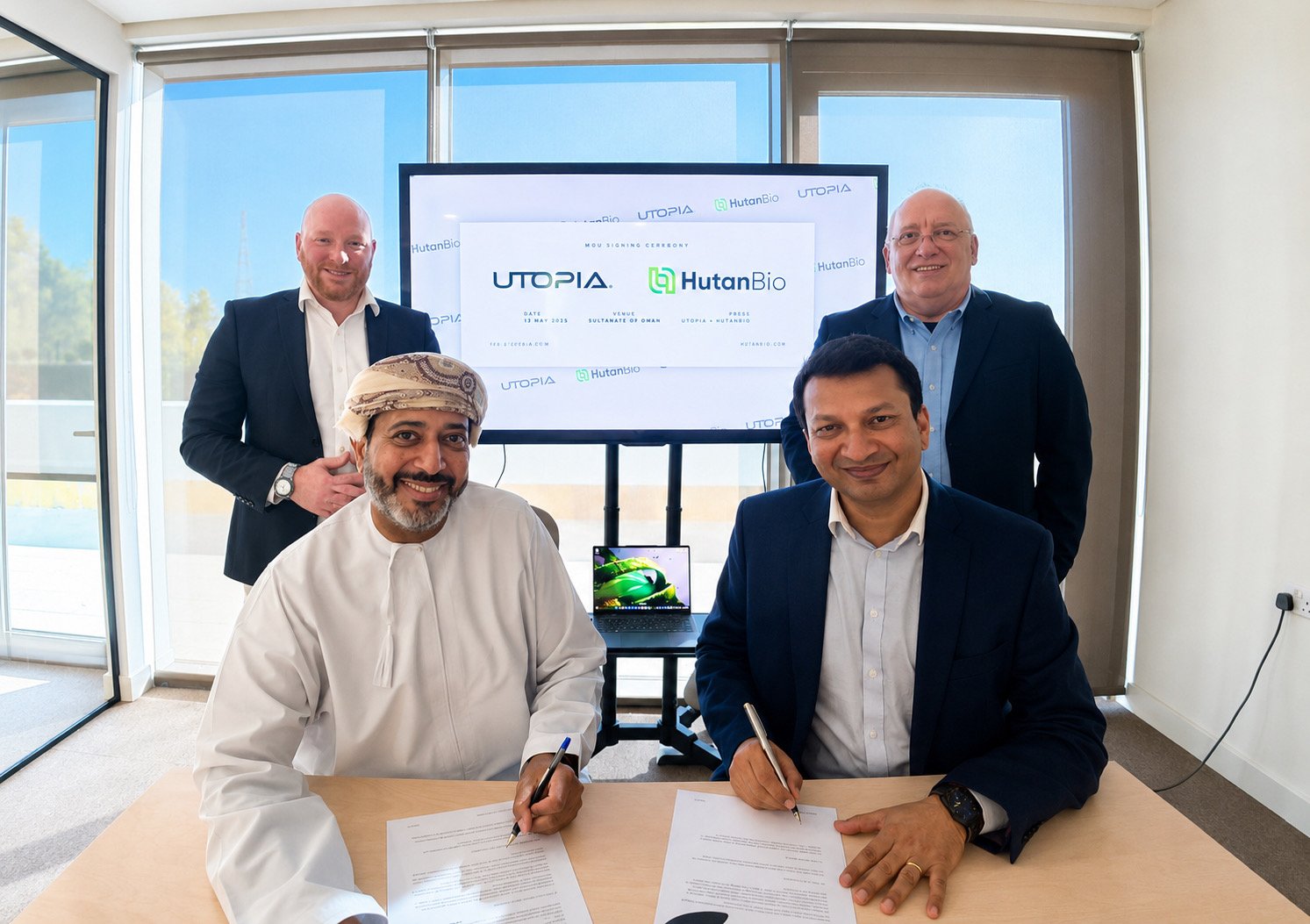
A UK-based biotechnology company is taking a significant step toward scaling sustainable aviation fuel (SAF) production, as it moves closer to commercial deployment of its algae-based fuel platform through a new partnership in Oman.
HutanBio, a Cambridge-founded biotech firm, has signed its first commercial Memorandum of Understanding (MoU) with Wakud International, an Omani company that owns the country’s first dedicated biodiesel refinery. The agreement is intended to support the future offtake of algae-derived oils used in SAF production.
The partnership comes at a critical moment for the aviation and air cargo industries, which are increasingly searching for scalable and sustainable feedstock solutions capable of meeting long-term decarbonisation targets.
Algae-based fuel production without land or freshwater constraints
HutanBio’s technology platform uses marine microalgae to produce low-carbon oil feedstocks using seawater, sunlight and carbon dioxide. The process, unlike conventional biofuel systems, does not depend on arable land or freshwater resources, which greatly diminishes the competition with food production and water supply.
The company, founded in 2019, is developing what it describes as a scalable low-carbon oil platform designed to support sustainable fuel production for hard-to-abate sectors such as aviation, maritime transport and heavy industry.
Its research origins trace back to the University of Cambridge and were further developed at King Abdullah University of Science and Technology (KAUST) in Saudi Arabia. Early academic work led to the discovery of a previously unidentified organism that now forms the basis of the company’s proprietary technology.
While production will be based in Oman, HutanBio maintains its intellectual property and engineering expertise in the UK, reinforcing Cambridge’s position as a global hub for advanced biofuel innovation.
Oman selected for optimal scaling conditions
The decision to establish the first commercial site in Oman reflects the country’s strong natural and industrial advantages, including high solar exposure, coastal desert geography, access to saline water and existing refinery infrastructure.
According to the company, these conditions make Oman particularly suitable for scaling algae-based fuel production at industrial levels.
“This agreement is an important step towards commercial deployment and demonstrates how new feedstock pathways can support the future growth of sustainable aviation fuels,” HutanBio noted.
The company also highlighted its broader ambition to diversify global fuel supply chains and reduce reliance on traditional fossil-based systems.
“Oman offers a unique combination of solar intensity, coastal geography, human capital and existing refinery infrastructure, making it one of the strongest locations globally to scale our platform,” the company added.
It further stated that aviation, shipping and heavy transport will continue to depend on liquid fuels for decades, underlining the need for alternative low-carbon solutions.
Strategic positioning for future SAF demand
The MoU marks an important milestone for HutanBio as it moves toward commercialisation, while also addressing one of the key challenges facing the SAF industry: the limited availability of scalable feedstock sources.
By securing early offtake interest, the company aims to support future production stability and market readiness as demand for SAF increases across aviation supply chains.
John Jones, COO of Utopia World BioEnergy, emphasized the strategic importance of the partnership: “By partnering with HutanBio, Utopia World is proactively building a pipeline of ultra-low carbon feedstocks for 2027 and beyond, ensuring continuity, scalability and integrity in future fuel production.”
Backing from UK innovation investment
HutanBio is supported by the UK Innovation & Science Seed Fund (UKI2S), managed by Future Planet Capital, through its Engineering Biology portfolio, which focuses on early-stage breakthrough technologies with environmental and industrial applications.
According to UKI2S Investment Lead for Engineering Biology, Oliver Sexton, the company’s platform represents a major advancement in sustainable fuel development.
“HutanBio’s unique carbon negative platform has shown it produces high quality aviation grade fuel that is entirely sustainable,” Sexton said.
He added that the technology offers an alternative to battery-based solutions for energy-dense transport sectors, while also improving energy security by enabling fuel production using sunlight, space and seawater, independent of geopolitical constraints.
As SAF demand continues to grow, the partnership between HutanBio and Wakud International positions algae-based feedstocks as a potential long-term contributor to aviation’s decarbonisation strategy.
- Latest
- Trending
ADVERTISEMENT