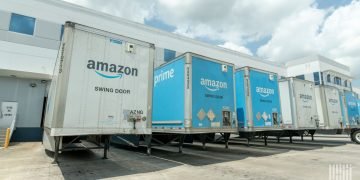





Amazon has expanded its logistics ambitions by opening its less-than-truckload (LTL) shipping service to all businesses, extending its reach far beyond its previous inbound-only model tied to Amazon facilities. The move adds another layer to the company’s broader strategy of building an end-to-end logistics offering under Amazon Supply Chain Services.The newly expanded service now allows shipments to move not only into Amazon warehouses but also directly to third-party distribution centers, retail stores and other business destinations across the United States. The development follows last month’s rollout of freight, distribution, fulfillment and parcel shipping services for non-Amazon sellers, marking a significant step in Amazon’s push to position itself as a full-scale logistics provider.Amazon initially launched its LTL service in April 2025, targeting shipments that do not require a full truckload. At that stage, the service was limited to inbound deliveries to Amazon facilities, where goods were broken down and redistributed through its parcel network. The company had also offered limited LTL capacity since 2019, but the latest expansion significantly broadens its operational scope.Amazon now describes its model as a traditional hub-and-spoke LTL network, where palletized freight is collected, transferred through regional terminals and delivered still on pallets to final destinations at lower costs than legacy carriers. The company says it operates a fleet of 80,000 trailers and 24,000 intermodal containers to support this network.The announcement has sparked debate across the logistics industry about the true nature of Amazon’s role in the LTL market. While some analysts see the move as a potential disruption to established carriers such as FedEx Freight, Old Dominion, Saia and Estes, others argue Amazon is effectively positioning itself as a freight broker rather than an asset-heavy carrier.Satish Jindel, president of ShipMatrix, said Amazon lacks the traditional infrastructure required to operate as a conventional LTL carrier, such as terminals, drivers and sorting facilities.“They are trying to offer a brokerage service. They don’t have drivers. They don’t have trucks. They don’t have terminals to sort and load and deliver and pickup,” Jindel said. “They are looking to leverage their relationship as a large LTL inbound customer to offer lower rates for pickup and delivery of shipments that don’t touch an Amazon facility.”He added that Amazon’s scale in trailers is likely overstated compared to established carriers in the market.Amazon, however, maintains that the expansion is driven by customer demand from its selling partners, who have already been using its initial LTL offering.“The feedback from Amazon selling partners using our LTL service was clear: the technology, visibility, and reliability were exactly what they needed — and they wanted to use it more broadly,” said Jim Ruiz, director of Amazon Freight. “Now Amazon LTL can move your freight wherever it needs to go, servicing destinations nationwide for businesses of all sizes.”The service allows businesses to ship between one and six pallets, or loads ranging from 150 to 15,000 pounds, between warehouses, distribution centers and retail partners. Amazon is also introducing features such as next-day live pickup for orders placed before 5 p.m., same-day pickup through a drop-trailer system and scheduled daily pickups for high-volume customers.The drop-trailer model uses a shared pool of trailers for both LTL and full truckload shipments, which are left at customer sites for loading rather than being immediately unloaded upon arrival.Additional features include real-time GPS tracking, automated appointment scheduling, electronic proof-of-delivery and sensor-equipped trailers designed to improve cargo visibility and security.Amazon Freight, which operates under Amazon Supply Chain Services, now spans full truckload, LTL and rail services, reinforcing the company’s broader ambition to become a central player in global logistics infrastructure.Interest in Amazon’s expanded LTL ambitions had already been building earlier this year, following a Morgan Stanley report suggesting the company had been actively engaging shippers to test demand for the service.
- Latest
- Trending
ADVERTISEMENT