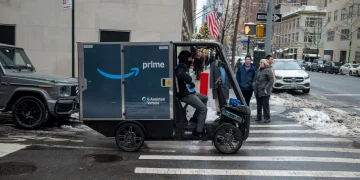




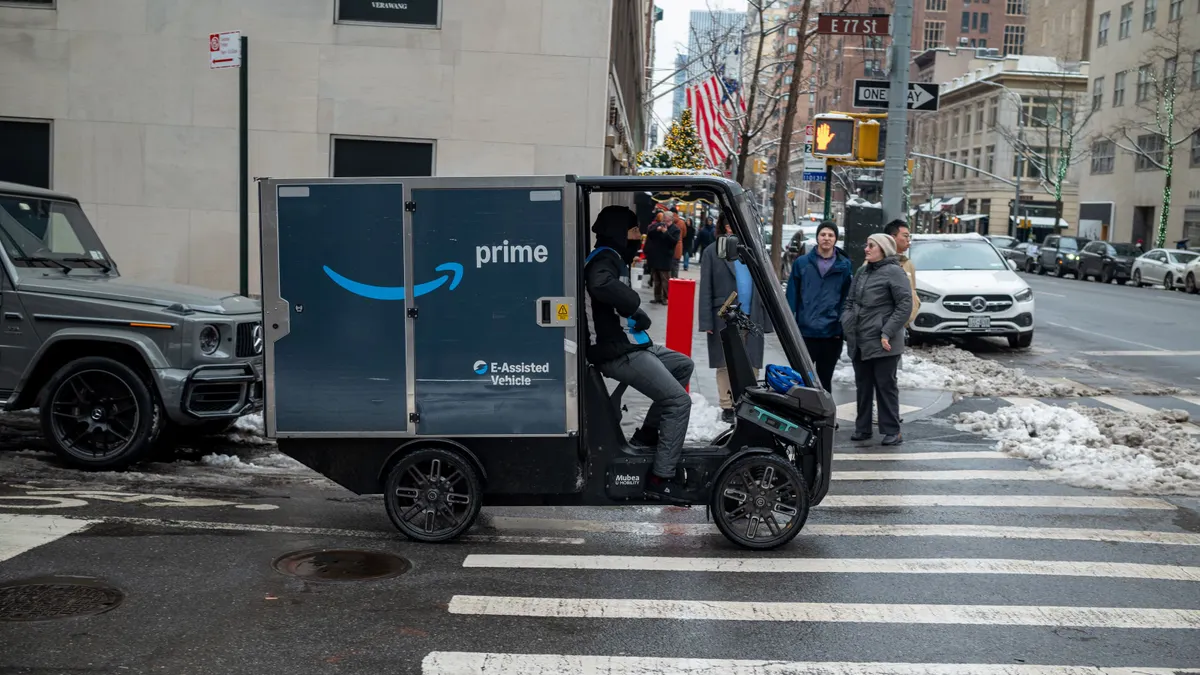
Every day, Amazon-branded vehicles move through New York City carrying packages that have been sorted, processed and fulfilled by the e-commerce giant. Yet the drivers behind the wheel are generally not Amazon employees.
Instead, many work for independent companies known as Delivery Service Partners, or DSPs, which operate under contract with Amazon to handle last-mile deliveries.
Amazon is far from the only carrier relying on this model. FedEx uses contracted service providers for its ground deliveries, while alternative carriers such as OnTrac and Gofo also depend on independent businesses to support their shipping networks.
A proposed New York City bill could significantly change how that system works.
The Delivery Protection Act would restrict the use of third-party contractors at last-mile warehouses and distribution facilities by requiring operators to directly employ core delivery and warehouse workers.
The proposal has already drawn a sharp divide between supporters, who say it would improve worker protections and public safety, and opponents, who warn it could increase shipping costs, disrupt delivery networks and slow service across the city.
New York City Mayor Zohran Mamdani voiced his support for the legislation earlier this month. The bill is currently before the City Council’s Committee on Consumer and Worker Protection.
Under the proposal, affected companies would receive a two-year grace period to comply with the direct-employment requirement. The legislation would also introduce a licensing system for storage and distribution facilities, alongside new safety, training and labor standards.
Those training requirements would include guidance on when and where drivers should make delivery stops along heavily trafficked roads, as well as measures designed to protect pedestrians during frequent stops.
According to Mamdani’s office, the legislation is intended to give the city greater oversight of last-mile operations and make companies such as Amazon more directly accountable for delivery drivers’ quotas, schedules and routes. It is also presented as a response to what officials describe as worsening traffic-safety problems around delivery facilities.
Exactly how quickly the bill could advance remains uncertain.
But its potential impact could extend well beyond New York. If passed, the legislation could become a template for other major U.S. cities while adding another layer of complexity for last-mile operators, according to Shawn Compton, chief logistics officer at DCL Logistics.
The International Brotherhood of Teamsters, which supports the Delivery Protection Act, is already pushing for similar legislation in Chicago.
“This could have a much farther-reaching impact because nobody’s expecting it to stay just in New York City if it passes,” Compton said in an interview with Supply Chain Dive.

Higher costs could push operations outside New York
One of the biggest questions surrounding the proposal is what companies would do if they were forced to convert contracted drivers into direct employees.
An economic and transportation analysis prepared by consultancy AKRF in June concluded that full compliance would increase labor and operating expenses for companies such as Amazon.
Rather than absorb those additional costs, carriers could move a significant share of their distribution activity outside New York City, particularly to nearby locations in New Jersey, according to the report.
The analysis was prepared for the Five Borough Jobs Campaign, an organization that supports New York Delivers, a coalition opposed to the legislation. The coalition includes Amazon, FedEx, Prologis and several smaller logistics companies.
Moving facilities farther away from customers could have direct consequences for delivery performance.
Longer journeys between distribution facilities and delivery routes would reduce network efficiency and eliminate dozens of stops that drivers can currently complete during a shift. The result, according to the AKRF report, could be slower deliveries for New York customers, particularly those in the outer boroughs.
Same-day and next-day services could also be reduced, while the availability of certain products could change.
The report estimates that about 36% of the city’s current daily parcel volume is connected to contractor operations that could be affected by the legislation.
Households and small businesses could also face higher per-package delivery costs if the bill becomes law. The size of any increase, however, would depend largely on how extensively carriers decide to relocate their operations.
Amazon is at the center of the dispute
Amazon has been one of the most vocal opponents of the proposal.
The company told the City Council’s Committee on Consumer and Worker Protection that the bill would prevent it from maintaining agreements with more than 40 local businesses currently involved in making deliveries across New York City.
Amazon has also pointed to safety improvements within its delivery operations and warned that it could move delivery facilities and other operations outside the city while continuing to serve customers if the legislation passes.
The company has urged City Council members to visit its delivery stations and meet with its delivery partners and their employees before voting.
Amazon argues that such a move could put thousands of New Yorkers’ jobs at risk and force local delivery businesses out of the market.
“We’re trying to prevent that by working collaboratively with the City Council,” Amazon said, while inviting council members to see its delivery operations firsthand.
Supporters of the bill take the opposite view.
Mamdani’s administration argues that Amazon’s reliance on contractors allows the company to avoid direct responsibility for safety and labor problems connected to its delivery network.
Julie Su, New York City’s deputy mayor for economic justice, said Amazon has spent years operating through a complicated subcontracting structure that leaves last-mile drivers without the same protections available to other workers, despite the company maintaining significant control over their schedules, workloads and uniforms.
Supporters believe the Delivery Protection Act would close that gap, strengthen safety for drivers and communities, and address what they see as an imbalance of power between large corporations and contracted workers.
A possible middle ground
Not everyone calling for changes to Amazon’s contractor model believes direct employment is the only solution.
Jason Burns, founder of Last2First, a community platform for last-mile delivery professionals, said some of the concerns surrounding the contractor system are legitimate. But he believes lawmakers could consider less disruptive alternatives.
One possibility would be to give contractors greater leverage in their commercial relationships with Amazon while increasing Amazon’s accountability for how those partnerships operate.
Burns, who previously owned last-mile delivery company QCS Logistics, also pointed to risk management, safety and compliance as areas where improvements could be made.
He argued that some contractual provisions between Amazon and its delivery partners may need to be revised to create a more balanced relationship.
FedEx, DoorDash and other operators could also be affected
Although Amazon has become the most visible target of the legislation, the potential impact reaches much further across New York City’s delivery ecosystem.
A City Council committee report from April found that nearly 30% of the city’s 50 last-mile delivery facilities larger than 50,000 square feet are operated by Amazon.
FedEx and UPS together account for another 60%, while the remaining facilities are associated with other logistics providers.
FedEx stressed the growing importance of these facilities as e-commerce continues to expand, describing last-mile delivery infrastructure as an increasingly essential part of the system that keeps New York City operating.
DoorDash has also raised concerns.
The company warned that the bill could make its neighborhood-scale DashMart operations economically unviable if regulators or courts determine that the legislation applies to those locations.
DoorDash currently operates five DashMart sites in New York City. Ivan Garcia, the company’s head of government relations for New York City, described them as local convenience stores that customers access virtually through the DoorDash app, with orders delivered by independent gig workers known as Dashers rather than DoorDash employees.
If the legislation becomes law, DoorDash said it could be forced to “curtail some operations and shutter others” to avoid additional costs associated with directly employing delivery workers who might make only a handful of deliveries each month from DashMart locations.
Garcia noted that Dashers generally make deliveries from multiple third-party merchant locations across the city. However, they occasionally collect orders from facilities that could fall under the bill, including DashMarts.
Some carriers could actually benefit
The legislation could create winners as well as losers.
While companies built around contractor-based delivery networks could face higher costs or be forced to relocate operations, carriers that already directly employ their drivers could gain additional parcel volume.
The AKRF report identified UPS and the U.S. Postal Service as potential beneficiaries, forecasting slight increases in their parcel volumes if competitors relying on contractors reduce or withdraw their operations in New York City.
UPS, in particular, may be better positioned because it already directly employs its delivery workforce.
“UPS has been paying it forward in this regard already,” Compton said. “They do hire their workers, and so they’re already poised for this.”
For now, the Delivery Protection Act remains under consideration by the City Council’s Committee on Consumer and Worker Protection. Its eventual fate could determine not only how Amazon and other carriers operate in New York City, but potentially whether other major U.S. cities adopt similar rules for the rapidly expanding last-mile delivery sector.