



Officials are seeing a surge in turtle trafficking on a scale they have rarely witnessed, according to the U.S. Fish and Wildlife Service (USFWS). Since October 2024, the Bronx Zoo of the Wildlife Conservation Society has treated and rehabilitated more than 800 North American box turtles seized from illegal wildlife trafficking operations.
The Bronx Zoo has become an important partner for the USFWS, offering emergency care, veterinary care, quarantine and rehabilitation for animals seized by law enforcement. Its teams also work on criminal investigations and help authorities find safe and suitable places for the turtles to go once they have recovered.
It is thought that most of the animals were taken from the wild to supply the international wildlife pet trade. Many were intercepted in transit through airports in and around New York City. Some were badly dehydrated or malnourished when they arrived at the Bronx Zoo and others had injuries or infectious diseases.
Confiscated turtles’ first stop
It’s not the first time the WCS Bronx Zoo has taken in confiscated wildlife. The facility has been caring for illegally trafficked animals for decades and works with government agencies to help support criminal investigations and to figure out the best and safest placement options for confiscated wildlife.
The scale of the operation is what has changed.
In 1996, WCS zoos and aquariums in New York City rescued and rehabilitated over 100 confiscated animals. By 2025 that had risen to some 500 animals a year. The cases now include a broad range of wildlife, including birds, mammals, reptiles, fish, corals and other species.
The growth is a signal of the growing role accredited zoos and aquariums play in the battle against wildlife trafficking.
The need has been especially acute for turtles. Since October 2024, the Bronx Zoo has rescued and rehabilitated over 800 North American box turtles. Of the turtles received to date, most have been Eastern box turtles, 3-toed box turtles, ornate box turtles and Florida box turtles.
Other species found in trafficking cases include Gulf Coast box turtles, spotted turtles and diamondback terrapins.
In certain cases it is not possible to know exactly where an individual turtle came from. Details of specific cases may be confidential while a criminal investigation is ongoing. Most now seem to have been collected from the wild to be sold on the international wildlife pet market.
Many arrive after having been subjected to extremely harsh conditions. Bronx Zoo staff have treated turtles for dehydration and severe weight loss, as well as animals suffering from injuries and infectious diseases.
“The Wildlife Conservation Society’s Bronx Zoo is doing important work in the fight against the illegal wildlife trade by partnering with law enforcement agencies to provide triage, quarantine, veterinary care, rehabilitation and placement for turtles and tortoises seized by law enforcement,” said Kevin Torregrosa, Bronx Zoo Curator of Herpetology.
“Lots of the turtles and tortoises show up in very poor condition,” Torregrosa said, due to how they were transported or held prior to being confiscated.
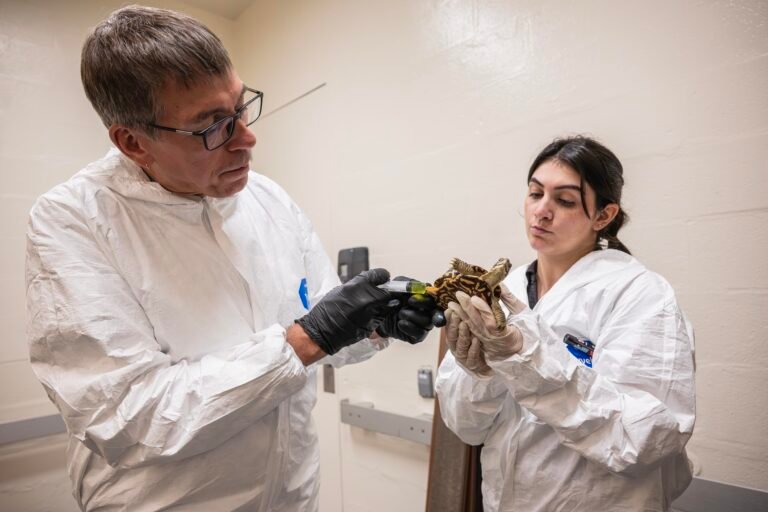
Due to their specialized expertise, the zoo’s teams are able to stabilize the animals and give them the care they need while investigations continue and authorities work to determine their long-term future.
“It’s not just about saving individual turtles,” Torregrosa said. It also supports broader efforts to combat wildlife trafficking, protect threatened and endangered species, and conserve wild turtle and tortoise populations.
What do you get when a turtle walks into the Bronx Zoo?
The process starts the moment a turtle is seized.
Each animal receives a complete intake exam. Veterinary and husbandry teams check its overall condition, record any injuries, test for disease, weigh it and establish its species and sex. Treatment with fluids and medical treatment if needed.
Depending on the animal’s health and individual needs, it is then either quarantined or moved into rehabilitation.
Not every turtle makes it.
Some are so badly off when they arrive that they die, even with intensive veterinary treatment. Others may be killed if their outlook is considered too poor. Sometimes animals die on the way to the zoo.
But many of them respond to treatment and start to recover under the care of the Bronx Zoo teams.
Disposition plans from the USFWS determine what happens next to a turtle once it’s healthy again. Depending on the species, the condition of the turtle, the circumstances of the case and the applicable legal requirements, rehabilitated turtles may be transferred to accredited zoological institutions or to conservation organizations.
Biologically possible and legally permitted, some animals may eventually be released back into protected habitat in the wild.
Wild turtle populations under threat from illegal harvest
Turtle trafficking affects far more than the animals seized by authorities.
Removing large numbers of turtles from the wild can have serious and long-term effects on local populations. Box turtles are especially vulnerable because of their biology: slow growth, slow reproduction, and long life span.
This makes it hard for wild populations to replace lost adult turtles
“Box turtles are especially at risk because they are slow growers and slow reproducers,” Torregrosa said. “Removing large numbers of breeding adults from the wild can be detrimental to local populations. If they do get any recovery at all it could take decades or generations,” Curnick said.
Many of the turtles that are part of trafficking cases are protected under the Convention on International Trade in Endangered Species of Wild Fauna and Flora (CITES). Others are protected by state wildlife laws.
For example, taking or possessing Eastern box turtles in New Jersey and New York is illegal.
The growing number of turtles seized points to two realities. Law enforcement agencies are increasing their efforts to detect and intercept wildlife trafficking, but international demand for turtles in the pet and hobbyist markets remains high.
Wildlife experts say the illegal collection and export of native turtles has been going on for decades, with overseas demand for wild-caught animals still a major driver of the trade.
Bronx Zoo Turtle Rescue Program: The Numbers
The role of the Bronx Zoo: The zoo provides emergency triage, quarantine, veterinary care, rehabilitation, animal husbandry and assistance with the long-term placement of wildlife confiscated by law enforcement agencies.
Primary law enforcement partner: U.S. Fish and Wildlife Service
Turtles rescued since October 2024. Over 800 North American box turtles have been rescued and rehabilitated at the WCS Bronx Zoo.
Species received: Florida box turtle, ornate box turtle, three-toed box turtle, eastern box turtle.
Origin The exact origin of individual animals is not always known with certainty but the great majority appear to have been collected from the wild.
Target market: The global wildlife pet industry.
Condition on arrival: Animals seized may be dehydrated, malnourished, injured, sick or carrying infectious diseases due to transportation or poor holding conditions.
Why box turtles are at risk: Box turtles are slow to mature and comparatively slow to reproduce, and they are long-lived, so when breeding adults are removed, wild populations are especially vulnerable.
Legal protections: Most species in trade are protected by CITES and/or state wildlife laws.
Disposition strategies USFWS disposition plans determine where rehabilitated animals may be released. Possible destinations include accredited zoological institutions, conservation organizations or, where legal and biologically appropriate, protected habitat in the wild.
Current trafficking trend: The USFWS said the illegal turtle trade has been on the rise for years, but the recent spike is unprecedented.
Zoos, aquariums handle more trafficking cases
The mounting number of seizures of wildlife is adding more pressure to the facilities that can take care of the animals that are taken away from traffickers.
If live animals are seized by the authorities, they need to have access to specialist veterinary treatment, quarantine facilities, experienced husbandry teams and conservation expertise. And an increasing number of accredited zoos and aquariums are providing that support.
In 2023, the Association of Zoos and Aquariums responded to this growing need by creating the Wildlife Confiscations Network.
The network links USFWS with accredited zoos, aquariums and other approved wildlife-care facilities to coordinate placement and long-term care of confiscated animals.
Another effort is the bipartisan Wildlife Confiscations Network Act (H.R. 3835). The bill would ensure that seized wildlife can be transferred to appropriate animal-care facilities, while freeing up state and federal officers to spend more time investigating and prosecuting traffickers.
The Wildlife Conservation Society backs the legislation in Congress.
What’s happening at the Bronx Zoo shows just how much more today’s zoos can do for wildlife conservation than simply serving the public.
The facility provides immediate treatment for trafficked animals to assist in their recovery and supports law enforcement investigations. It forms part of a larger effort to break up illegal wildlife trafficking rings and protect wild turtle and tortoise populations.