



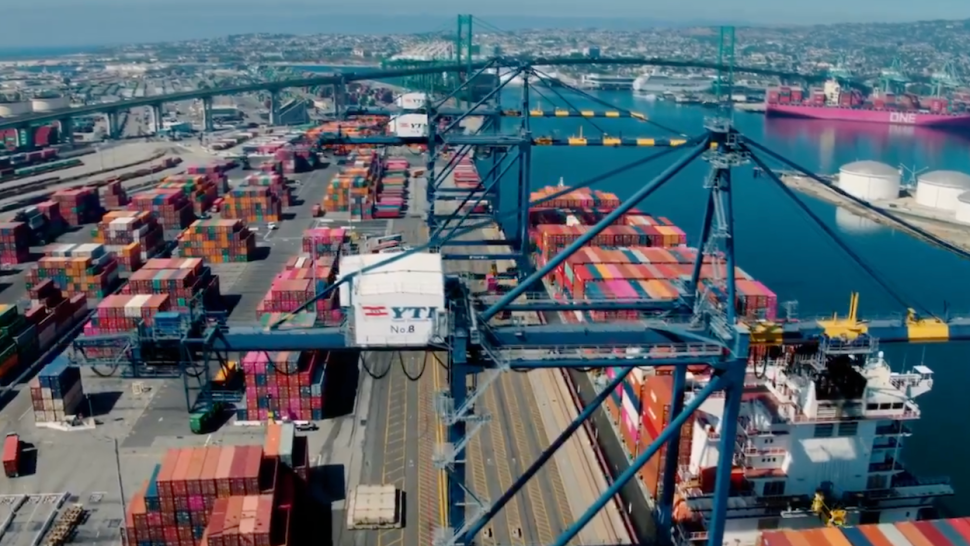
The Port of Los Angeles closed out the summer with a record-setting three-month run, processing more than 2.9 million twenty-foot equivalent units (TEUs) across June, July and August as resilient consumer demand and early holiday shipments continued to support cargo volumes.
August alone accounted for 955,907 container units, putting monthly throughput 6% above the port’s five-year average and roughly in line with August 2025, according to the port’s monthly media briefing.
The strong August result capped the busiest consecutive three-month period in the port’s history. Despite mixed export trends and continuing economic pressures, Los Angeles entered the fall season with significant momentum.
“We’ve put together an exceptionally strong summer in Los Angeles,” said Port Executive Director Gene Seroka, pointing to resilient consumer demand, early holiday shipments and a broad mix of cargo as the main factors behind the performance.
Imports remain steady as exports decline
Loaded imports totaled 500,302 TEUs in August, essentially flat compared with the same month last year but 7% above the port’s five-year August average.
The picture was weaker on the export side. Loaded exports reached 115,561 TEUs, a 9% decline from August 2025.
Meanwhile, empty container volumes moved in the opposite direction, increasing 4% year over year to 340,044 TEUs.
For the first eight months of 2026, the Port of Los Angeles handled just over 7 million TEUs. That represents a 1.5% increase from the same period in 2025 and puts the port 5% ahead of its five-year pace.
Retailers prepare for the holiday season
Retail industry leaders remain optimistic about the approaching holiday season, even as higher fuel costs, tariffs and other economic pressures continue to weigh on supply chains.
Brian Dodge, president and chief executive of the Retail Industry Leaders Association, said a significant portion of holiday merchandise is already in the United States.
Retailers accelerated shipments earlier in the year because of uncertainty surrounding fuel prices, tariffs and potential supply chain disruptions. Additional cargo is still expected to move as businesses replenish inventories.
The early movement of holiday merchandise has therefore helped sustain container volumes through the summer, giving the port a strong platform heading into the final months of the year.
West Coast routing remains competitive
Seroka also highlighted the economics of moving cargo through Los Angeles despite current trans-Pacific freight rates that favor East Coast routings.
While freight rates to the West Coast may currently make East Coast alternatives appear more attractive, the speed at which cargo can move through Los Angeles and onto rail can change the overall equation for importers.
For companies serving markets across the United States, faster cargo movement through the Southern California gateway can make the total logistics cost competitive even when the ocean rate itself is less favorable.
Looking ahead to the final months of 2026
The port expects the strong momentum to continue into September.
“September is shaping up to be another strong month, and Los Angeles is well positioned to respond as global trade patterns continue to evolve,” Seroka said.
With more than 7 million TEUs already handled through August and a record summer quarter behind it, the Port of Los Angeles is heading into the final stretch of 2026 with confidence that it can continue absorbing changing global trade patterns and sustained demand through the end of the year.