


• Latest
  • Trending
Export Ban Debate Pushes Diesel Prices Lower While Gasoline Futures Surge

Export Ban Debate Pushes Diesel Prices Lower While Gasoline Futures Surge

September 24, 2026
Maersk and MOL stress multi-fuel and diverse solutions to decarbonise

Maersk and MOL stress multi-fuel and diverse solutions to decarbonise

September 24, 2026
Drones and USVs replace mines as Black Sea’s floating hazard

Drones and USVs replace mines as Black Sea’s floating hazard

September 24, 2026
ADVERTISEMENT
Importers push back on CBP supply chain data proposals

Importers push back on CBP supply chain data proposals

September 24, 2026
AerSale leases Boeing 757 freighter to Jupiter Jet

AerSale leases Boeing 757 freighter to Jupiter Jet

September 24, 2026
DHL Express and Singapore Airlines renew Boeing 777 freighter agreement

DHL Express and Singapore Airlines renew Boeing 777 freighter agreement

September 24, 2026
SF Airlines launches Shanghai-Singapore freighter service as Singapore hub plans advance

SF Airlines launches Shanghai-Singapore freighter service as Singapore hub plans advance

September 24, 2026
InterGlobe Air Transport named exclusive cargo GSA for STARLUX Airlines in India

InterGlobe Air Transport named exclusive cargo GSA for STARLUX Airlines in India

September 24, 2026
SATS launches autonomous cargo vehicle service to speed up airfreight deliveries at Changi

SATS launches autonomous cargo vehicle service to speed up airfreight deliveries at Changi

September 24, 2026
Avianca Cargo becomes first airline in the Americas to secure GDP Pharma certification

Avianca Cargo becomes first airline in the Americas to secure GDP Pharma certification

September 24, 2026
Shippers’ coalition accelerates adoption of Class 8 battery-electric trucks

Shippers’ coalition accelerates adoption of Class 8 battery-electric trucks

September 24, 2026
Tesla takes lead role in 2,500-truck electric Class 8 order

Tesla takes lead role in 2,500-truck electric Class 8 order

September 24, 2026
Samsara targets $2B in recoverable fleet fuel spend

Samsara targets $2B in recoverable fleet fuel spend

September 24, 2026
  • Home
  • About Us
  • Press Room
  • Podcasts
  • Media Kit
  • Contact Us
  • Careers
Thursday, September 24, 2026
  • Login
  • Register
The Logistic News
  • Logistic
  • Air
  • Maritime
  • Land
  • World
  • Business
  • Tech
  • Events
  • Advertise
No Result
View All Result
  • Logistic
  • Air
  • Maritime
  • Land
  • World
  • Business
  • Tech
  • Events
  • Advertise
No Result
View All Result
The Logistic News
No Result
View All Result
Home Business

Export Ban Debate Pushes Diesel Prices Lower While Gasoline Futures Surge

Talk of a possible U.S. diesel export ban is already reshaping fuel markets, with refiners potentially forced to cut runs and put fresh pressure on gasoline and jet fuel prices

The Logistic News by The Logistic News
September 24, 2026
in Business, Land, Logistic, World
Reading Time: 5 mins read
0
Export Ban Debate Pushes Diesel Prices Lower While Gasoline Futures Surge
ADVERTISEMENT

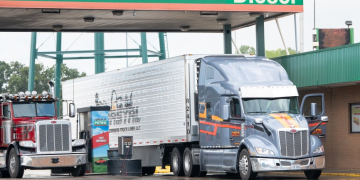
Even without a formal diesel export ban, the growing discussion around the measure appears to have achieved one immediate objective: pushing diesel prices lower, at least in the futures market.

Ultra low sulfur diesel (ULSD) on the CME commodity exchange dropped 16.57 cents per gallon on Wednesday, a 3.35% decline, settling at $4.7764/g. That was the lowest settlement since September 8, a relatively recent date that highlights just how sharply prices had climbed during the month. ULSD futures had reached an all-time high settlement of $5.2465/g on September 23.

The decline in diesel, however, came with an important consequence elsewhere in the fuel market.

ADVERTISEMENT

RBOB, the intermediate product used as the pricing benchmark for gasoline in futures trading, jumped 9.95 cents per gallon to $3.587/g. That represented a 2.85% increase and marked its highest settlement since July 23. Before that, the last time RBOB had settled at similar levels was during a series of settlements above $3.60/g in the first half of May.

That market reaction is at the center of the criticism surrounding a possible diesel export ban. Numerous opponents of the proposal have warned that reducing diesel exports could simply move the pricing pressure into other refined fuels.

The Wall Street Journal, for example, published an editorial attacking the possibility of an export ban under the headline “Republicans are Running on Empty.”

Wednesday’s market moves came one day after President Trump signaled his support for a potential ban, with several Republican lawmakers also backing the idea.

U.S. ULSD exports for the week ending September 18 stood at 1.33 million barrels per day, well below the levels recorded in many recent weeks, when exports were generally between 1.6 million and 1.7 million b/d.

At the same time, U.S. consumption of non-jet fuel distillates, roughly 90% of which is ULSD, has been running at approximately 3.6 million to 3.8 million b/d. Those export volumes remain above recent norms.

A report from S&P Global Energy outlined the potential consequences of an export ban without yet incorporating Wednesday’s market reaction, which closely mirrored the report’s assessment.

According to S&P Global Energy, any diesel surplus created inside the United States by an export ban “would create significant operational and financial pressure for imports, shifting yield away from diesel.”

Refiners could cut crude runs by 2 million b/d

The expected response from refiners would be substantial.

S&P Global Energy said refiners could reduce crude runs by roughly 2 million b/d in order “to eliminate the resulting diesel surplus.”

Since the beginning of June, U.S. ULSD production has averaged just below 5 million b/d. That is around 150,000 b/d higher than during the corresponding period a year earlier. Achieving that production level, however, has required U.S. refiners to operate at approximately 97% of capacity.

A reduction in refinery runs of the magnitude described by S&P Global Energy would inevitably affect the supply of other fuels.

“A run cut of this magnitude would inevitably lower the supply of gasoline and jet fuel, raising prices of these fuels,” the report said.

That is effectively what futures markets signaled on Wednesday, with diesel prices falling while gasoline futures moved sharply higher.

S&P Global Energy also warned that even a 3% shift in refinery yield from diesel toward gasoline would not necessarily eliminate the pressure.

“Even with a 3% shift in yield from diesel to gasoline, the drop in gasoline production would cause the U.S. to become a net importer of gasoline in the fourth quarter of 2026,” the report said.

As a result, regions on the East and West Coasts that depend on imports could become particularly exposed to price shocks caused by more expensive imported fuel.

White House position remains unclear as restrictions are discussed

Late Wednesday, the White House position on a complete diesel export ban remained uncertain, although several reports suggested that some form of restriction could be moving closer to consideration.

Energy Secretary Chris Wright was quoted by Politico as saying during a New York energy forum held as part of Climate Week that he opposed a ban.

According to Politico, Wright argued that a blanket prohibition would be ineffective because the United States exports large quantities of diesel. He noted that the country is the world’s largest diesel exporter and emphasized that the same refinery producing diesel also produces gasoline and jet fuel.

Wright explained that if refiners were unable to export diesel once domestic storage capacity became constrained, they would have to reduce U.S. refining activity. That, in turn, would put upward pressure on gasoline and jet fuel prices.

At the same time, Politico reported that support is growing within the administration for taking some form of action to provide relief to sectors of the economy particularly affected by elevated diesel prices, including trucking and agriculture.

One measure reportedly under consideration is a 90-day ban on diesel exports.

Bloomberg separately reported that Wright had warned oil industry leaders to prepare for possible U.S. restrictions on diesel exports as debate intensified inside the Trump administration.

According to the report, Wright delivered that message to company executives during calls late Tuesday. The conversations took place just hours after President Donald Trump said he had encouraged administration officials to examine possible restrictions on diesel exports.

The policy debate therefore remains unsettled, but the market response has already highlighted the central issue: lowering diesel prices through export restrictions could come with a corresponding increase in gasoline and jet fuel costs, particularly if refiners respond by cutting crude runs.


Previous Post

Next Phase for Autonomous Railcar Technology Begins in Commercial Service Testing

Next Post

Samsara targets $2B in recoverable fleet fuel spend

Next Post
Samsara targets $2B in recoverable fleet fuel spend

Samsara targets $2B in recoverable fleet fuel spend

Leave a Reply Cancel reply

Your email address will not be published. Required fields are marked *

A D V E R T I S E M E N T

Popular News

  • Drone Delivery Takes Flight: Amazon Partners with UPS for Trial Program

    Drone Delivery Takes Flight: Amazon Partners with UPS for Trial Program

    0 shares
    Share 0 Tweet 0
  • Rail Cargo Group Strengthens European Network with Captrain Netherlands Acquisition

    0 shares
    Share 0 Tweet 0
  • Automotive Inbound Logistics Market: Navigating Future Challenges

    0 shares
    Share 0 Tweet 0
  • Global Inflation Cools to Target After Three Years, Central Banks Face Policy Dilemma

    0 shares
    Share 0 Tweet 0
  • Dubai Mercantile Exchange Rebrands as Gulf Mercantile Exchange Following Saudi Tadawul Group Acquisition

    0 shares
    Share 0 Tweet 0

Recent News

Maersk and MOL stress multi-fuel and diverse solutions to decarbonise

Maersk and MOL stress multi-fuel and diverse solutions to decarbonise

September 24, 2026
Drones and USVs replace mines as Black Sea’s floating hazard

Drones and USVs replace mines as Black Sea’s floating hazard

September 24, 2026
Importers push back on CBP supply chain data proposals

Importers push back on CBP supply chain data proposals

September 24, 2026

Discover a new era of logistics reporting with The Logistic News, your go-to platform for breaking news, insightful features, and exclusive interviews shaping the global logistics and freight landscape. Trust us to deliver accurate, timely, and relevant information that empowers professionals and enthusiasts alike in navigating the intricacies of this vital sector.

Navigation

  • Home
  • About Us
  • Press Room
  • Podcasts
  • Media Kit
  • Contact Us
  • Careers
  • Privacy Policy
  • Terms of Use

© 2024 - thelogisticnews.com

Welcome Back!

Login to your account below

Forgotten Password? Sign Up

Create New Account!

Fill the forms below to register

All fields are required. Log In

Retrieve your password

Please enter your username or email address to reset your password.

Log In

SIgn Up Newsletter

This will close in 20 seconds

Manage Cookie Consent
We use technologies like cookies to store and/or access device information. We do this to improve browsing experience and to show (non-) personalized ads. Consenting to these technologies will allow us to process data such as browsing behavior or unique IDs on this site. Not consenting or withdrawing consent, may adversely affect certain features and functions.
Functional Always active
The technical storage or access is strictly necessary for the legitimate purpose of enabling the use of a specific service explicitly requested by the subscriber or user, or for the sole purpose of carrying out the transmission of a communication over an electronic communications network.
Preferences
The technical storage or access is necessary for the legitimate purpose of storing preferences that are not requested by the subscriber or user.
Statistics
The technical storage or access that is used exclusively for statistical purposes. The technical storage or access that is used exclusively for anonymous statistical purposes. Without a subpoena, voluntary compliance on the part of your Internet Service Provider, or additional records from a third party, information stored or retrieved for this purpose alone cannot usually be used to identify you.
Marketing
The technical storage or access is required to create user profiles to send advertising, or to track the user on a website or across several websites for similar marketing purposes.
Manage options Manage services Manage {vendor_count} vendors Read more about these purposes
View preferences
{title} {title} {title}
No Result
View All Result
  • Logistic
  • Air
  • Maritime
  • Land
  • World
  • Business
  • Tech
  • Events
  • Advertise

© 2024 - thelogisticnews.com