



The U.S. Federal Motor Carrier Safety Administration (FMCSA) has received more than 2,200 comments on its proposal to formalize English-language proficiency (ELP) requirements for commercial truck drivers. Most submissions support codifying the existing rules, but a smaller number have raised concerns about how the requirements would be enforced, particularly the risk of discrimination during roadside inspections.
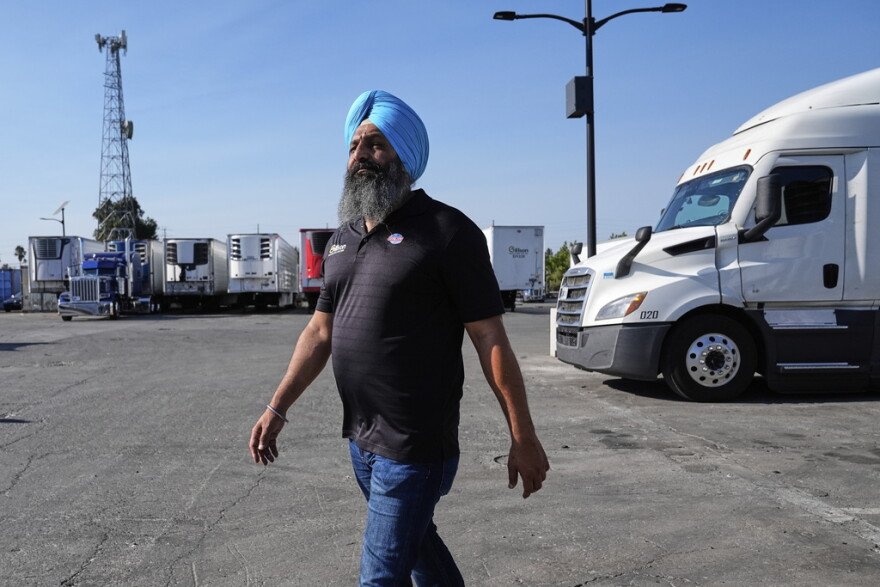
Among the critics is the Sikh Coalition, a nonprofit, nonpartisan organization that focuses on protecting the rights and religious freedoms of Sikhs in the United States. Given the significant number of Sikh drivers operating on American highways, the organization has taken a particular interest in the proposed changes.
In its submission to FMCSA, the Coalition explained that its work includes defending the civil rights and civil liberties of Sikhs, including truck drivers, through direct legal services, legislative advocacy, public education about Sikhism and civic engagement among Sikh Americans.
The public comment period for the notice of proposed rulemaking (NPRM) closed last Friday. According to the proposal, the changes would update existing regulations to clarify that drivers who fail to meet English-language proficiency requirements must be placed out of service (OOS). An exception would apply to truck movements confined to the U.S.-Mexico border area that do not continue farther into the United States.
Supporters mobilize around Dalilah Coleman’s case
A significant share of the comments came through an email campaign organized by an unidentified group in support of the proposed rule. Dozens of submissions used identical wording and referred to the case of Dalilah Coleman, who was five years old when she was injured in a 2024 truck crash in California involving a driver who was in the United States illegally.
The messages argued that her experience should prevent similar incidents from happening again and called for the driver involved in the crash to have been barred from operating a truck.
The accident prompted the introduction of Dalilah’s Law in both the House of Representatives and the Senate. The proposed legislation includes English-language proficiency requirements.
The House Committee on Transportation and Infrastructure voted to advance the bill, but the full House has not yet considered it. The corresponding Senate committee also did not vote on its companion legislation. Given the legislative calendar, enactment of Dalilah’s Law appears unlikely this year. The proposal would have to be taken up by the next Congress to become law.
Sikh Coalition warns of discriminatory enforcement
The Sikh Coalition acknowledged that commercial drivers need to understand and communicate in English at the level already required by federal law. However, it argued that additional safeguards are necessary to reduce the risk of discrimination during enforcement.
The organization said it had previously raised concerns with the U.S. Department of Transportation about the absence of clear criteria for roadside inspectors deciding whether a driver should undergo an English-proficiency assessment. It also highlighted the lack of information about the options available to drivers placed out of service for alleged ELP violations.
The Coalition pointed to a 2016 FMCSA decision to remove the requirement to place drivers out of service for such violations. At the time, the agency had determined that the Commercial Vehicle Safety Alliance (CVSA) could not substantiate the safety impact of that requirement.
The organization also cited its analysis of FMCSA roadside inspection data covering 2021 to 2025. According to the Coalition, only 0.19% of the inspections involved a driver’s inability to communicate in or understand English.
However, the issue gained greater prominence during this year’s Road Check Week. English-language proficiency violations ranked among the five leading reasons inspectors issued out-of-service orders, accounting for 9.1% of all such orders.
The Coalition argued that drivers could be singled out because of their appearance and subjected to disproportionate scrutiny under the pretext of enforcing English-language requirements. It called on FMCSA to establish clear, objective standards for roadside inspectors to reduce the risk of wrongful discrimination against Sikh drivers and other commercial motorists.
Its submission also referenced a social media post published by the Department of Homeland Security the previous month and subsequently removed. The post targeted Sikh drivers with the statement: “Get off our roads, you don’t know how to drive, Mr. Singh.”
The Coalition said the agency’s actions had consistently raised concerns that improving road safety was not its sole objective and that drivers could instead be targeted because of their origins. It concluded by asking FMCSA to withdraw the proposed rule and invest in more targeted, evidence-based safety measures.
ATA calls for standardized proficiency assessments
Major U.S. trucking organizations have generally supported the objectives of the proposed English-language proficiency rule, although their submissions included recommendations for changes.
The American Trucking Associations (ATA) raised concerns about the possibility of inconsistent enforcement, echoing some of the Sikh Coalition’s criticism of potentially vague criteria for determining when a driver should be placed out of service.
According to ATA, the current assessment process leaves too much room for individual enforcement officials to interpret drivers’ proficiency subjectively. Without standardized scoring systems or clearly defined evaluation criteria, the same driver could pass an assessment conducted by one officer and fail one conducted by another.
ATA urged FMCSA to work with the states responsible for issuing commercial driver’s licenses (CDLs) to incorporate a standardized English-language assessment into the licensing and renewal process.
The association argued that testing drivers before they receive their credentials would help identify deficiencies at the outset. This approach, it said, would ensure that applicants are assessed against a consistent national standard rather than relying primarily on roadside inspections to identify problems after drivers have entered the workforce.
OOIDA highlights a decade of reduced enforcement
The Owner-Operator Independent Drivers Association (OOIDA) offered fewer recommendations and expressed stronger support for the proposal than ATA. However, it also drew attention to the history of English-language proficiency enforcement.
OOIDA said CVSA removed an ELP requirement in 2015, after which violations went largely unenforced and unreported for approximately a decade.
The association cited figures showing that more than 100,000 ELP violations were recorded during roadside inspections in 2014, compared with approximately 9,700 reported violations in 2024.
OOIDA argued that the decline in enforcement coincided with an increase in states issuing non-domiciled commercial driver’s licenses to foreign drivers. In its view, the combination allowed hundreds of thousands of unqualified drivers to operate on U.S. roads and contributed unnecessarily to numerous fatal crashes.
The debate over FMCSA’s proposal therefore reflects two related but distinct concerns: ensuring that commercial drivers meet federal English-language requirements and establishing a consistent enforcement process that supports road safety without exposing drivers to arbitrary or discriminatory treatment.