



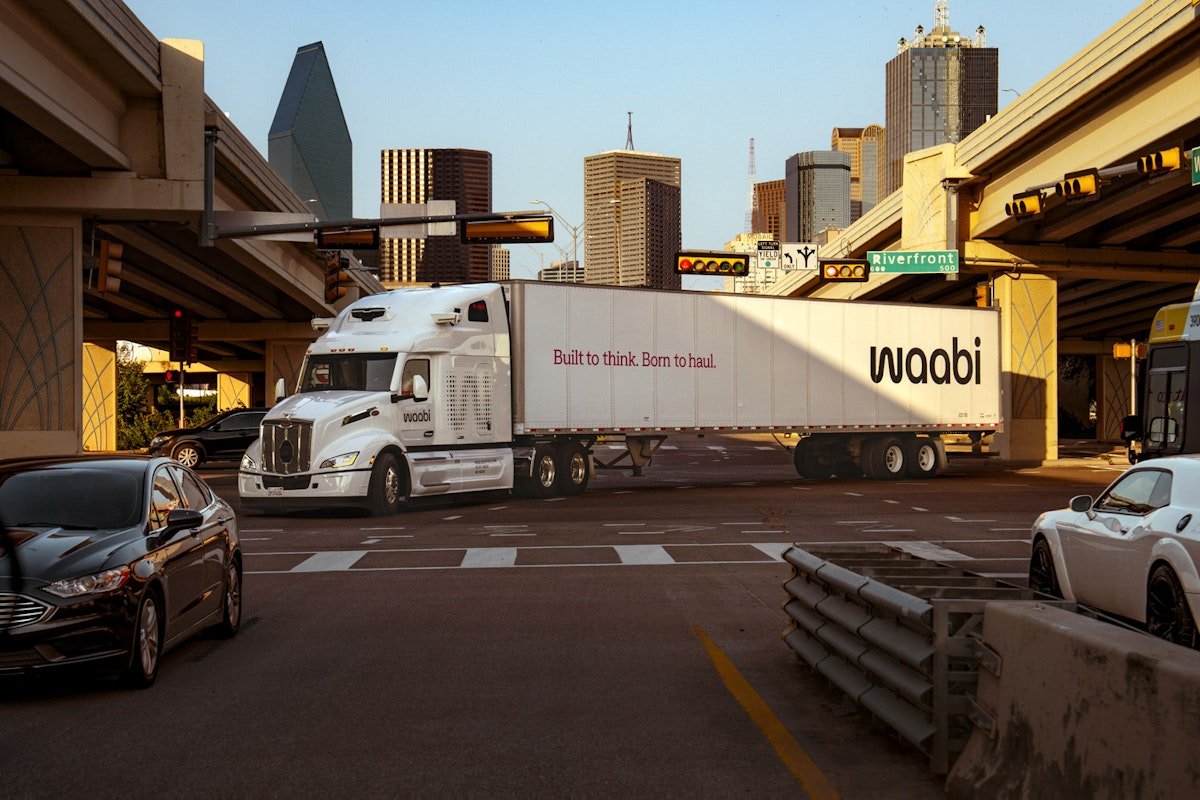
Waabi and Warrior Logistics have formalized a commercial partnership to transport regular customer shipments between Dallas and Houston using autonomous trucks powered by Waabi Driver. Announced Wednesday, the agreement expands the deployment of autonomous trucking technology on one of Texas’s key freight corridors.
Warrior Logistics, an asset-based carrier headquartered in Coppell, Texas, has integrated a fleet of Waabi-equipped trucks into its transportation network. The vehicles are handling recurring shipments for customers in the food and beverage sector, consumer goods and other industries.
Commercial operations began earlier in 2026. According to Waabi, the autonomous trucks have since completed their assigned routes with a 100% on-time pickup and delivery rate and no reported safety incidents. The companies have not disclosed the number of Waabi-powered trucks operating within Warrior’s network or the total volume of freight transported under the agreement.
Founded in 2015, Warrior Logistics operates a fleet of more than 200 trucks, according to the companies’ announcement. The carrier is using Waabi’s autonomous vehicles to increase available capacity and improve utilization across its wider fleet as customer demand continues to grow.
“Our customers want more capacity on our core lanes, and they want it to be consistent,” said Scott McFarlane, CEO of Warrior Logistics. He explained that the partnership provides greater operational flexibility, with autonomous trucks complementing professional drivers, increasing freight density on the carrier’s main routes and adding capacity on lanes that are less attractive to its drivers.
The approach is designed to allow autonomous vehicles and human-driven trucks to operate alongside one another. According to McFarlane, this arrangement enables Warrior to accept additional shipments while allowing its professional drivers to concentrate on the routes they prefer.
Why Warrior Logistics chose Waabi
McFarlane identified three main factors behind the decision to partner with Waabi: confidence in the technology company’s leadership, the innovative nature of its autonomous driving system and a co-development process that gave Warrior direct insight into the safety performance of Waabi Driver.
“The results on our own freight speak for themselves,” McFarlane said.
Waabi also highlighted the carrier’s role in developing the technology throughout their collaboration. Lior Ron, the company’s chief operating officer, said Warrior’s involvement had helped shape the system and that the results across the carrier’s operations demonstrated how autonomous trucking could help transportation companies handle more freight, serve additional customers and expand their businesses.
The partnership will now move into another phase. Over the next year, Waabi and Warrior plan to jointly identify and develop additional routes for autonomous trucks across Warrior’s network.
Dallas-Houston becomes a key corridor for Waabi
The Warrior agreement follows another commercial milestone for Waabi. Nine days earlier, Waabi and Volvo Autonomous Solutions began transporting freight for Warp, marking their first customer operation together.
Under that arrangement, Volvo VNL Autonomous trucks equipped with Waabi Driver transport Warp shipments directly to third-party facilities along the Dallas-Houston corridor. An observer remains in the driver’s seat during these operations.
Waabi also reported that commercial load volumes on its Dallas-Houston route have increased by more than 80% in 2026. The company did not provide a baseline against which to measure the increase.
The corridor has been part of Waabi’s commercial development for several years. Its first revenue-generating shipments on Interstate 45 between Dallas and Houston took place in September 2023, during the week the company announced a 10-year autonomous trucking agreement with Uber Freight.
In July 2026, Waabi demonstrated that its software, trained exclusively on a Peterbilt 579 truck, could also operate a Volvo VNL Autonomous vehicle without additional data or fine-tuning. The demonstration highlighted the potential for the company’s technology to work across different truck platforms.
Driverless operations remain the next milestone
Despite the progress, Waabi’s trucks are not yet operating without a driver. In January, Ron told FreightWaves that the company would remove the driver only when the truck and its fully redundant autonomous platform were ready from the manufacturer.
This month, Ron reaffirmed the company’s timeline, saying Waabi was “fully on track for driverless next year, with Volvo as the first OEM platform.”
The next stage of the company’s development will therefore depend on the readiness of the vehicle and its redundant systems, as well as the continued expansion of commercial freight operations. For Warrior Logistics, the immediate objective is to use autonomous trucks to supplement its existing fleet, increase capacity on established routes and develop additional lanes with Waabi over the coming year.