



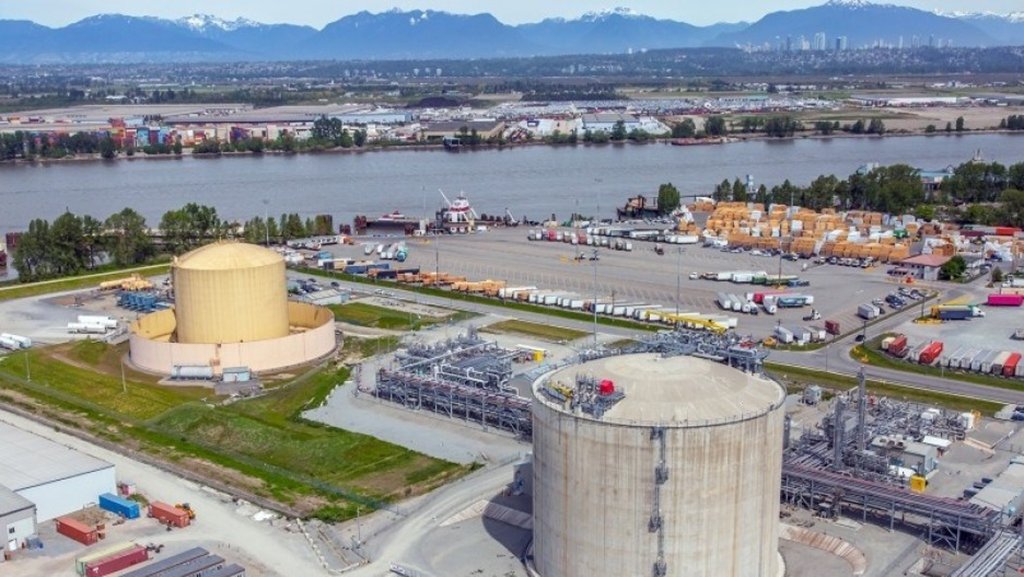
FortisBC is gearing up to invest almost $6 billion to convert its Tilbury Island liquefied natural gas (LNG) facility into a major supply hub for both residential energy needs and the rapidly growing marine fuel market on Canada’s West Coast.
The multi-phase expansion could start construction as early as 2027 and is expected to boost the facility’s LNG production capacity by about 250%.
The investment involves three major projects that are currently undergoing regulatory and approval processes: Tilbury Expansion Phase 1B Tilbury Marine Jetty, developed by FortisBC subsidiary Tilbury Pacific Tilbury Expansion Phase 2 No general construction contracts have been awarded yet as engineering work and procurement planning are still underway, according to FortisBC.
According to the company, the next stage will focus on advancing the project’s engineering design before procurement schedules are finalized.
Expanding a strategic LNG hub
Originally commissioned in 1971, the Tilbury facility serves as one of British Columbia’s two LNG storage sites, helping meet peak winter demand for residential natural gas.
The site previously underwent a major expansion in 2018 with the completion of Phase 1A, which added storage capacity to strengthen energy supply during colder months.
In recent years, however, Tilbury has evolved into an important LNG refuelling location for BC Ferries and Seaspan Ferries. It now supports Seaspan Energy’s growing fleet of LNG bunkering vessels supplying ships operating along the British Columbia coast.
Phase 1B targets marine fuel demand
The proposed Phase 1B expansion represents a $2.2 billion investment aimed at strengthening British Columbia’s marine LNG infrastructure.
The project received approval through a provincial Order in Council on July 24, allowing it to proceed without obtaining a Certificate of Public Convenience and Necessity under the B.C. Utilities Commission Act.
On completion, Phase 1B will deliver up to 0.65 million tonnes per annum of LNG liquefaction capacity, supporting the growing need for lower-carbon marine fuel.
The expansion also includes:
A new 230-kilovolt transmission line developed with the City of Delta.
Construction of the Tilbury Marine Jetty.
New onshore LNG pipelines connecting the marine terminal directly to the existing facility.
FortisBC President and CEO Roger Dall’Antonia said the project will strengthen the region’s ability to supply lower-carbon fuel for the next generation of commercial vessels while continuing the company’s partnership with the Musqueam Indian Band.
According to the British Columbia government, construction is expected to generate more than $800 million in provincial GDP while supporting an average of 1,100 jobs annually over a four-year construction period. Operations are expected to begin in 2031.
Marine jetty enables direct ship-to-ship fueling
A key component of the expansion is the Tilbury Marine Jetty, which will replace the current practice of transporting LNG by truck and barge before loading vessels.
Instead, the new infrastructure will enable direct ship-to-ship LNG transfers via a dedicated marine loading platform connected to the Tilbury facility by pipeline.
The terminal will include:
A marine loading platform.
A temporary floating bunker berth.
Mooring dolphins.
An access trestle.
LNG pipelines linking directly to the production facility.
The jetty will accommodate bunker vessels, barges and larger ocean-going ships.
The project received both its Environmental Assessment Certificate and federal approval in 2024, with construction targeted for early 2027 and operations potentially beginning around 2029.
The Vancouver Fraser Port Authority noted that LNG bunkering has become the first alternative marine fuel available at commercial scale in the Port of Vancouver. Cruise, cargo and container ships have been using more LNG since it was introduced, and Seaspan Energy is set to become the port’s first accredited LNG supplier in late 2024.
Phase 2 would significantly expand capacity
FortisBC’s Phase 2 proposal represents an additional investment estimated between $3 billion and $3.5 billion.
Plans include constructing a 142,400-cubic-metre LNG storage tank, increasing the site’s storage capacity by approximately 2.5 times, while adding up to 2.5 million tonnes of annual liquefaction capacity.
According to documents submitted to the B.C. Environmental Assessment Office (EAO), the liquefaction facilities could be developed in multiple stages.
FortisBC estimates the project would become one of the largest capital investments in British Columbia’s Lower Mainland, contributing approximately $1.7 billion to the province’s economy during construction.
The project is now in the environmental assessment process and the Environmental Assessment Office is expected to release its final report later this year (2026) after public consultation ends on July 27.
Concerns linger in communities
While the expansion is expected to provide economic benefits, a number of municipalities and environmental groups have opposed the expansion.
Among those expressing concerns is Kelly Greene, MLA for Richmond-Steveston, who has questioned the project’s safety despite the proposed mitigation measures.
She acknowledged that many community concerns could be addressed through safety controls but said the possibility of a major incident remains an issue that cannot be ignored as the project moves through the approval process.