




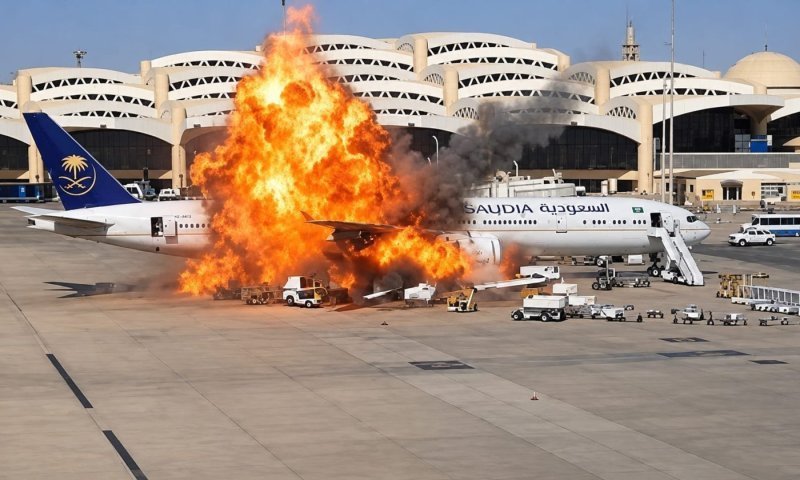
The latest Houthi escalation against Saudi Arabia is creating more uncertainty in the container shipping market at the start of the 2027 annual contract negotiation season. Missile and drone attacks on airports and energy facilities have escalated the Saudi-Houthi conflict, raising fears of a renewed major disruption of commercial shipping through the Red Sea.
Saudi Arabia has vowed a “serious response” to strikes that killed at least 14 people and injured more than 300 at Riyadh’s King Khalid International Airport. Airlines canceled flights and the airport is expected to stay closed at least until Oct. 17. The Houthis have also threatened more attacks on Saudi airports and military bases.
The escalation has also extended into the energy sector. Yemen-based militia fires missiles at Saudi oil producer Aramco headquarters overnight.
These developments come after Houthi attempts to restrict traffic associated with Saudi Arabia through the Bab el-Mandeb Strait since July. After nearly nine months of relative calm, attacks on vessels continued into August. The strategic passage, at the southern entrance to the Red Sea, connects the waterway with the Gulf of Aden and remains an important route for international trade.
While no widespread closure of the Red Sea has been confirmed, the latest attacks increase the prospect of vessels passing through the region again being met with dangerous operating conditions.
However, the immediate consequence for container carriers is uncertainty, not a confirmed reduction in available capacity, said Freightos (NASDAQ: CRGO), the logistics platform and SONAR data contributor. Since June, shipping lines had been restoring Asia-Europe services via the Red Sea in a staged manner, effectively increasing vessel availability by shaving days off voyage times. A renewed campaign of attacks could reverse that trend and bolster freight rates.
Asia-Europe Rates Still High Despite Recent Falls
Asia-Europe freight rates have been steadily falling since July, reflecting the slowdown in demand after the peak shipping season and the gradual return of carriers to Red Sea routings.
Prices are still well above year-ago levels, despite the downward move. Both key Asia-Europe routes were above $3,000 per FEU last week, up about 70% from October 2025.
A number of carriers already have announced large rate hikes for October. Spot rates on the Asia-Mediterranean lane rose 7% last week to $3,800 per FEU, potentially setting a higher benchmark as annual contract talks get underway.
But the market’s foundation is still weak underneath. Ongoing congestion in Northern Europe and the Far East is supporting rates and continuing to soak up shipping capacity despite softening demand. At the same time, a threatened strike at German ports, which could have added to delays across Europe, has been averted recently.
Contradictory Signals for 2027 Contract Talks
Shippers and carriers have different expectations going into the annual tendering season for the year ahead.
Carriers are going into negotiations with freight rates still at record highs. But there are plenty of reasons for shippers to balk at locking in current prices for long-haul contracts.
Global fleet capacity will increase with new vessel deliveries in 2027. Meanwhile, further expansion of Red Sea transits would further increase effective capacity as sailing times on Asia-Europe services would be reduced.
These factors have combined to lead some shippers to expect lower freight rates in 2027. Such an outlook could make them shy away from signing long-term deals at current market levels, even as geopolitical tensions threaten to complicate the outlook.
A further deterioration in Red Sea security could therefore undermine the capacity-based arguments for lower rates, adding another source of uncertainty for both sides in the negotiations.
Trans-Pacific Peak Season Demand Shows Early Signs of Weakness
Freight rates in the trans-Pacific have been holding at peak season levels since July, supported by strong demand and congestion in Asia.
We’re seeing the first signs of a slowdown now. Rates from the Far East to the U.S. West Coast fell 2% to $8,150 per FEU, possibly the start of a post-Golden Week slump.
The latest forecast of U.S. imports from the National Retail Federation also shows a pronounced seasonal deceleration. November ocean arrivals are expected to drop 11% month on month.
But even with the decline, total U.S. imports are projected to be fairly resilient in 2026. Full year volumes are expected to be 1.4% higher than 2025 and 1.2% above 2024, bringing imports close to the record levels seen in 2021.
Outlook: Rate correction could be complicated by geopolitical risks
Container freight rates may ease further in the balance of the quarter as peak season volumes wane.
The main upside risk to this outlook is geopolitical instability. A sustained Houthi campaign against Saudi targets, or a renewal of attacks on commercial vessels in the Red Sea, could reduce effective shipping capacity and make it harder for carriers to sustain freight rates.
The timing is especially sensitive for the industry. Any further disruption to Red Sea traffic could upset the balance of supply and demand as carriers try to defend their pricing positions and shippers try to take advantage of opportunities to secure lower rates for 2027.