




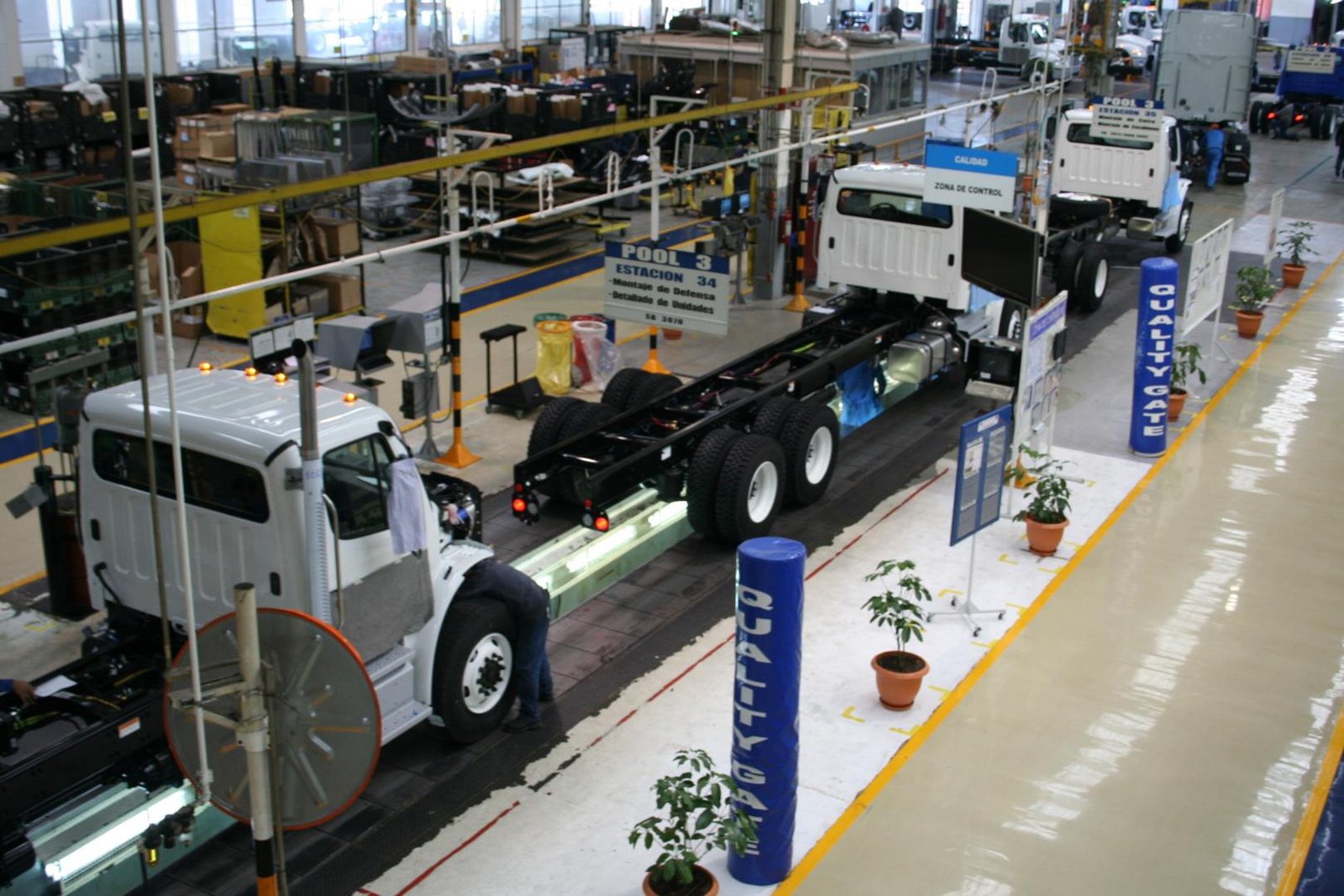
Mexico’s heavy-duty vehicle industry production and exports jumped in September 2026 as U.S. customers increased purchases ahead of upcoming emissions rules. The export boom, however, contrasts sharply with continued weakness in Mexico’s domestic truck market, where falling sales and uncertainty over trade policy continue to hamper fleet renewal. Mexican plants built 15,181 heavy duty vehicles in September, up 121.4% from 6,857 a year earlier in September 2025. Exports soared 144.6 percent to 12,707 vehicles from 5,196 a year earlier. The figures, compiled by Mexico’s National Institute of Statistics and Geography (INEGI) and published by the National Association of Bus, Truck and Tractor-Trailer Producers (ANPACT), underscore the growing importance of cross-border demand to Mexico’s commercial vehicle manufacturing industry.
The move comes as Mexico’s domestic market is suffering from weak sales, delayed fleet renewal decisions and uncertainty over US trade policy that is stifling buying activity.
“U.S. customers are gearing up for a shift in emissions requirements and that is responsible for much of the increase in production and exports,” said ANPACT Executive President Rogelio Arzate.
The United States, Mexico’s largest trading partner, is going through a technological transition which has led manufacturers and buyers to alter their production and purchase schedules, Arzate said in an October news conference.
Customers are ordering big volumes of vehicles ahead of the U.S. Environmental Protection Agency emissions standards changes in 2027. “That demand is being directly translated into higher Mexican production and shipments to the U.S. market,” Arzate said.
That growth cements Mexico as an important manufacturing base for commercial trucks headed for North America. But tariffs, shifting emissions standards and an upcoming review of the USMCA (United States-Mexico-Canada Agreement) are weighing on producers.
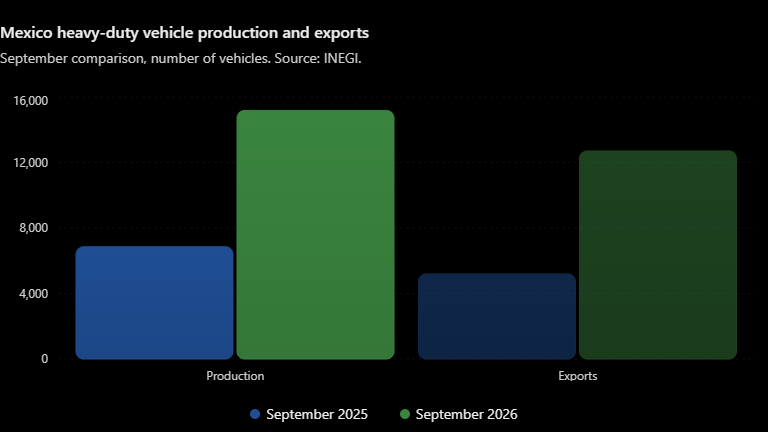
Mexico’s heavy-duty vehicle production and exports increased sharply in September 2026 as U.S. demand strengthened. Sources: INEGI, Registro Administrativo de la Industria Automotriz de Vehículos Pesados, October 9, 2026; ANPACT-AMDA October 2026 news conference transcript.
The United States absorbs the vast majority of Mexican truck exports
Mexico exported 98,394 heavy-duty vehicles during the first nine months of 2026, an increase of approximately 12% compared with the corresponding period in 2025. Freight vehicles accounted for 98,389 units, representing year-over-year growth of 12.1%, according to ANPACT.
The United States remained by far the largest destination for Mexican-built trucks. Between January and September, American buyers received 90,967 vehicles, up 9.6% from the same period a year earlier. The U.S. market consequently represented approximately 92.5% of Mexico’s total heavy-duty vehicle exports over those nine months.
Canada also registered significant growth. Shipments to the country increased 47.6% year over year through September, while exports during September alone reached 680 vehicles, more than double the volume recorded in September 2025.
Other destinations posting export growth over the year-to-date period included Colombia, Peru, Honduras and Guatemala. By contrast, shipments to Chile, El Salvador, Ecuador and Costa Rica declined.
The export performance was accompanied by a broader recovery in domestic manufacturing output. Mexican factories produced 117,121 heavy-duty vehicles from January through September, up 10.3% from the 2025 period. Freight vehicles accounted for 114,443 units.
Diesel-powered models continued to dominate production and export activity. ANPACT reported that no electric or natural gas-powered heavy-duty vehicles were produced or exported during September.
Domestic sales remain a major weakness.
Domestic truck sales kept falling, although foreign demand for the manufacturers was stronger. Retail sales of heavy-duty vehicles ended September with 2,980 units, a drop of 11.3% compared to 3,358 units sold in the same month of the previous year, said Cristina Vázquez, coordinator of economic studies of the Mexican Association of Automotive Distributors (AMDA).
Mexico’s heavy-duty vehicle retail market fell in September for the eighth straight month on a year-over-year basis. Sales for the first nine months of 2026 stood at 25,289 vehicles, down 17.5% compared to the same period in 2025.
Tractor-trucks also were among the weaker categories. Dealers sold 1,153 units in September, 14% lower than a year earlier. But sales of other freight trucks crept up to 1,378 units, a gain of 0.5%.
Retail sales of combined freight vehicles were 2,531 units, down 6.7% from September 2025. Sales of passenger vehicles including busses fell 30.5% to 449 vehicles, a sharper contraction.
“The market hasn’t recovered from the extraordinarily strong buying activity in 2024,” Vázquez said. Fleet operators have been rushing to acquire vehicles ahead of regulatory changes, bringing forward demand that would have otherwise been expected in 2025 and 2026.
That caution is compounded by uncertainty about U.S. trade policy and the upcoming review of the USMCA, discouraging fleet operators from making big equipment investments.
The weakness is still apparent, although there are signs of recovery in the broader Mexican economy, including a bounce in fixed investment. AMDA projects 2026 retail sales of about 36,051 heavy-duty vehicles, but the association warned the final figure could be lower if buyers continue to delay purchases.
ANPACT seeks tariff reductions and incentives to renew fleets
ANPACT is working with Mexican authorities to address U.S. tariffs affecting commercial vehicles and their components as the North American automotive industry approaches the USMCA review.
The association is advocating lower tariffs while seeking to preserve the agreement’s existing regional rules of origin, which require manufacturers to meet progressively higher North American content thresholds. Arzate said manufacturers have invested substantially in production facilities and supply chains to comply with the agreement.
ANPACT’s preferred outcome is the elimination of U.S. duties imposed under Section 232 of the Trade Expansion Act. However, Arzate acknowledged that reducing the tariffs could represent a more achievable short-term objective.
“In an ideal world, we should have zero tariffs,” he said.
Alongside its trade-policy efforts, the association is working with Mexico’s Ministry of Finance and Ministry of Economy to stimulate domestic fleet replacement. Proposed measures include accelerated depreciation, financing guarantees and a scrappage program intended to remove older commercial vehicles from service.
ANPACT is also coordinating with Nacional Financiera, Mexico’s development bank, to develop additional financial incentives that could help transport operators acquire newer trucks and equipment.
The initiatives aim to address the gap between Mexico’s strong export-oriented manufacturing activity and the limited purchasing capacity currently evident in its domestic market.
September 2026: Key heavy-duty vehicle industry figures
| Metric | September 2025 | September 2026 | Year-over-year change |
|---|---|---|---|
| Production | 6,857 | 15,181 | +121.4% |
| Exports | 5,196 | 12,707 | +144.6% |
| Wholesale sales | 2,514 | 2,965 | +17.9% |
| Retail sales | 3,358 | 2,980 | -11.3% |
Why it matters
Mexico’s export surge underscores its central role in North American truck manufacturing as U.S. buyers prepare for new emissions standards. Yet falling domestic sales, tariff pressures and uncertainty surrounding the USMCA review continue to complicate manufacturers’ and fleet operators’ investment decisions.