



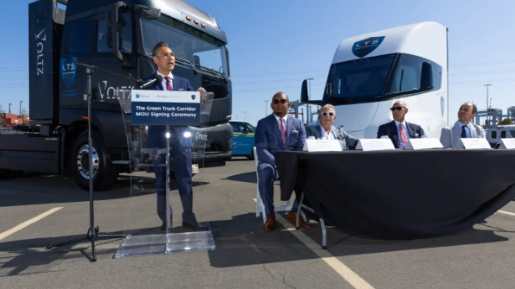
The Port of Long Beach has entered into a strategic partnership with The Wonderful Co. and Lincoln Transportation Services to develop a 150-mile “Green Truck Corridor” designed to transform freight movement between Southern California’s coast and its inland logistics hubs.
The agreement, formalized through a memorandum of understanding, sets out a framework to coordinate cargo flows between port operations, inland distribution networks and emerging zero-emissions trucking systems. The objective is twofold: to improve supply chain efficiency while significantly reducing air pollution and greenhouse gas emissions along one of the region’s busiest freight corridors.
The proposed route connects the Port of Long Beach with California’s Central Valley, a critical logistics artery that processes more than 300,000 shipping containers of imports and exports annually. The corridor already involves major logistics stakeholders, including Amazon, Walmart, Target and Ross Stores, according to Port of Long Beach CEO Noel Hacegaba.
The initiative builds on California’s broader push to decarbonize freight transport while strengthening the link between seaports and inland distribution centers, where cargo is staged and redistributed across the United States.
At the heart of the project is The Wonderful Co., a $6 billion privately held agribusiness and real estate developer known for brands such as Wonderful Pistachios and POM Wonderful. The company is developing a 2,000-acre master-planned logistics hub in Shafter, California, located approximately 150 miles from the port.
The site already accommodates 24 tenants, including major global companies such as Amazon, FedEx and Walmart. Prior to the port agreement, The Wonderful Co. had already advanced plans for its “Central Valley Green Pass,” a truck bypass designed to reduce congestion on State Route 99 and limit emissions in nearby residential areas.
The new Green Truck Corridor expands that vision by directly linking port operations with inland freight infrastructure and accelerating the transition toward low- and zero-emission transportation systems.
“This corridor demonstrates how strategic master planning can create real, lasting impact and reflects how that system is being built over time – through coordination, collaboration and long-term planning that improves efficiency today while supporting the transition to cleaner freight,” said Joe Vargas, president of Wonderful Real Estate Development.
Lincoln Transportation Services will act as the corridor’s first lead truck ambassador and has already placed orders for 300 Tesla Semi electric trucks, each with an estimated 500-mile range. The first deliveries, consisting of 50 to 70 units, are expected in June.
In parallel, Voltz, an electric truck manufacturer affiliated with Lincoln, plans to produce an additional 100 electric trucks, with deliveries scheduled to begin in the third quarter of 2027.
“By setting a strong example, we hope to inspire our industry partners to join us in creating a more sustainable future,” said Sepehr Matinifar, president of Lincoln Transportation Services.
Supporting infrastructure at the Port of Long Beach is also expanding to accommodate this shift. The port currently operates 102 charging stations, with 92 additional units expected to come online later this year, strengthening its capacity to support the growing deployment of zero-emission trucks along the corridor.